dsh-memory
Run the following command in DeepSeek Harness:
dsh plugin install masquerator-coder/dsh-memory
Paste the following prompt into your AI chat to install this plugin:
To install this plugin in DeepSeek Harness, run dsh plugin install masquerator-coder/dsh-memory; the full source repository is available at https://github.com/masquerator-coder/dsh-memory .
About this plugin
Every new DSH session starts with amnesia. Preferences you stated last week, project conventions, architectural decisions the agent helped you make—all of it evaporates. dsh-memory turns cross-session recall into a predictable, budgeted, non-blocking retrieval path. Every memory is an atomic subject-predicate-object assertion; semantic, episodic, and procedural memories all degrade to the same contract, making dedup, retrieval, and conflict resolution deterministic and auditable.
The model interacts through explicit tools-memory_recall, memory_remember, memory_forget, memory_link, and read_user-profile-so it reaches for memory on purpose rather than relying on implicit recall. Entity cards aggregate scattered facts about a subject into a structured, budgeted summary. A user.md view renders to disk and watches for external edits: a line you tweak in Obsidian is written back to atomic facts at maximum credibility. A fast-channel capture listener uses zero-LLM, deterministic rules to pick up fact-worthy signals in the conversation stream, handing them to a background worker; the main LLM only delegates and never performs extraction itself.
Privacy is first-class. PII is detected and redacted at capture time so raw values never enter storage. Every retrieval path-recall, context injection, the memory_* tools, the user.md view-is gated by a privacy-tier ladder (public / private / confidential / secret); PII-flagged facts are never auto-injected, and secret facts require explicit configuration to be visible at all. Storage is a dependency-free local JSON document with no vector database, SQLite, or graph engine, keeping the footprint light and the data entirely under your filesystem control.
Built for individual developers and small teams who want their agent to genuinely recognize them across sessions, maintain consistent context over repeated collaborations, and keep the memory mechanism transparent, auditable, and under their own control rather than locked inside an opaque service.
Use Cases
- Retain coding style and tooling preferences across independent sessions
- Keep architectural decisions, tech-stack conventions, and hard-won lessons across projects
- Edit a personal profile directly in Obsidian via user.md and sync changes back to memory
Best For
- Solo developers who want their agent to genuinely recognize them across sessions
- Small and mid-size teams needing consistent agent context over repeated collaborations
- Developers who prioritize local data sovereignty and reject closed-source memory services
Related Plugins

Memory layer for coding agents that indexes local session history and auto-recalls relevant context before edits, commands, and failures, with no manual search needed.
Traceable, searchable cross-session memory for AI agents that turns conversation knowledge into a typed knowledge graph and recalls relevant subgraphs instead of replaying full history, natively integrated with DeepSeek Harness.
Gives DSH AI cross-session long-term memory, to-do and skill management, plus multi-session orchestration, external AI delegation, and an infinite canvas that grows with you.
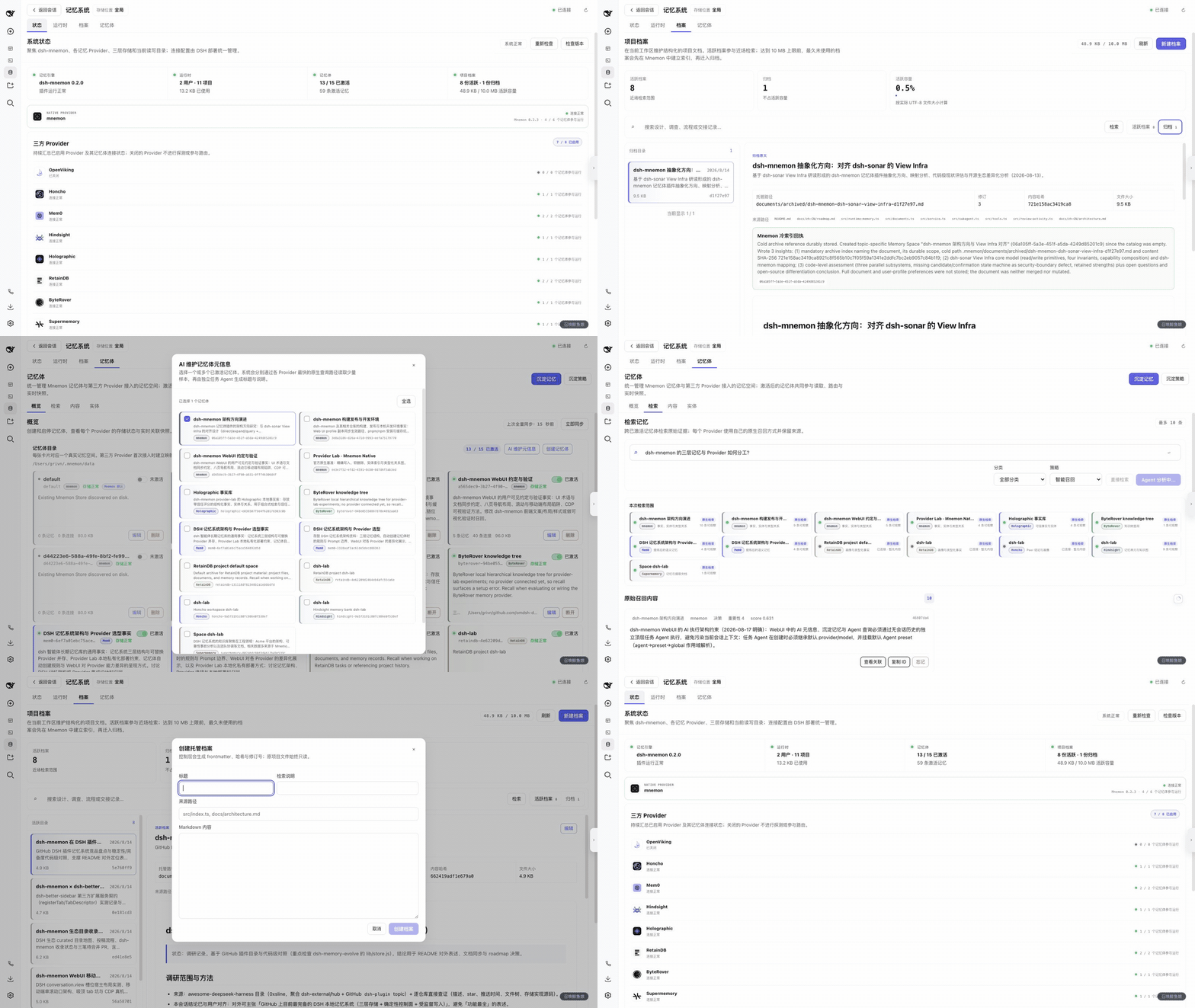
dsh-mnemon is a three-tier, pluggable, Agent-driven memory system for DeepSeek Harness, combining Runtime memory, Project Documents, and replaceable Memory Spaces with nine long-term providers.