dsh-sync-plugin
Run the following command in DeepSeek Harness:
dsh plugin install dpskk2/dsh-sync-plugin
Paste the following prompt into your AI chat to install this plugin:
Run dsh plugin install dpskk2/dsh-sync-plugin in your terminal to install this plugin; the source code is available at https://github.com/dpskk2/dsh-sync-plugin.
About this plugin
Moving between a work desktop and a laptop usually means re-importing conversation history, attachments, model settings, and workspace files each time you switch — and one missed step can silently drop context. dsh-sync-plugin packages all of that DeepSeek Harness state and ships it through your own GitHub repository, so the second machine can pick up the exact same project where you left off.
Synchronization is available as a manual one-click action from the sidebar or settings page, or as an automatic mode (roughly every five minutes by default, also reacting to active session events). On first run the plugin can auto-provision a private repository via the GitHub CLI, or you can point it at an existing remote you already manage. The sync scope covers session indices, chat transcripts, attachments, global preferences, and workspace files, with merge-boundary guards and explicit exclusion lists (e.g. credential files). A built-in bidirectional verification flow lets you confirm the A-to-B and B-to-A path is intact before you rely on it.
It is designed for solo developers who juggle two machines or need to restore a DSH setup after a system reinstall. It is not a real-time collaborative editor, nor a standalone disaster-recovery backup. The recommended habit is to sync once before starting work and once after finishing, keeping the conflict window as small as possible.
Use Cases
- Switch from an office desktop to a home laptop and continue the same project seamlessly.
- Restore sessions and preferences from a private repo after a system reinstall.
- Sync before a hardware change, then pull workspace files on the new machine to keep building.
Best For
- Solo developers working across multiple machines who want to skip reconfiguration.
- Users who treat DSH sessions and attachments as portable assets worth managing.
- Developers who just reinstalled or upgraded hardware and need to restore context fast.
Related Plugins

Memory layer for coding agents that indexes local session history and auto-recalls relevant context before edits, commands, and failures, with no manual search needed.
Traceable, searchable cross-session memory for AI agents that turns conversation knowledge into a typed knowledge graph and recalls relevant subgraphs instead of replaying full history, natively integrated with DeepSeek Harness.
Gives DSH AI cross-session long-term memory, to-do and skill management, plus multi-session orchestration, external AI delegation, and an infinite canvas that grows with you.
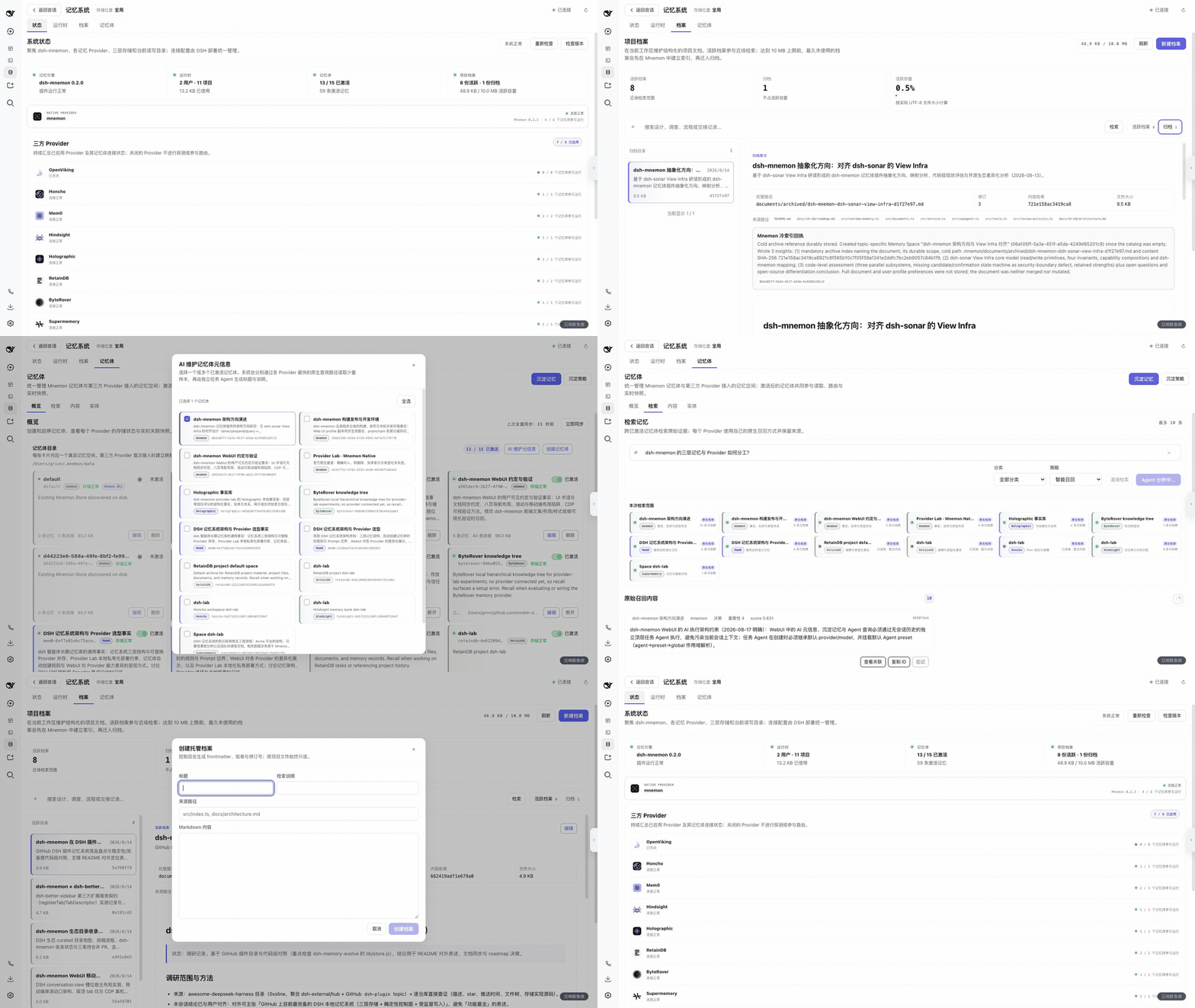
dsh-mnemon is a three-tier, pluggable, Agent-driven memory system for DeepSeek Harness, combining Runtime memory, Project Documents, and replaceable Memory Spaces with nine long-term providers.