file-brief
Run the following command in DeepSeek Harness:
dsh plugin install Zhiyi-Zhao/file-brief
Paste the following prompt into your AI chat to install this plugin:
Run dsh plugin install Zhiyi-Zhao/file-brief in your terminal to install the file-brief skill into DeepSeek Harness; the source is available at https://github.com/Zhiyi-Zhao/file-brief . Start a new agent session after installation so the skill list reloads.
About this plugin
When an agent faces a pile of local files, the costliest part of the work is often not the task itself but the repeated ritual of opening files, printing field names, and confirming formats. file-brief turns that repetitive structural inspection into a reusable, task-local documentation layer: after a single pass, every input file receives a concise Markdown explanation and a SQLite search index. Later sessions simply read those docs and only reparse files that have actually changed.
Coverage spans 20+ common formats including delimited tables, Excel workbooks, Parquet, SQLite databases, JSON/YAML/TOML, ZIP/TAR archives, XML/HTML, Jupyter notebooks, Stata, R data objects, and more than twenty programming languages. Parsing extracts only structural metadata such as field names, types, dimensions, missing-value counts, table schemas, and archive member lists. Raw rows, cell values, and text content are never written into the catalog, keeping the privacy boundary explicit. Each task owns its own .file-catalog directory, so it travels naturally with backups, directory moves, and version control.
The skill is platform-agnostic by design: any environment that can execute Python commands follows the same workflow, whether the host is OpenAI Codex, Claude Code, or DeepSeek Harness. It suits developers whose agent pipelines repeatedly reason over local files, teams that need to share file-structure knowledge across sessions or between multiple agents, and engineering practices that want to keep ad-hoc debugging prints out of production scripts for good.
Use Cases
- When an agent repeatedly inspects the same data files for fields, types, and structure, a single pass generates persistent docs that replace redundant reads
- In multi-agent pipelines that need to share file metadata, committing the .file-catalog directory lets downstream agents reuse structural explanations directly
- When archiving or migrating a project directory after a task ends, documentation travels with .file-catalog and files need no re-parsing
Best For
- Automation developers whose agents repeatedly process local files
- Engineering teams in multi-agent pipelines seeking to eliminate redundant structural discovery
- Developers who prioritize data privacy and prefer retaining only structural metadata without copying raw rows
Related Plugins

Memory layer for coding agents that indexes local session history and auto-recalls relevant context before edits, commands, and failures, with no manual search needed.
Traceable, searchable cross-session memory for AI agents that turns conversation knowledge into a typed knowledge graph and recalls relevant subgraphs instead of replaying full history, natively integrated with DeepSeek Harness.
Gives DSH AI cross-session long-term memory, to-do and skill management, plus multi-session orchestration, external AI delegation, and an infinite canvas that grows with you.
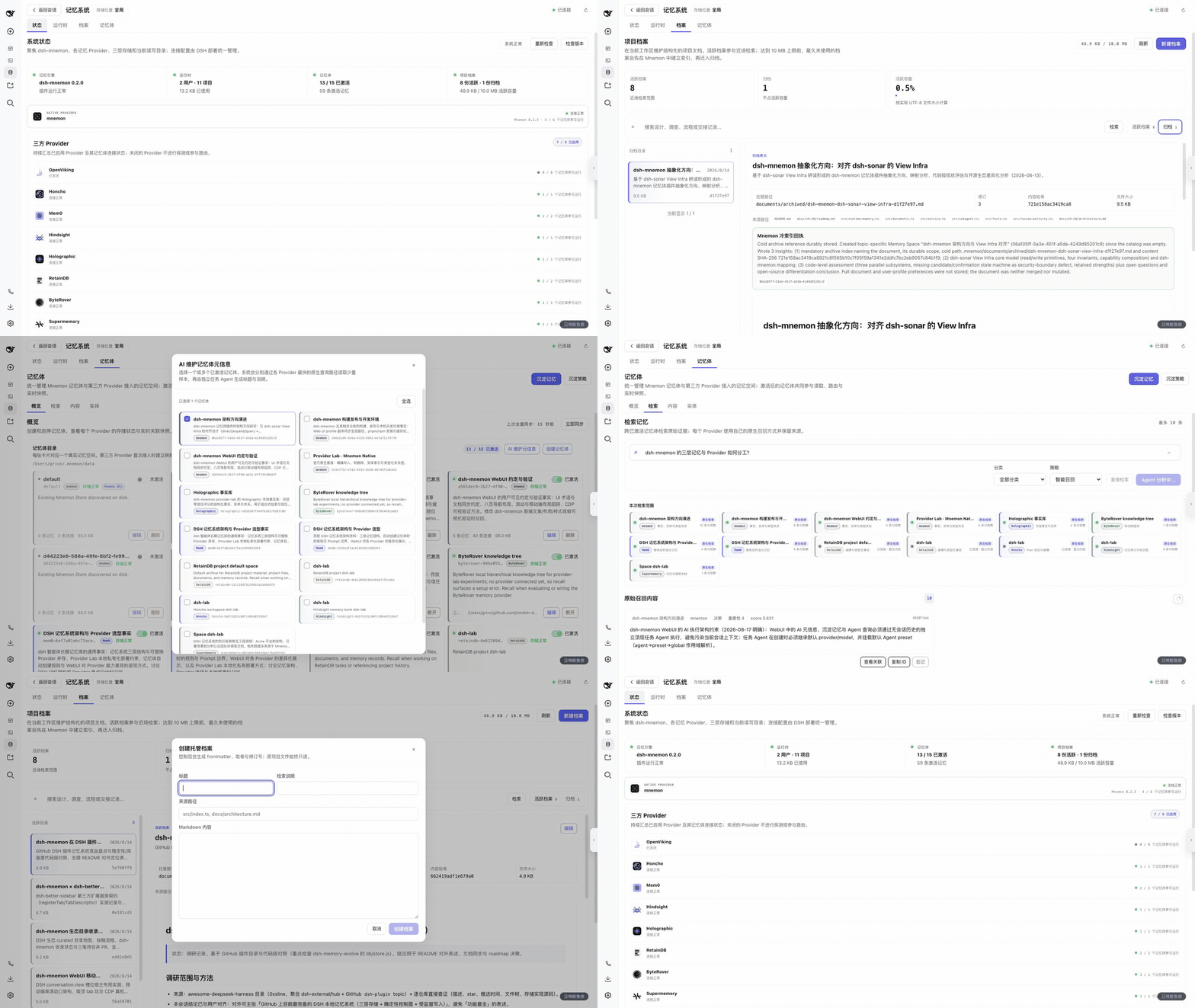
dsh-mnemon is a three-tier, pluggable, Agent-driven memory system for DeepSeek Harness, combining Runtime memory, Project Documents, and replaceable Memory Spaces with nine long-term providers.