dsh_cardian
Run the following command in DeepSeek Harness:
dsh plugin install myYangyunfan/dsh_cardian
Paste the following prompt into your AI chat to install this plugin:
Run dsh plugin install myYangyunfan/dsh_cardian in the DeepSeek Harness terminal to install; full source is available at https://github.com/myYangyunfan/dsh_cardian
About this plugin
The Knowledge Center in mainstream agentic IDEs tends to be locked inside the host: code-repo documentation, atomic knowledge cards, and cross-session memory cannot be searched offline or folded into a personal knowledge base. cardian re-creates all three pillars as a local engine where every wiki page, knowledge card, and memory entry is a Markdown file with YAML frontmatter, persisted into a single Obsidian vault you can open, search, and graph at will—no cloud dependency required.
The three pillars work together. RepoWiki scans local code repositories to build a structured skeleton, then an agent session back-fills each entry with semantic descriptions covering responsibilities, key implementations, dependencies, and caveats. Knowledge Cards organise atomic units by category and tag, support typed relations, bidirectional links, and SM-2 spaced-repetition scheduling. Memory persists cross-session facts grouped by scope, with an append-only revision history. All three share a hybrid keyword-plus-semantic search, an activity-driven auto-refresh that rebuilds MOC indexes whenever the project directory sees conversation activity, and a one-click Condense flow that is idempotent by design: already-enriched cards are preserved, never clobbered.
Whether embedded in the DeepSeek Harness desktop client via a sidebar Knowledge Tree panel or run standalone as a CLI, cardian exposes the same matrix of 36 tools, each annotated as read-only, idempotent, or destructive so agents pick the right operation without trial-and-error. It is built for developers and small teams who want to externalise what their AI-assisted coding sessions learn into a local, Obsidian-native knowledge base that survives project changes and session resets.
Use Cases
- Auto-scan local repos into a structured Wiki skeleton and let an agent back-fill semantic descriptions.
- Browse Knowledge Cards, Memory, and RepoWiki pages together in an Obsidian graph view.
- Search the project Knowledge Tree and condensed cards directly in the DeepSeek Harness sidebar.
Best For
- Developers who want to externalise AI-assisted coding knowledge into a local Obsidian vault.
- Programmers maintaining cross-session memory across multiple projects.
- Small teams that prefer offline, searchable, version-friendly personal knowledge tooling.
Related Plugins

Memory layer for coding agents that indexes local session history and auto-recalls relevant context before edits, commands, and failures, with no manual search needed.
Traceable, searchable cross-session memory for AI agents that turns conversation knowledge into a typed knowledge graph and recalls relevant subgraphs instead of replaying full history, natively integrated with DeepSeek Harness.
Gives DSH AI cross-session long-term memory, to-do and skill management, plus multi-session orchestration, external AI delegation, and an infinite canvas that grows with you.
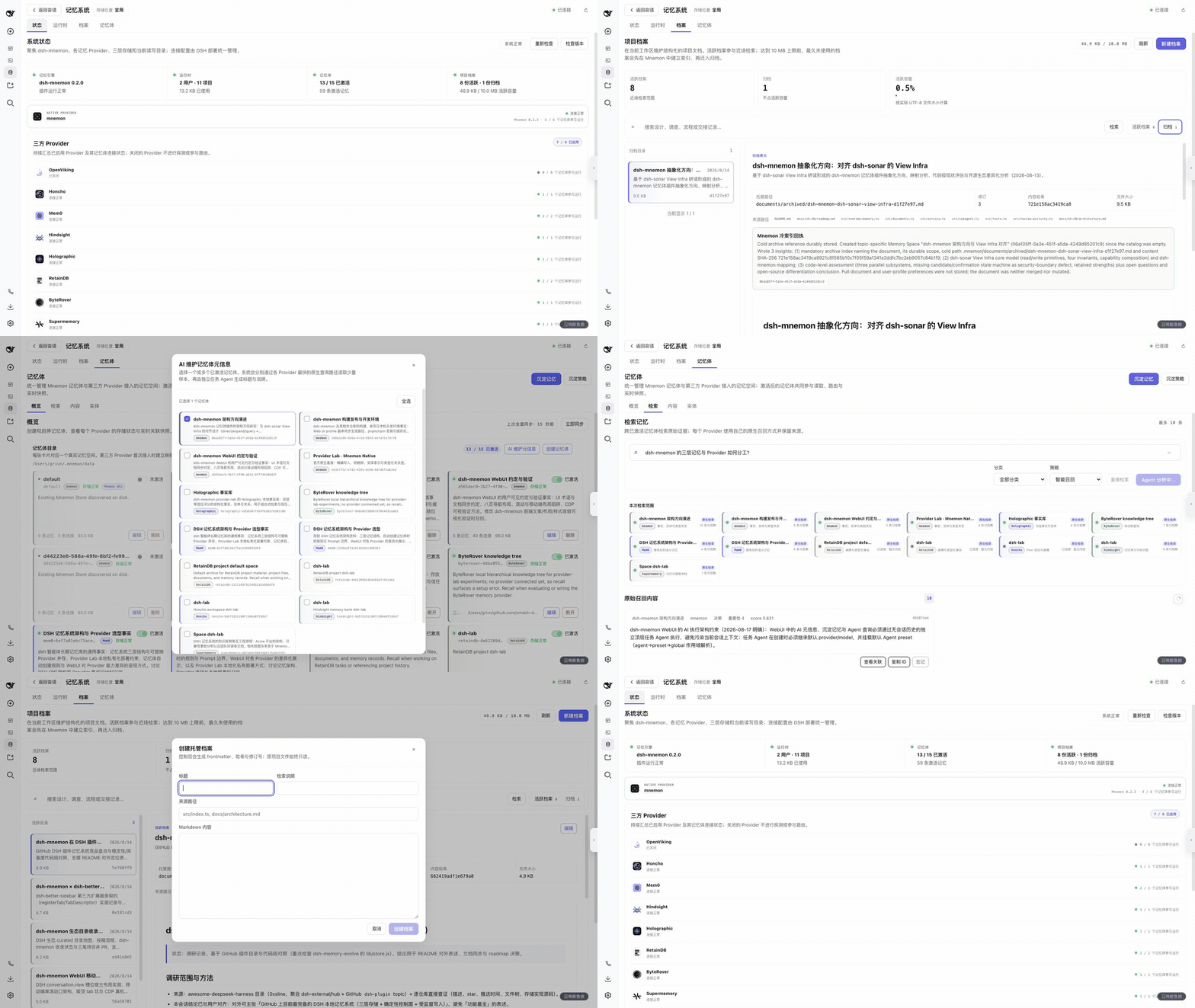
dsh-mnemon is a three-tier, pluggable, Agent-driven memory system for DeepSeek Harness, combining Runtime memory, Project Documents, and replaceable Memory Spaces with nine long-term providers.