
memobranch
Run the following command in DeepSeek Harness:
dsh plugin install sens-io/memobranch
Paste the following prompt into your AI chat to install this plugin:
Run dsh plugin install sens-io/memobranch inside DeepSeek Harness to install this plugin; the source repository is at https://github.com/sens-io/memobranch
About this plugin
Most AI agent memories are nothing but a vector store: where the content came from, who modified it, and how conflicting updates were resolved are questions that simply go unanswered. MemoBranch redefines long-term memory as a governable knowledge chain — Markdown is the source of truth, Git records every change with authorship, and the LLM is an optional enhancement layer only. Even when the model API is down, capture, review, CJK/English lexical search, and remote sync all keep working.
Knowledge flows through a three-stage pipeline: evidence (append-only raw facts) to candidates (refined and queued for review) to wiki (formal, searchable memories). Server-side access control checks permission, scope, sensitivity, and tenant before any decryption occurs. Sensitive records are protected with per-record AES-256-GCM envelope encryption; logical keys use opaque paths and are excluded from Git indexes and vector APIs. Multi-file writes go through a transaction journal followed by atomic replacement, enabling precise rollback or full replay after a crash. Remote sync is built on standard Git with ahead/behind/diverged detection and conflict abort, delegating authentication to credential helpers so tokens never touch disk.
MemoBranch plugs into agent toolchains as either a native DeepSeek Harness plugin or an MCP toolset. It is well suited for teams and developers who need auditable, shareable long-term memory across multiple agent instances, who prioritise data sovereignty and compliance, and who run in local or private-cloud environments.
Screenshots
Use Cases
- Sharing auditable, traceable long-term knowledge across multiple agent instances
- Production systems requiring provenance tracking, revision history, and conflict handling
- Offline or degraded environments where CJK/English lexical search and Git sync must still work without a model API
Best For
- Engineering teams building multi-agent systems with auditable knowledge requirements
- Developers and platform teams working within the DeepSeek Harness or MCP toolchain
- Enterprise users with strict data-sovereignty, compliance, and local-first deployment requirements
Related Plugins

Memory layer for coding agents that indexes local session history and auto-recalls relevant context before edits, commands, and failures, with no manual search needed.
Traceable, searchable cross-session memory for AI agents that turns conversation knowledge into a typed knowledge graph and recalls relevant subgraphs instead of replaying full history, natively integrated with DeepSeek Harness.
Gives DSH AI cross-session long-term memory, to-do and skill management, plus multi-session orchestration, external AI delegation, and an infinite canvas that grows with you.
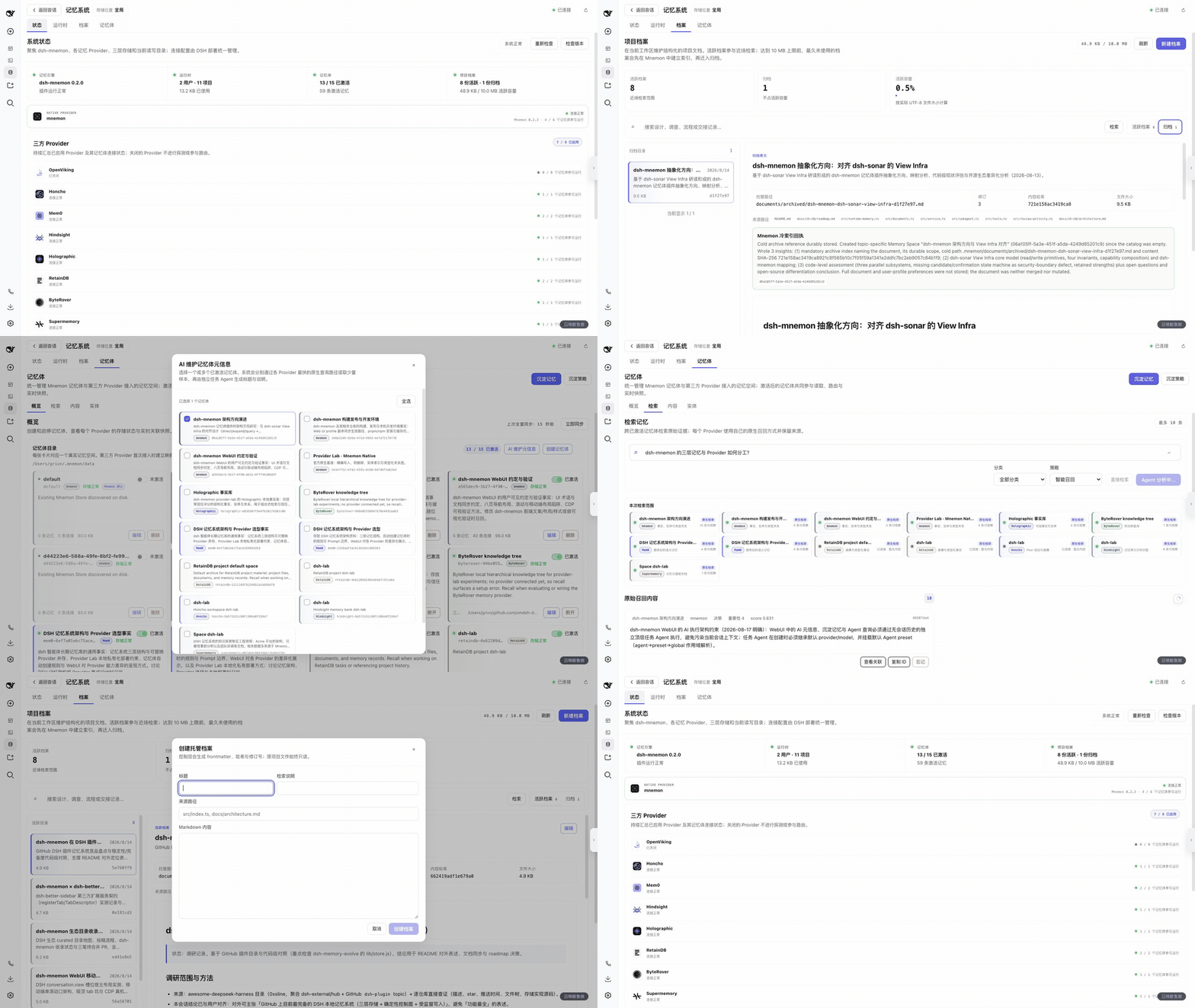
dsh-mnemon is a three-tier, pluggable, Agent-driven memory system for DeepSeek Harness, combining Runtime memory, Project Documents, and replaceable Memory Spaces with nine long-term providers.