dsh-work-continuity
Run the following command in DeepSeek Harness:
dsh plugin install Icstick/dsh-work-continuity
Paste the following prompt into your AI chat to install this plugin:
Run dsh plugin install Icstick/dsh-work-continuity in your DeepSeek Harness terminal to install this plugin; the source is available at https://github.com/Icstick/dsh-work-continuity
About this plugin
You log off mid-task at 1 a.m. The next morning you open a fresh session and the agent draws a blank. You end up scrolling through chat history to re-explain the goal, the decisions you made, and what was left on the table. dsh-work-continuity turns that hand-off into an automatic, auditable trail. Goal changes, todo writes, and conversation-level milestones are captured into a dedicated work-state layer, so a new session picks up exactly where the last one left off.
The plugin layers three complementary capture mechanisms that back each other up. Event-driven capture listens to authoritative host events (goal/change and todo/write) for deterministic, LLM-free recording. LLM-autonomous capture injects a compact ~150-token summary every round so the model can decide on its own when to log a thought, a decision, or a milestone via the work_state tool. And the explicit /checkpoint command keeps full manual control in the user's hands—set goals, record decisions, add next steps, track artifacts and unresolved issues, all viewable, editable, and clearable at a glance.
Two design principles hold firm: human-verifiability and data ownership. Every entry written to work.db can be inspected and audited at any time; there is no hidden per-turn summarization. Uninstalling the plugin never deletes your data, and reinstalling restores it instantly. All failure paths are fail-open—plugin errors are logged but never block the conversation. This plugin is built for engineers who drive agent-assisted development and need reliable, cross-session continuity across goals, decisions, and next steps.
Use Cases
- A new session picks up the previous goal, decisions, and next steps automatically
- Multi-step agent tasks log progress changes without any manual command
- Record decisions, artifact paths, and unresolved issues via /checkpoint
Best For
- Engineers who drive agent-assisted development and need cross-session continuity
- Developers who want work context tracked without polluting general memory
- Teams that prefer auditable, human-verifiable work-state records
Related Plugins

Memory layer for coding agents that indexes local session history and auto-recalls relevant context before edits, commands, and failures, with no manual search needed.
Traceable, searchable cross-session memory for AI agents that turns conversation knowledge into a typed knowledge graph and recalls relevant subgraphs instead of replaying full history, natively integrated with DeepSeek Harness.
Gives DSH AI cross-session long-term memory, to-do and skill management, plus multi-session orchestration, external AI delegation, and an infinite canvas that grows with you.
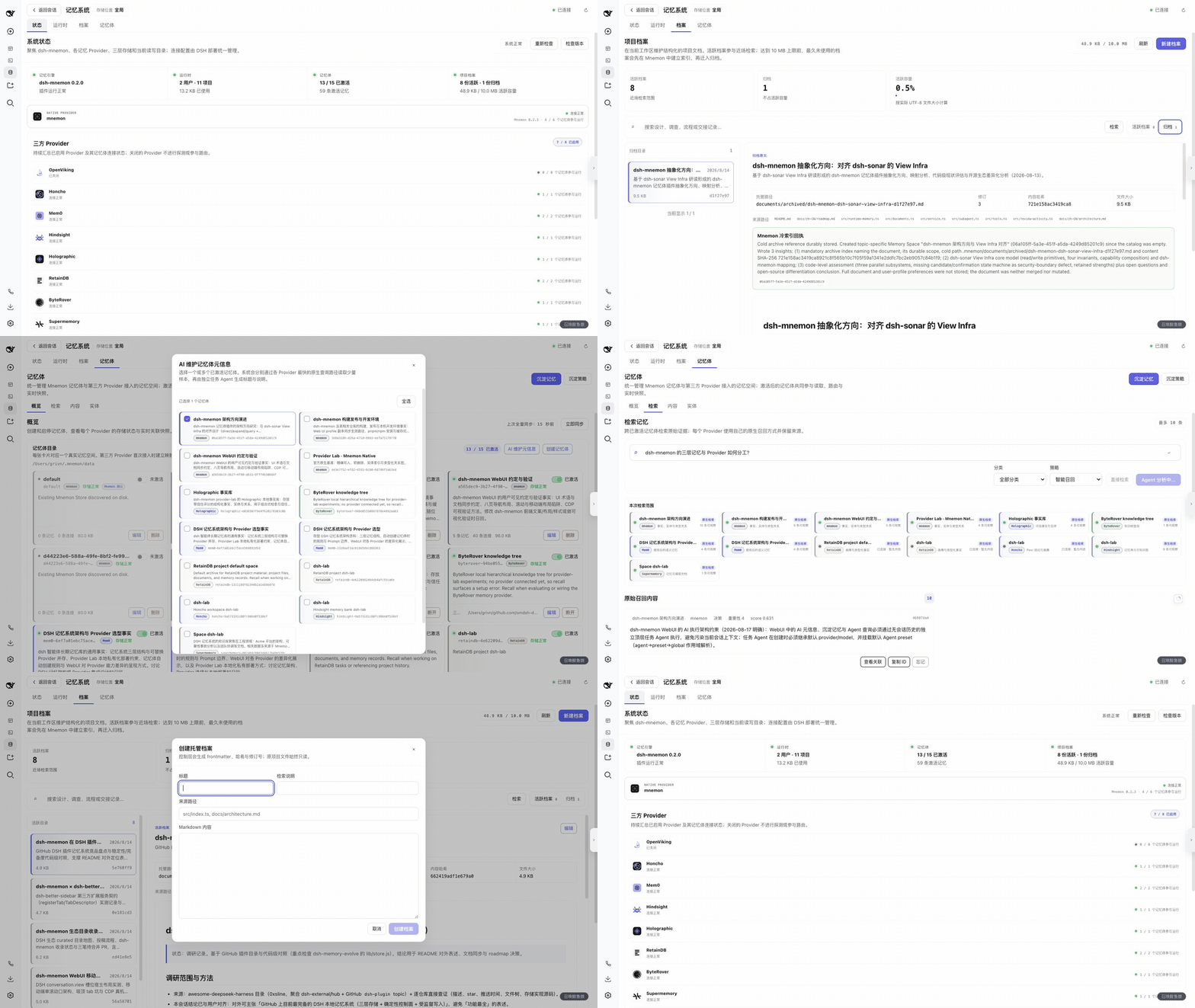
dsh-mnemon is a three-tier, pluggable, Agent-driven memory system for DeepSeek Harness, combining Runtime memory, Project Documents, and replaceable Memory Spaces with nine long-term providers.