dsh-session-delete
Run the following command in DeepSeek Harness:
dsh plugin install TANGBINGBINGING/dsh-session-delete
Paste the following prompt into your AI chat to install this plugin:
Run dsh plugin install TANGBINGBINGING/dsh-session-delete in your terminal; the full source is available at https://github.com/TANGBINGBINGING/dsh-session-delete .
About this plugin
DeepSeek Harness lets you archive or delete a conversation from the sidebar, but once that happens, finding a specific session, restoring in bulk, or purging permanently quickly becomes tedious. dsh-session-delete turns the archive area and the trash into two commands — /t-archive and /t-restore — so the full lifecycle (list, restore, delete, clear) stays at your fingertips.
The interaction model is built around stable list numbering: between two refreshes a number always maps to the same conversation, and an operated slot shows a gap instead of renumbering. Combine that with keyword-first targeting and batch number selection, and working through dozens or hundreds of archived sessions becomes far less error-prone. The plugin is also multi-workspace aware — the archive listing spans every workspace folder, restores return each conversation to its original directory, and the trash is global with a single clear-all.
It is aimed at heavy Harness users who run several workspaces in parallel, frequently spawn fork or sub-agent sessions, and want file-manager-style control over conversation history. The plugin ships as a self-registering bundle, so no manual loader configuration is needed; restart dsh and type the command.
Use Cases
- Archive area has grown large; filter by keyword and batch-restore or purge in one pass
- Accidentally deleted a conversation; retrieve it from the global trash and restore it to its original workspace folder
- Working across multiple workspaces; browse every archive folder and clean up orphaned fork or sub-agent sessions
Best For
- Heavy Harness users running multiple workspaces in parallel with large conversation volumes that need frequent archiving and cleanup
- Researchers or teams whose workflows spawn many fork and sub-agent sessions that must be tracked and cleaned
- Users who want file-manager-style control over conversation lifecycle via stable numbering, keyword targeting, and batch operations
Related Plugins

Memory layer for coding agents that indexes local session history and auto-recalls relevant context before edits, commands, and failures, with no manual search needed.
Traceable, searchable cross-session memory for AI agents that turns conversation knowledge into a typed knowledge graph and recalls relevant subgraphs instead of replaying full history, natively integrated with DeepSeek Harness.
Gives DSH AI cross-session long-term memory, to-do and skill management, plus multi-session orchestration, external AI delegation, and an infinite canvas that grows with you.
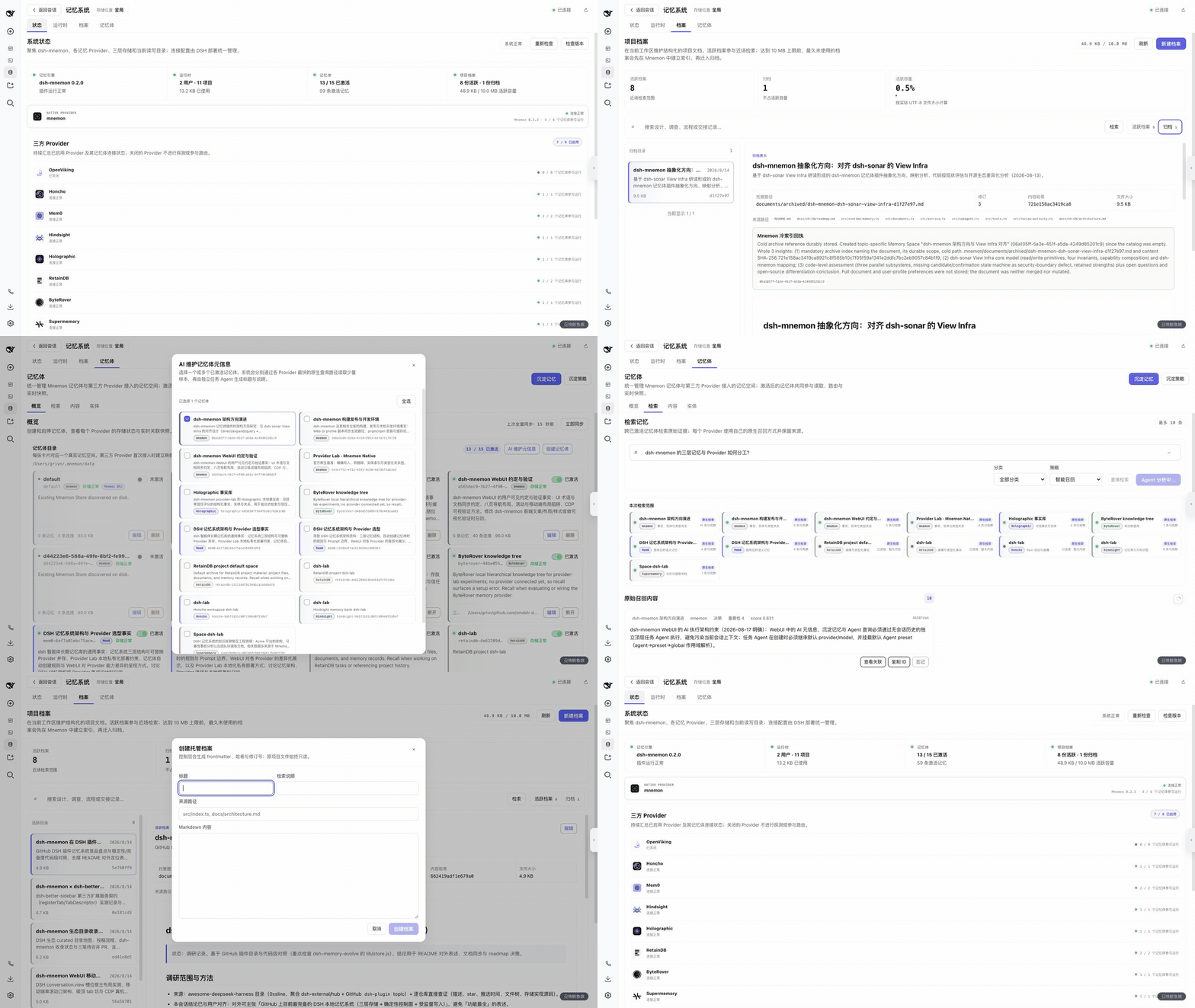
dsh-mnemon is a three-tier, pluggable, Agent-driven memory system for DeepSeek Harness, combining Runtime memory, Project Documents, and replaceable Memory Spaces with nine long-term providers.