dsh-request-manager
Run the following command in DeepSeek Harness:
dsh plugin install tree-func/dsh-request-manager
Paste the following prompt into your AI chat to install this plugin:
Run dsh plugin install tree-func/dsh-request-manager in your terminal (source at https://github.com/tree-func/dsh-request-manager), then restart the DSH process to activate the plugin.
About this plugin
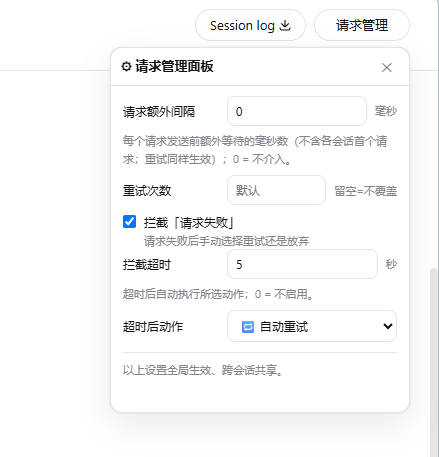
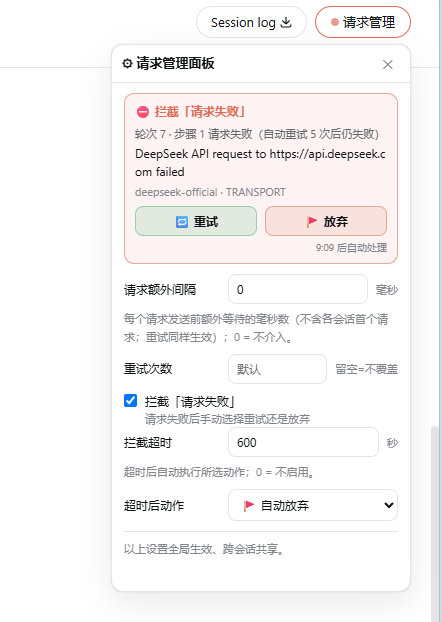
DeepSeek Harness ships with a fixed request policy: no adjustable interval between API calls, a hard-coded 5-attempt retry loop, and immediate termination on stream or network errors. dsh-request-manager exposes all of these knobs in a single global panel accessible from the conversation header, so you configure once and the settings apply across every session with no per-chat toggles.\n\nControl comes in three layers. First, insert a custom millisecond-level delay between successive API requests; the interval applies to both automatic and manual retries, and setting it to 0 disables the feature. Second, override the default retry count—leave it blank to fall back to the native strategy—while leaving DSH's native no-retry rules (such as SSE stream ended without DONE, NETWORK ERROR) untouched. Third, intercept failed requests: the panel auto-expands and offers two action cards, \"Retry in place\" and \"Abort via native path,\" with optional timeout duration and timeout action (auto-retry or auto-abort). Hitting Stop or destroying the session releases the hold immediately. UI strings follow the DSH language setting for English/Chinese, and styling adapts to light and dark themes via semantic design tokens.\n\nThis plugin suits developers who need fine-grained rate control under tight API quotas, who want to avoid burning all retries on transient hiccups, or who prefer to make the go-or-no-go call on a failed request by hand rather than letting a one-size-fits-all policy decide for them.
Screenshots
Use Cases
- Throttle API call frequency with millisecond-level intervals under tight quotas
- Decide per-failure whether to retry or abort instead of relying on a fixed policy
- Apply a single global request strategy across all conversations without per-chat config
Best For
- Developers with tight API quotas who need precise rate control
- Engineers who want to avoid wasting all retries on transient errors
- Users who prefer manual go-or-no-go decisions on failed requests over fully automated policies
Related Plugins
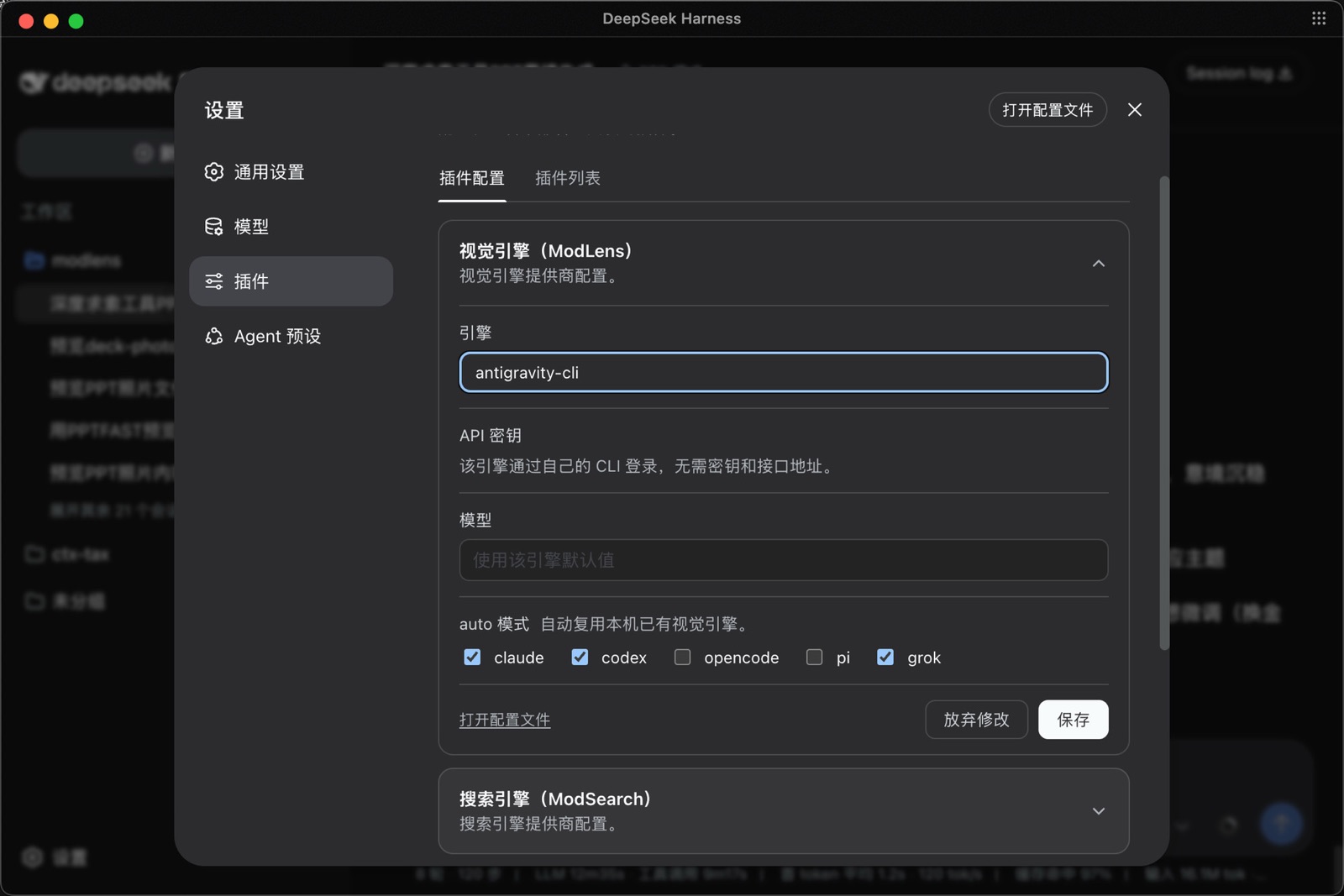
ModLens is a vision plugin for DeepSeek Harness that gives text-only models sight by reading images pasted directly into chat, with zero-config setup and multiple vision engines.
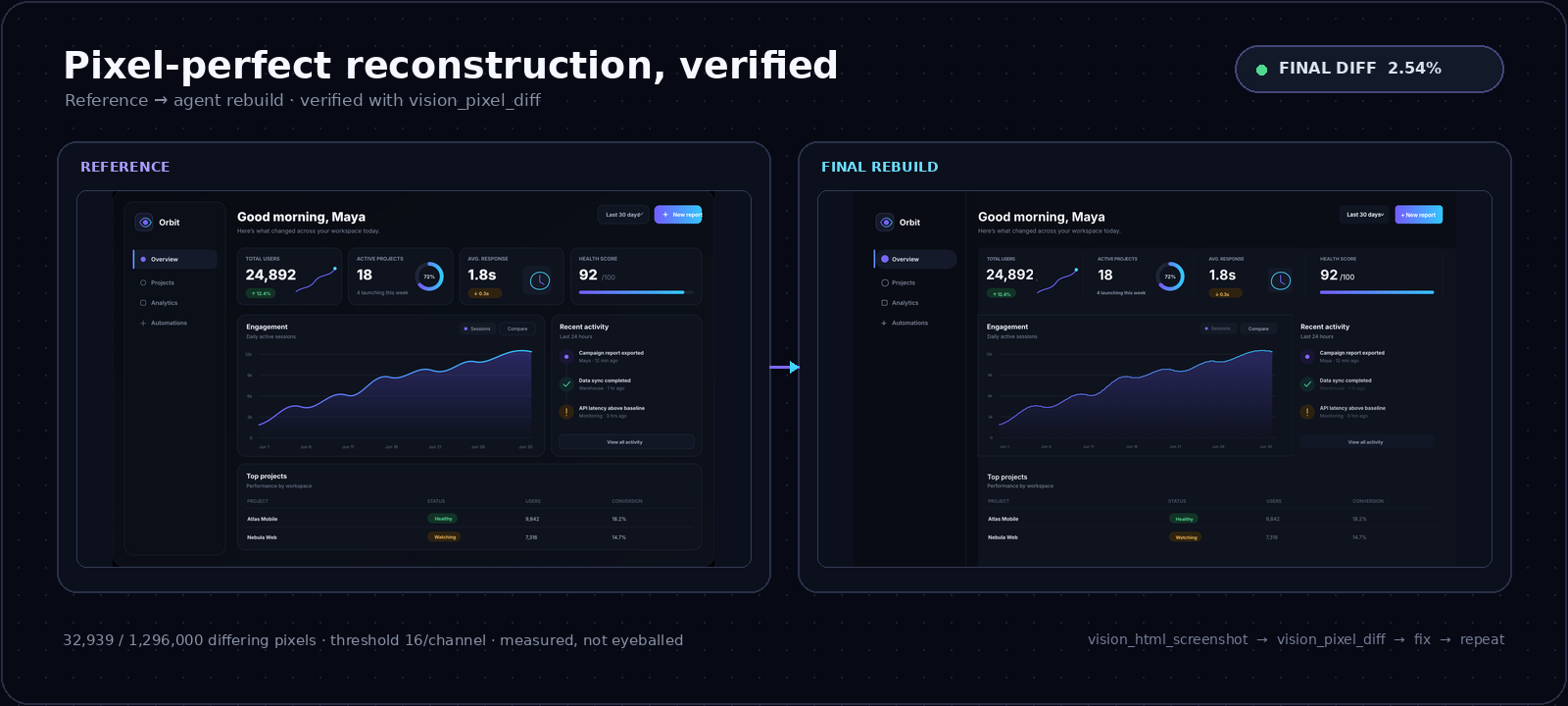
On-demand vision for text-only DeepSeek Harness agents: built-in free keyless vision chain and 14 vision tools, routing image turns as tool calls to vision models with pixel fidelity, no Python needed, one-command install.

Give text-only models in DeepSeek Harness eyes, enabling image Q&A, long-screenshot OCR, UI restoration, and GUI visual tasks.
An armor-breaking plugin for DeepSeek: rewrites instruction priority, expands refusal-blocked phrases, persists across sessions, and shows a green active indicator.