
xmemo-deepseek-plugin
Run the following command in DeepSeek Harness:
dsh plugin install yonro/xmemo-deepseek-plugin
Paste the following prompt into your AI chat to install this plugin:
Install the plugin with dsh plugin install yonro/xmemo-deepseek-plugin; the full source is available at https://github.com/yonro/xmemo-deepseek-plugin . After installation, configure an XMemo account or API key as prompted to start using the memory tools.
About this plugin
DeepSeek Harness sessions are ephemeral: close the terminal and the context is gone. xmemo-deepseek-plugin solves this by acting as a native Cordis plugin that talks directly to the MemoryOS REST API behind XMemo, giving dsh a persistent, local-first memory layer without routing through an MCP bridge. Every write—remember, recall events, timeline entries, TODOs, decisions—lands in a local JSON store first. An offline-durable outbox queues writes when the network is unavailable, replaying idempotent operations automatically and holding non-idempotent ones for explicit confirmation, so nothing is silently lost or double-applied.
The plugin exposes 16 structured tools spanning the full memory lifecycle: recall and storage of facts and preferences, timeline event recording, active task state with restart snapshots for session resumption, TODO and decision tracking. Recall merges local token-overlap scoring with cloud results and applies a strict fail-closed bucket/scope filter, dropping any cloud item that does not exactly match the request to prevent context contamination. Authentication supports the full OAuth 2.1 + PKCE flow (Dynamic Client Registration, loopback redirect, token rotation and revocation) as well as a static API key. Deletion defaults to a recoverable soft delete. A settings card appears in dsh's Web GUI where users can connect or disconnect their XMemo account and switch between hybrid, local-only, and cloud-only modes with immediate effect—no restart required.
If you are using DeepSeek Harness for long-running development work and need cross-session persistence for project decisions, open TODOs, and working state—or simply want your memory to survive an offline dev session—this plugin offers a more native, lower-latency memory substrate than the MCP-bridge approach. It is MIT-licensed and ready to configure per dsh profile.
Screenshots
Use Cases
- Retain project decisions, TODOs, and timeline across sessions without re-explaining context after restart
- Keep memory writes durable during offline development and auto-sync to XMemo cloud once connectivity returns
- Resume working state after a crash via restart snapshots instead of replaying full session history
Best For
- DeepSeek Harness users who need cross-session persistent memory
- Developers running long-horizon agentic workflows with dsh
- Teams that prefer a native Cordis plugin over an MCP bridge approach
Related Plugins
Traceable, searchable cross-session memory for AI agents that turns conversation knowledge into a typed knowledge graph and recalls relevant subgraphs instead of replaying full history, natively integrated with DeepSeek Harness.
Gives DSH AI cross-session long-term memory, to-do and skill management, plus multi-session orchestration, external AI delegation, and an infinite canvas that grows with you.
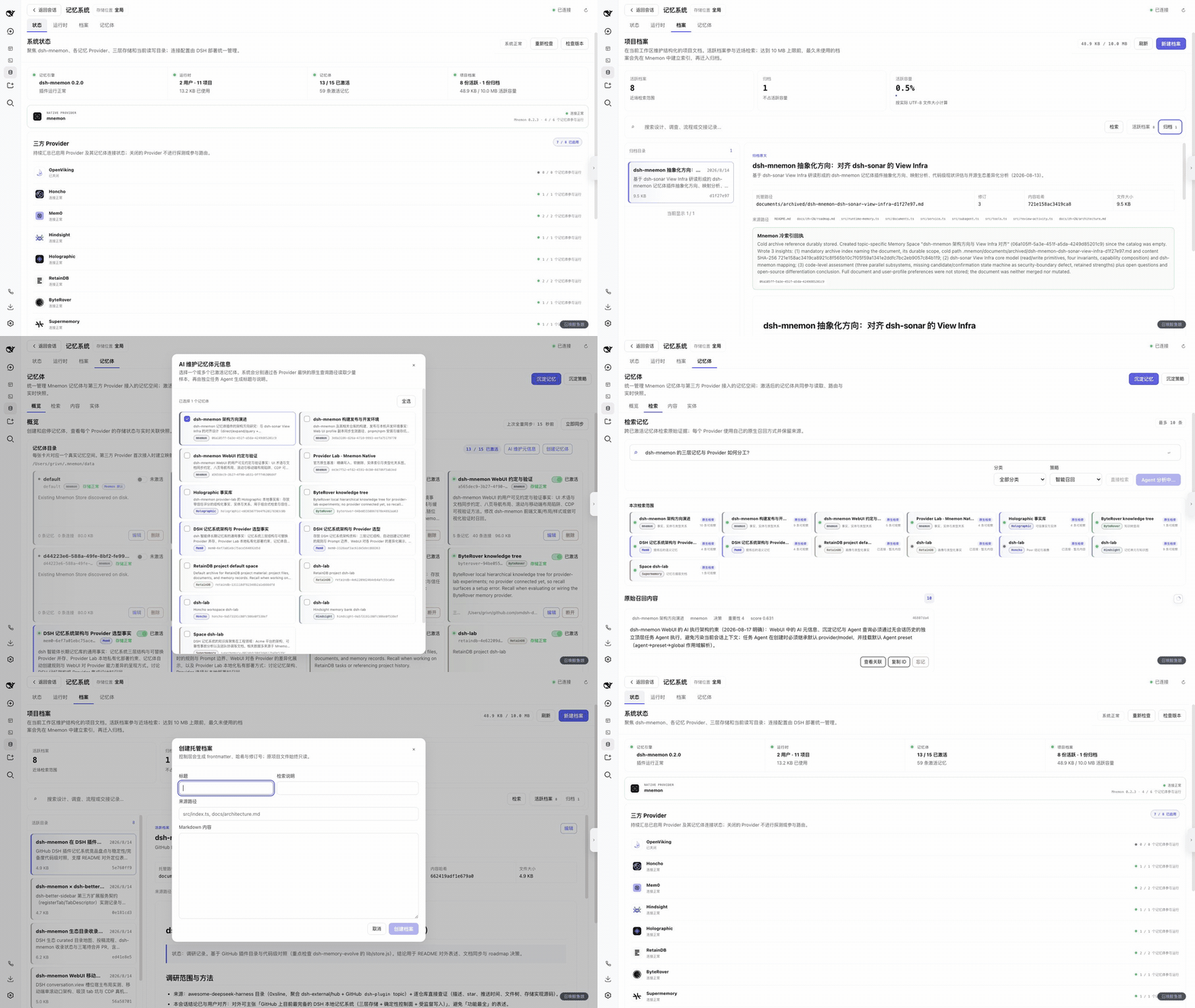
dsh-mnemon is a three-tier, pluggable, Agent-driven memory system for DeepSeek Harness, combining Runtime memory, Project Documents, and replaceable Memory Spaces with nine long-term providers.
An opinionated, zero-infrastructure file-based memory protocol: human-readable markdown files plus a bounded always-loaded index, curation discipline, and no database or embeddings.