dsh-ontology
Run the following command in DeepSeek Harness:
dsh plugin install tancheng33/dsh-ontology
Paste the following prompt into your AI chat to install this plugin:
Run dsh plugin install tancheng33/dsh-ontology in DeepSeek Harness to install; source code at https://github.com/tancheng33/dsh-ontology
About this plugin
Most agent memory is a bag of strings: the agent writes prose, later reads prose, and nothing ever tells it that what it just recorded contradicts what it recorded last week. dsh-ontology upgrades memory into a typed ontology. You declare which classes exist, how they relate, and what domain and range constraints each relation carries. Every subsequent assertion is then validated against that vocabulary; a violation is rejected with the exact constraint named, rather than silently stored as another undistinguishable blob of text.
The core power lies in inference and traceability. Transitive, symmetric, and inverseOf rules are applied to a fixpoint so composition works correctly. Entailed facts are derived on read and never persisted; retract a premise and every fact resting on it vanishes cleanly, leaving no stale residue. Queries support subclass-aware class matching, triple-pattern matching, neighborhood traversal, and shortest-path search, far more reliable than grepping prose. Functional cardinality ensures a subject has at most one valid object per relation, and retraction cascades safely through every fact mentioning an entity, keeping the entire graph self-consistent.
It is built for teams that need their agent to manage structured domain knowledge over the long term: maintaining knowledge bases, tracking product specifications, mapping dependency graphs, or any scenario where every fact the agent remembers must be verifiable, derivable, and safely retractable.
Use Cases
- Building a verifiable product specification knowledge base where every assertion conforms to a predefined ontology
- Tracking inter-component dependencies and auto-deriving indirect dependencies via transitive closure
- Maintaining long-term project memory with cascade retraction that removes all dependent inferences when a premise is wrong
Best For
- Teams that need their agent to manage structured domain knowledge over the long term
- Product or architecture teams that demand strict knowledge consistency and reject free-text memory
- Developers who want to reuse the rule engine standalone as a pure function with no IO
Related Plugins
Traceable, searchable cross-session memory for AI agents that turns conversation knowledge into a typed knowledge graph and recalls relevant subgraphs instead of replaying full history, natively integrated with DeepSeek Harness.
Gives DSH AI cross-session long-term memory, to-do and skill management, plus multi-session orchestration, external AI delegation, and an infinite canvas that grows with you.
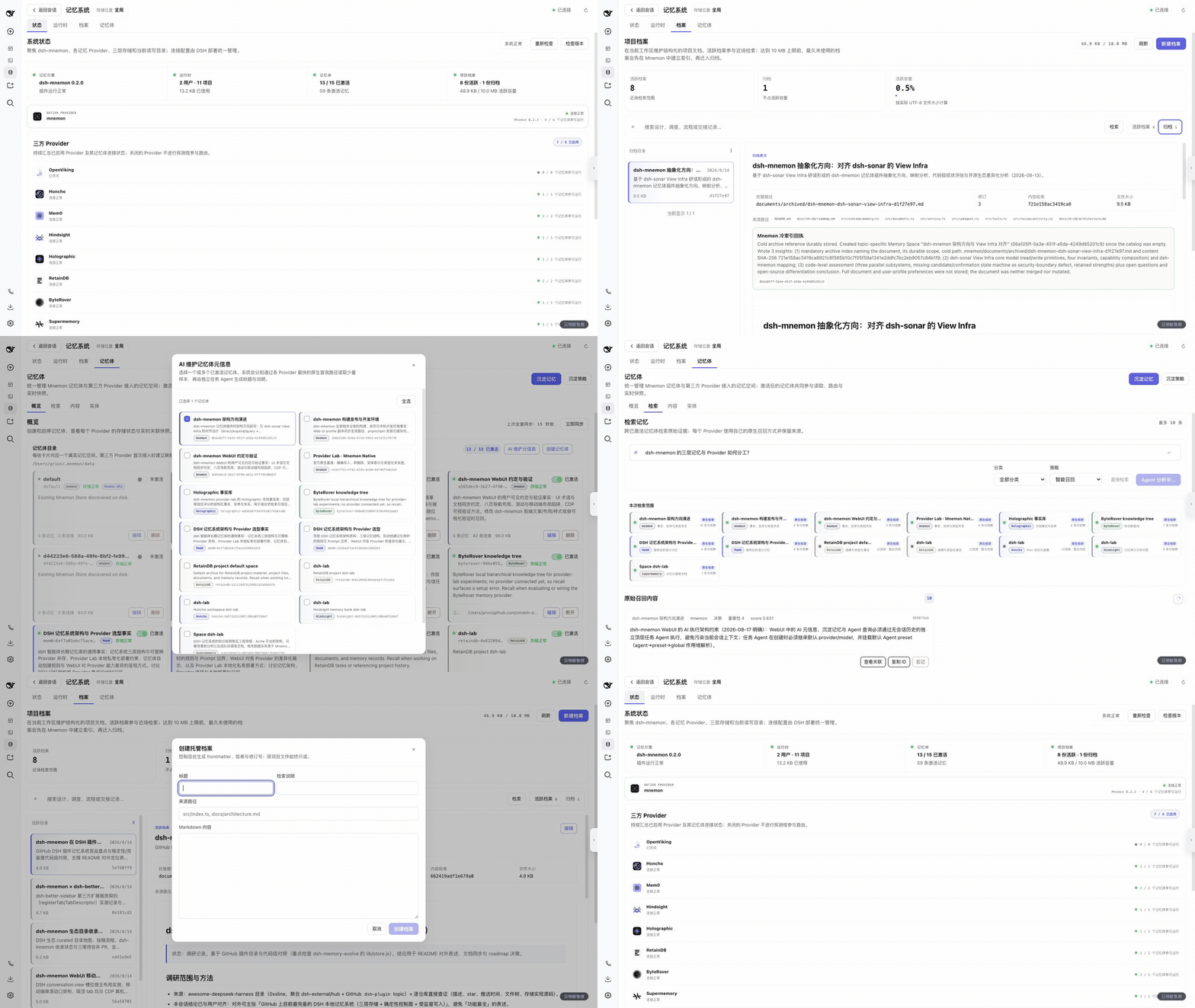
dsh-mnemon is a three-tier, pluggable, Agent-driven memory system for DeepSeek Harness, combining Runtime memory, Project Documents, and replaceable Memory Spaces with nine long-term providers.
An opinionated, zero-infrastructure file-based memory protocol: human-readable markdown files plus a bounded always-loaded index, curation discipline, and no database or embeddings.