dsh-math
Run the following command in DeepSeek Harness:
dsh plugin install hatter123/dsh-math
Paste the following prompt into your AI chat to install this plugin:
Install this plugin in DeepSeek Harness by running dsh plugin install hatter123/dsh-math, or installing from the source at https://github.com/hatter123/dsh-math.
About this plugin
When an agent hits a determinant, a unit conversion, or an indefinite integral mid-conversation, the usual workaround is to guess or bounce the question back to the user. dsh-math makes math a first-class capability of DeepSeek Harness—the agent invokes the math tool right in context, gets the answer, and keeps the conversation flowing without switching to an external calculator.
Two engines share the load under the hood: mathjs covers numeric evaluation (units, matrices, statistics, complex numbers, big numbers), and Algebrite plugs the symbolic-algebra gaps mathjs does not fill—simplification, expansion, factoring, differentiation, indefinite integration, and polynomial root-finding. The caller simply passes an operation and an expression (plus an optional variable), and a readable result returns to the dialog: derivative(x^2, x) yields 2*x, roots(x^2 - 3x + 2) yields [1, 2].
It suits anyone whose Harness workflows regularly involve math: researchers who need quick unit and matrix computations in physics or chemistry coursework, students who ask an agent to simplify and verify algebraic steps, and engineers who lean on complex numbers, big integers, or statistics in data analysis. One lightweight, MIT-licensed plugin that keeps the math inside the conversation where it belongs.
Use Cases
- Evaluate determinants, unit conversions, or big-number powers right in the conversation
- Ask the agent to differentiate and integrate polynomials, then verify the result
- On-the-fly complex-number or matrix-statistics computation for data work
Best For
- STEM researchers who need quick unit and matrix lookups
- Students who let an agent simplify formulas and check their steps
- Engineers who regularly hit complex numbers, big integers, or statistics in their work
Related Plugins
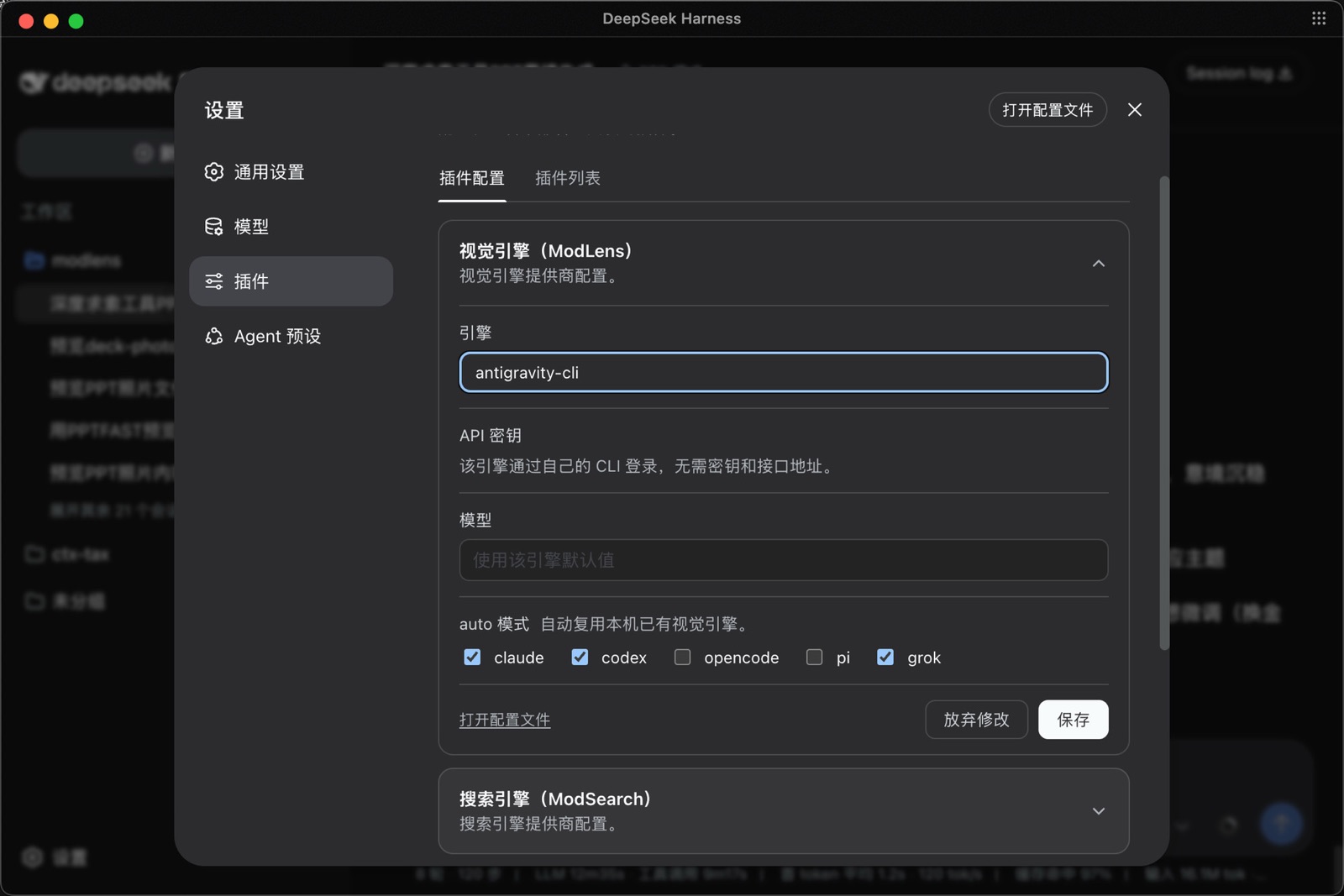
ModLens is a vision plugin for DeepSeek Harness that gives text-only models sight by reading images pasted directly into chat, with zero-config setup and multiple vision engines.
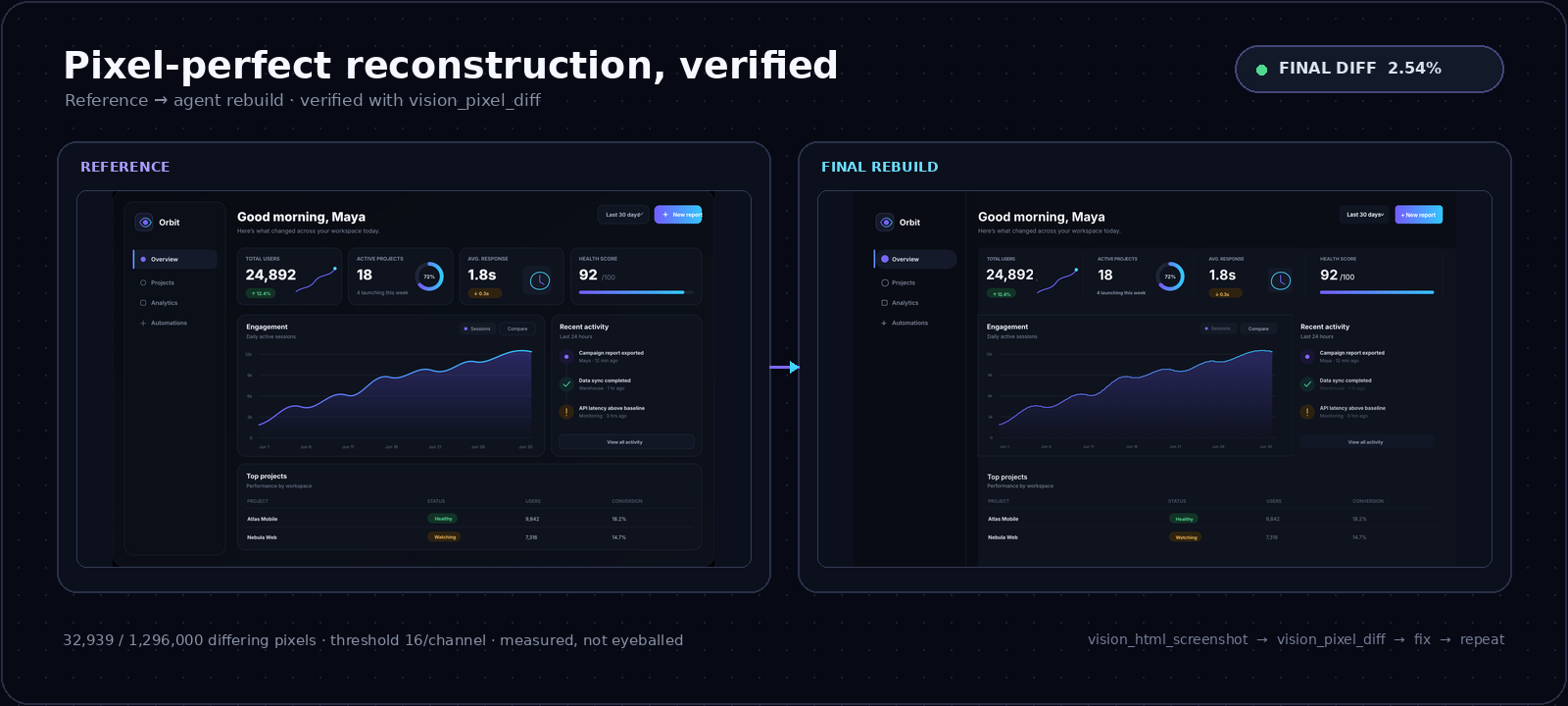
On-demand vision for text-only DeepSeek Harness agents: built-in free keyless vision chain and 14 vision tools, routing image turns as tool calls to vision models with pixel fidelity, no Python needed, one-command install.

Give text-only models in DeepSeek Harness eyes, enabling image Q&A, long-screenshot OCR, UI restoration, and GUI visual tasks.
An armor-breaking plugin for DeepSeek: rewrites instruction priority, expands refusal-blocked phrases, persists across sessions, and shows a green active indicator.