dsh-markdown-memory
Run the following command in DeepSeek Harness:
dsh plugin install SYMlp/dsh-markdown-memory
Paste the following prompt into your AI chat to install this plugin:
Run dsh plugin install SYMlp/dsh-markdown-memory in your DeepSeek Harness terminal to install the plugin; source code is available at https://github.com/SYMlp/dsh-markdown-memory .
About this plugin
Most agent memory schemes write facts into a vector store or a hosted service, locking your memory behind one engine or one platform. Switch to a different agent and you wire it back up; want to edit a single line and you route through an external API. dsh-markdown-memory takes the simplest possible route: your memory is a Markdown folder you already own. Each durable fact lives in its own file with YAML frontmatter, and a single index file lists every entry. The plugin injects that index together with a recursive file listing into the system prompt; the model opens individual files on demand with its file tools, incurring no token cost until it actually reads one.
On top of that minimal structure the plugin offers two active delivery mechanisms. Memories marked as seed are injected automatically at session start, suited to background facts the model should hold before any question arrives. Unmarked memories are recalled on demand via trigger strings declared in their frontmatter, performing literal substring matching against the text entering each step and appending only when relevant. Both paths share deduplication, byte budgets, and truncation guards so nothing is silently dropped.
If you already manage notes in Obsidian, that vault is your memory folder and mounts directly. If you just want memory you can git diff, share across agents, and delete a line of by hand, without standing up an embedding pipeline or depending on a cloud service, dsh-markdown-memory is the option where pointing at a folder is the whole setup.
Use Cases
- Mount an existing Obsidian vault as shared long-term memory for multiple agents without migration.
- Share one set of Markdown memory files across different agent harnesses using a universal format.
- Keep agent memory human-editable, git-trackable, and deletable line by line.
Best For
- Solo developers already managing knowledge in Markdown who want agents to read and write directly.
- Teams needing shared memory across multiple agent frameworks without a vector DB or cloud dependency.
- Users who prioritize data ownership, offline access, auditability, and manual editability of agent memory.
Related Plugins
Traceable, searchable cross-session memory for AI agents that turns conversation knowledge into a typed knowledge graph and recalls relevant subgraphs instead of replaying full history, natively integrated with DeepSeek Harness.
Gives DSH AI cross-session long-term memory, to-do and skill management, plus multi-session orchestration, external AI delegation, and an infinite canvas that grows with you.
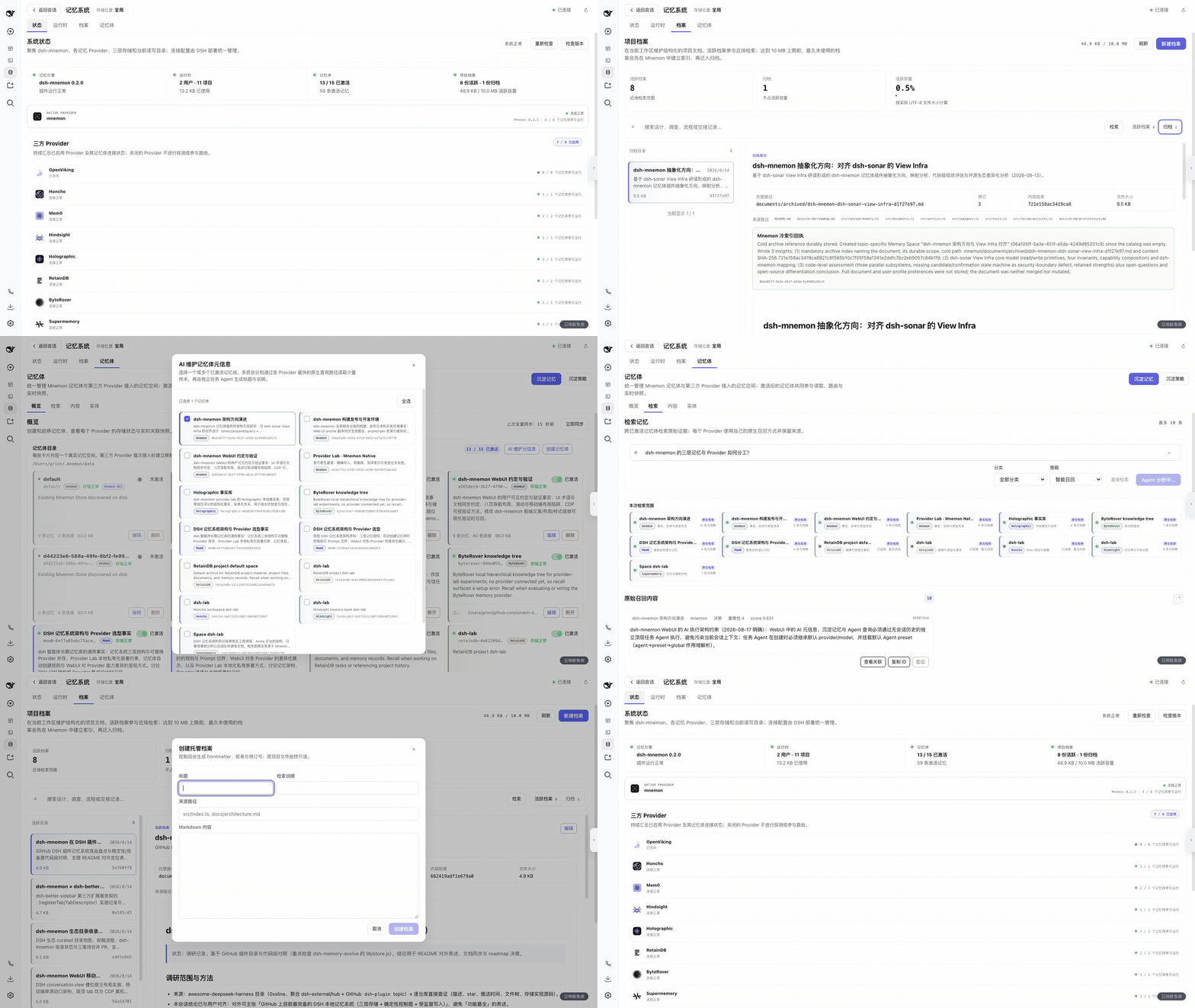
dsh-mnemon is a three-tier, pluggable, Agent-driven memory system for DeepSeek Harness, combining Runtime memory, Project Documents, and replaceable Memory Spaces with nine long-term providers.
An opinionated, zero-infrastructure file-based memory protocol: human-readable markdown files plus a bounded always-loaded index, curation discipline, and no database or embeddings.