dsh-memory-canvas
Run the following command in DeepSeek Harness:
dsh plugin install guobinmengxiang-rgb/dsh-memory-canvas
Paste the following prompt into your AI chat to install this plugin:
Run the install command in your DeepSeek Harness profile to load the plugin; the source repository is available at https://github.com/guobinmengxiang-rgb/dsh-memory-canvas .
About this plugin
Running multi-step agent tasks means tool logs pile up fast, filling the context window while what you actually need to keep is just the skeleton of the task structure. dsh-memory-canvas tackles exactly that: it offloads bulky tool output to local refs files, leaves a single Mermaid canvas in context to track task nodes, and lets the agent pull the full body back by node ID when needed. No daemon, no vector database, no ports to babysit. Everything lives in a local .dsh-memory directory, making it simple, auditable, and dependency-free.
The plugin exposes three tools the agent calls explicitly: memory_offload writes a title and body into refs and returns a short ID while updating the canvas; memory_recall fetches stored content by ID (truncated at 8k with a note); memory_canvas prints the current Mermaid Markdown in full. It does not auto-intercept logs. The agent decides when to offload and when to recall, keeping full control over context pacing.
Ideal for developers running long-chain tasks inside DeepSeek Harness who want the lightest possible way to manage the context window. It is not a persona pipeline, not a vector search engine, and not a daemon-backed service. It is a minimal references-plus-canvas memory layer that slots into the tool layer of your agent.
Use Cases
- Tool logs keep growing in long multi-step tasks and need to be offloaded to files while retaining only the structural skeleton
- Recalling earlier tool-call results by node ID mid-reasoning without re-running them
- Managing task memory with local files and a Mermaid diagram, with no vector DB or resident daemon
Best For
- Agent developers running long-chain tasks inside DeepSeek Harness
- Developers who want minimal-dependency context management without heavyweight infra
- Individual developers who prefer local file storage, zero daemons, and out-of-the-box simplicity
Related Plugins
Traceable, searchable cross-session memory for AI agents that turns conversation knowledge into a typed knowledge graph and recalls relevant subgraphs instead of replaying full history, natively integrated with DeepSeek Harness.
Gives DSH AI cross-session long-term memory, to-do and skill management, plus multi-session orchestration, external AI delegation, and an infinite canvas that grows with you.
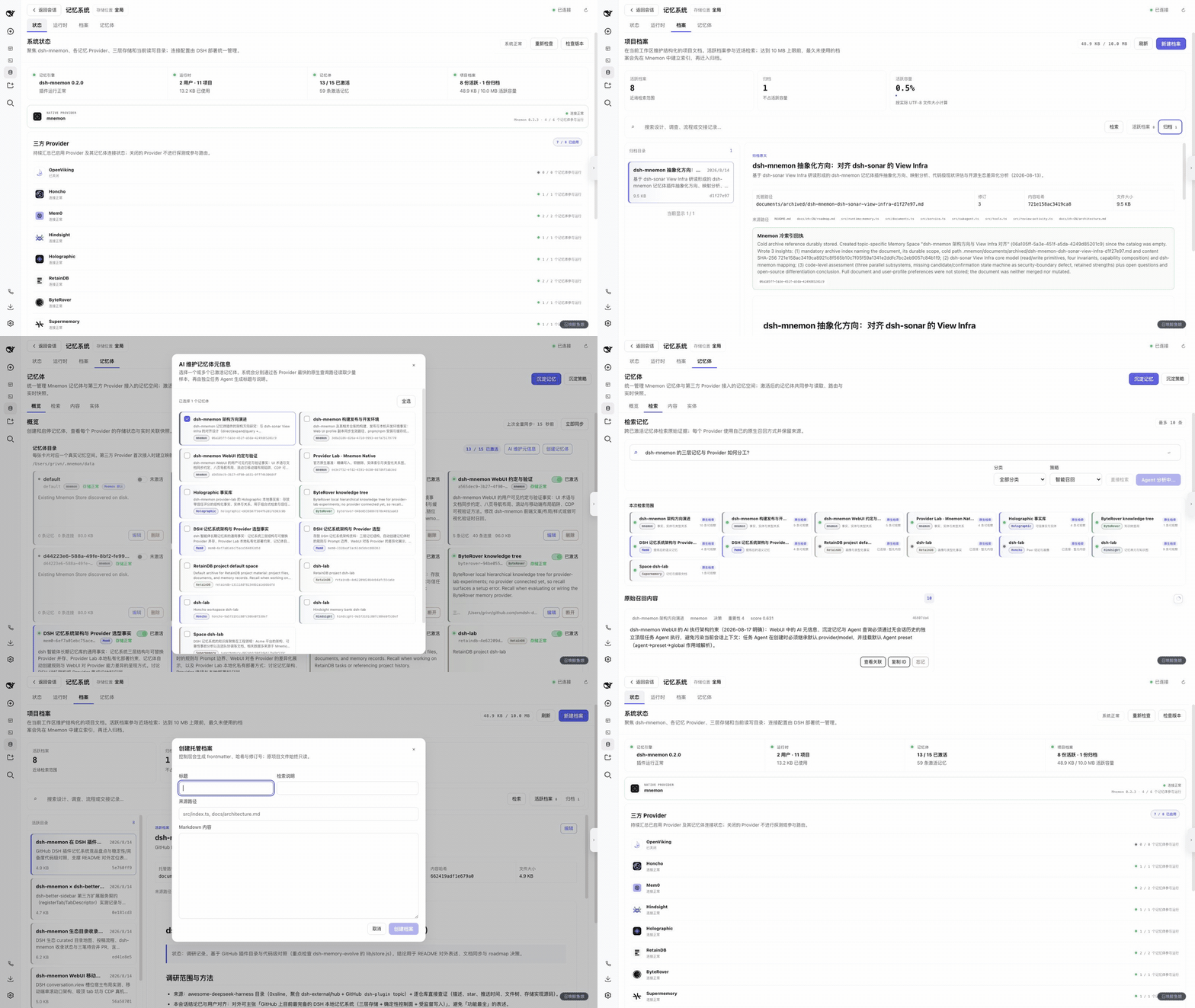
dsh-mnemon is a three-tier, pluggable, Agent-driven memory system for DeepSeek Harness, combining Runtime memory, Project Documents, and replaceable Memory Spaces with nine long-term providers.
An opinionated, zero-infrastructure file-based memory protocol: human-readable markdown files plus a bounded always-loaded index, curation discipline, and no database or embeddings.