dsh-engram
Run the following command in DeepSeek Harness:
dsh plugin install skepsun/dsh-engram
Paste the following prompt into your AI chat to install this plugin:
Clone or install dsh-engram from https://github.com/skepsun/dsh-engram, then run dsh plugin install skepsun/dsh-engram and restart dsh web to see the injected [ENGRAM]/[ESR] memory index and ESR kanban in the native settings panel.
About this plugin
Long-term memory plugins for DeepSeek Harness share a blind spot: they bolt an LLM onto the write path for summarization, then dump raw captured text straight into the context window, making every session pay for both distillation and bloat. dsh-engram takes the opposite route. Its intake layer is pure pattern matching, capturing only meaningful signals (git milestones with commit messages, edits to key files, repeated errors, failing test runs) while deliberately skipping pure plumbing such as silent commits and git push. Nothing on the hot path calls a model, and before any byte hits disk a deterministic secret redactor strips API keys, JWTs, Bearer tokens, and cloud-vendor credentials so sensitive text can never land in storage.
Retrieval follows a retrieved ≠ injected principle. At prompt assembly a compact [ENGRAM] symbolic index (default 700 characters, roughly 175 tokens, one line per memory) is injected and frozen for the rest of the session, keeping the request prefix byte-stable for KV-cache reuse. When the agent actually needs detail it calls engram_recall or engram_detail, which rank the pool with an in-process BM25 pass (TF-IDF, label boosts, gentle time-decay) and surface an entity-neighborhood table for anchored hits; near-identical repeat errors are revived and merged rather than stacked; zero local hits fall back to DSH's own cross-session full-text index before a bounded substring scan over recent logs. Memory-to-memory semantics let a new statement supersede or contradict an older one: the stale row is demoted and excluded from the index block but never hard-deleted. A failure-to-fix closure loop watches the same command signature, and when it finally succeeds the old error rows are tagged resolved so recall surfaces the fix instead of the stale failure.
On the task side, the ESR protocol gives every piece of work a draft, active, stable lifecycle where stable requires real evidence: an artifact, an evaluation, or a memory reference. A non-URL artifact must exist on disk in the workspace before the gate closes. Tasks hang off entity nodes with first-class dependency edges, and a full-screen kanban plus a force-directed relation graph live inside the native DSH settings surface. When a session tears down with pending todos, they auto-sink as ESR drafts rather than evaporating. Context GC replaces DSH's lossy LLM-summary compaction with mechanical eviction: evicted turns that carry engram or ESR anchors are replaced with a one-line re-fetch pointer, and only un-provenanced turns receive a scoped narrative. Who is this for? Developers who run long, multi-tool sessions, feel the token bill add up, want memory that stays out of the way until asked, and believe a task should not be declared done without proof.
Use Cases
- Repeated test failures captured in a long session are auto-tagged resolved once the same command later succeeds, so recall surfaces the fix instead of the stale error
- Cross-session decisions, git milestones, and key-file edits persist in a bounded symbolic index, retrieved on demand rather than dumped into context
- Context GC evicts surplus turns while replacing engram/ESR-anchored lines with one-line re-fetch pointers, avoiding lossy LLM summarization
Best For
- Developers running multi-tool long sessions who feel the token bill add up
- Practitioners who want memory to stay out of the way until explicitly recalled
- Engineers who insist a task is not done without verifiable evidence and reject verbal closure without proof
Related Plugins
Traceable, searchable cross-session memory for AI agents that turns conversation knowledge into a typed knowledge graph and recalls relevant subgraphs instead of replaying full history, natively integrated with DeepSeek Harness.
Gives DSH AI cross-session long-term memory, to-do and skill management, plus multi-session orchestration, external AI delegation, and an infinite canvas that grows with you.
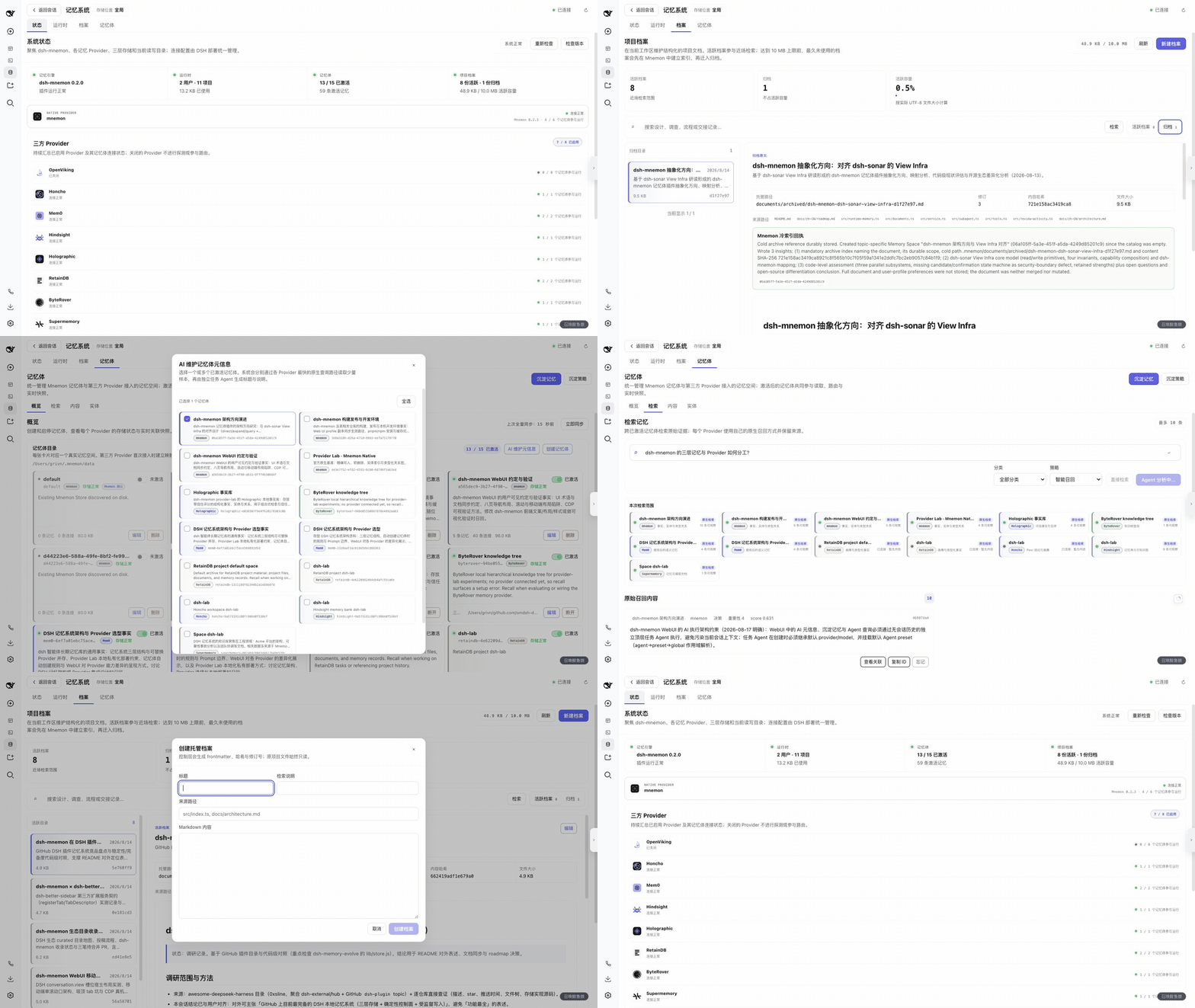
dsh-mnemon is a three-tier, pluggable, Agent-driven memory system for DeepSeek Harness, combining Runtime memory, Project Documents, and replaceable Memory Spaces with nine long-term providers.
An opinionated, zero-infrastructure file-based memory protocol: human-readable markdown files plus a bounded always-loaded index, curation discipline, and no database or embeddings.