memory-standard
Run the following command in DeepSeek Harness:
dsh plugin install JohnXu22786/memory-standard
Paste the following prompt into your AI chat to install this plugin:
To install this plugin in DeepSeek Harness, run dsh plugin install JohnXu22786/memory-standard. The source code is hosted at https://github.com/JohnXu22786/memory-standard .
About this plugin
The dsh ecosystem has dozens of memory plugins but no shared standard: formats are closed, budgets are ad hoc, truncation is silent, and agents cannot read each other notes. memory-standard (mm v1) fills that gap by anchoring memory in plain Markdown files governed by a public SPEC and a JSON Schema, so any compliant reader or writer can operate on the same set of files without a proprietary protocol.
Three pillars drive the design. First, layered memory: MEMORY.md serves as a hand-loaded index with a hard cap (200 lines / 25 KiB by default), while detailed notes live under memories/ and load on demand. Second, deterministic budgets: any write that exceeds its character budget, a note that breaches its byte cap, or an index that passes its hard cap returns a structured error that explicitly demands a rewrite; silent content loss is treated as a data-loss violation. Third, cross-agent interop via mm:/// URIs, a documented Markdown format, and an open read/write API. On top of that, mem_digest ingests official dsh session logs and compaction output to distill candidate memories for human review, entirely LLM-free and never writing automatically.
It suits dsh users who want a portable, auditable memory layer, as well as multi-agent workflows that need deterministic memory contracts. Zero runtime dependencies (Node built-ins only), and it runs both as a dsh plugin and as a standalone CLI.
Use Cases
- Providing auditable, layered memory read/write for dsh agents
- Enabling multi-agent collaboration via a shared Markdown memory format
- Distilling candidate memories from official dsh session logs and compaction output
Best For
- Developers who need a portable and auditable memory layer inside dsh
- Teams building multi-agent workflows with deterministic memory contracts
- Users who prefer plain Markdown and zero runtime dependencies
Related Plugins
Traceable, searchable cross-session memory for AI agents that turns conversation knowledge into a typed knowledge graph and recalls relevant subgraphs instead of replaying full history, natively integrated with DeepSeek Harness.
Gives DSH AI cross-session long-term memory, to-do and skill management, plus multi-session orchestration, external AI delegation, and an infinite canvas that grows with you.
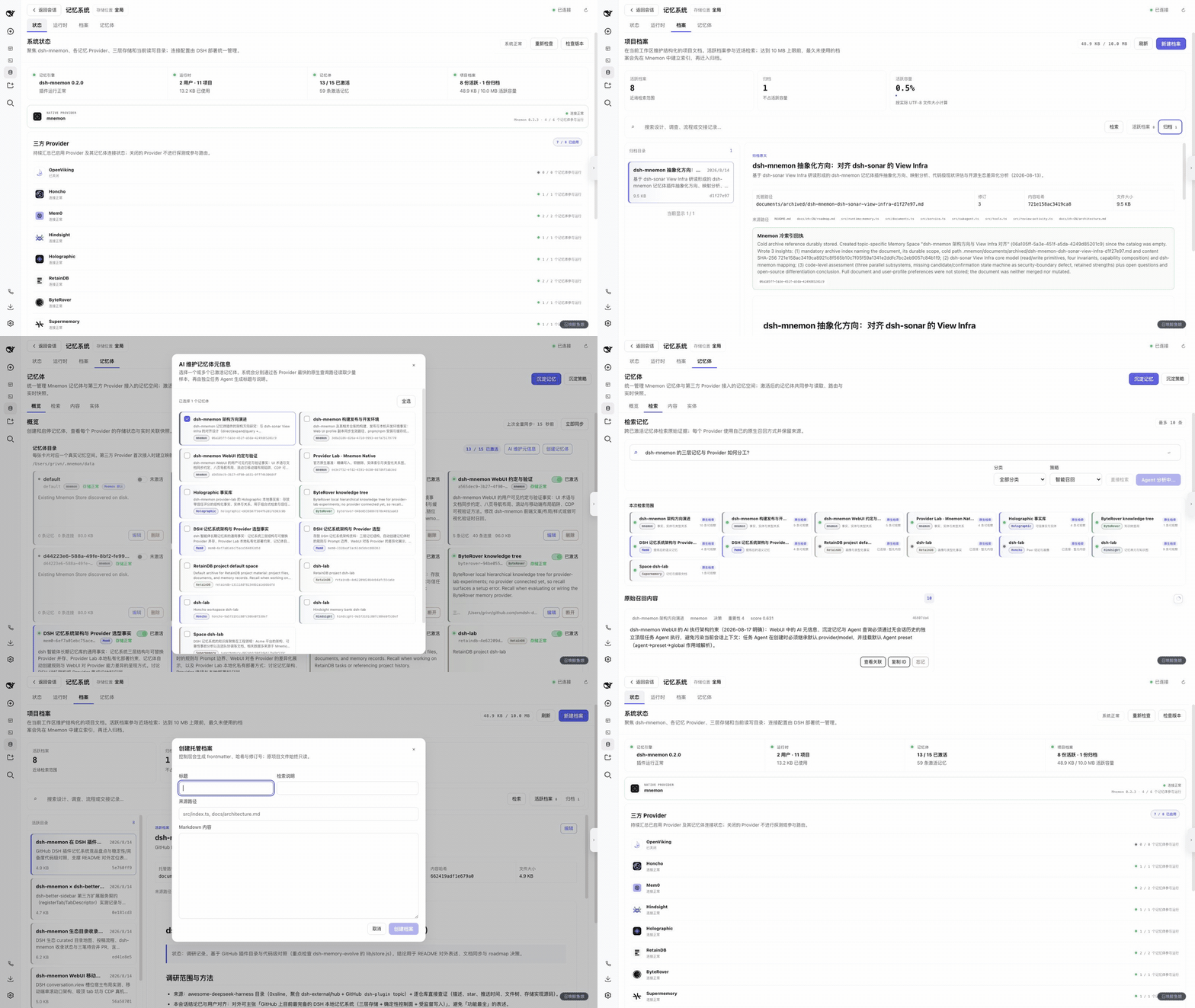
dsh-mnemon is a three-tier, pluggable, Agent-driven memory system for DeepSeek Harness, combining Runtime memory, Project Documents, and replaceable Memory Spaces with nine long-term providers.
An opinionated, zero-infrastructure file-based memory protocol: human-readable markdown files plus a bounded always-loaded index, curation discipline, and no database or embeddings.