l123-harness
Run the following command in DeepSeek Harness:
dsh plugin install reatcat/l123-harness
Paste the following prompt into your AI chat to install this plugin:
Run dsh plugin install reatcat/l123-harness in your terminal, or fetch the plugin package from https://github.com/reatcat/l123-harness and install it with dsh plugin --profile web add.
About this plugin
In AI-assisted development, agents routinely suffer from context bloat, uncontrolled reasoning drift, and an inability to accumulate knowledge across sessions. l123-harness packages a battle-tested methodology into a plugin so the host kernel stays lean while memory gating, event logging, and TDD execution are mounted as independent, swappable components. The host is the kernel; the plugin only provides capability components. Project knowledge is not baked in—it accumulates in the project itself after installation.
The core is a three-tier memory architecture: L1 (CLAUDE.md) holds stable principles, priorities, safety baselines, and a routing table as a small ever-present prefix; L2 (INDEX.md) provides fast symptom-to-rule-to-pointer indexing and is auto-injected at SessionStart; L3 (.agents/) stores knowledge, pitfalls, runbooks, current state, an immutable event log, and a weekly review inbox. Combined with gate approval for protected files (explain, obtain explicit approval, touch a gate token, then retry), zero-judgement immutable event records, periodic knowledge distillation, and TDD-driven stopping conditions, every agent action is traceable and bounded. Knowledge promotion follows a strict path—scratch into memory, weekly review into the inbox, and escalation to knowledge or L2 always requires explicit user approval, preventing silent scope creep.
The plugin ships for both Claude Code and DeepSeek Harness simultaneously, reusing the same hooks.json and four methodology skills (init-harness, event-review, tdd, write-a-skill) across both hosts. On mount it auto-registers skills into the context and bridges the official DSH hooks layer so the single hooks.json runs natively on either platform. It suits independent developers and small teams who maintain projects long-term and want their agents to behave in a traceable, progressively improving way.
Use Cases
- Accumulate project knowledge across sessions with L1-L3 layered context management
- Enforce an explain-approve-retry gate before modifying protected files
- Log immutable events and promote reviewed candidates to formal knowledge weekly
Best For
- Independent developers maintaining long-lived projects and wanting progressive agent knowledge
- Small engineering teams requiring traceable, auditable agent behavior
- Developers who use both Claude Code and DeepSeek Harness in their workflow
Related Plugins
Traceable, searchable cross-session memory for AI agents that turns conversation knowledge into a typed knowledge graph and recalls relevant subgraphs instead of replaying full history, natively integrated with DeepSeek Harness.
Gives DSH AI cross-session long-term memory, to-do and skill management, plus multi-session orchestration, external AI delegation, and an infinite canvas that grows with you.
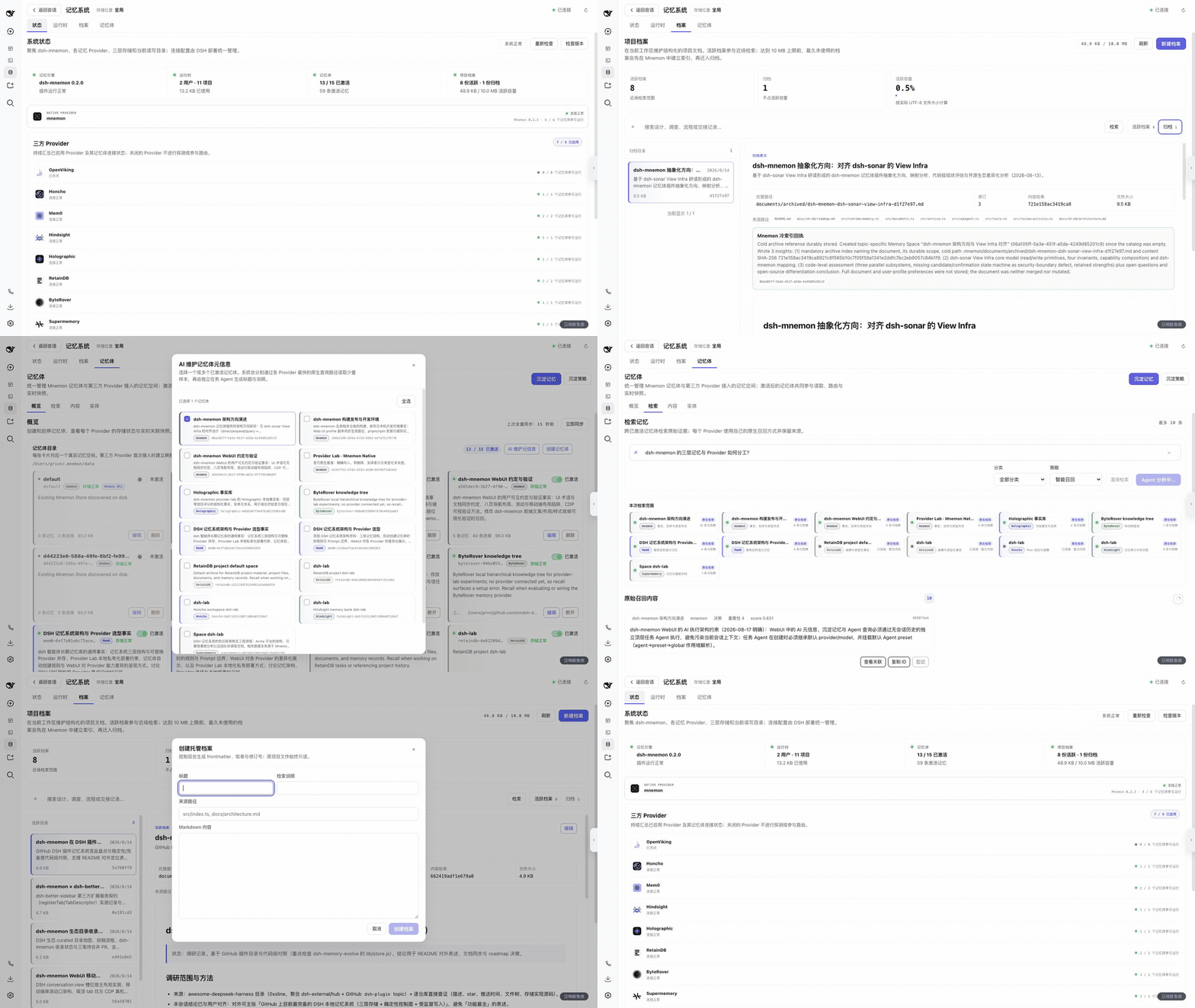
dsh-mnemon is a three-tier, pluggable, Agent-driven memory system for DeepSeek Harness, combining Runtime memory, Project Documents, and replaceable Memory Spaces with nine long-term providers.
An opinionated, zero-infrastructure file-based memory protocol: human-readable markdown files plus a bounded always-loaded index, curation discipline, and no database or embeddings.