dsh-kb-rag
Run the following command in DeepSeek Harness:
dsh plugin install YuMu247/dsh-kb-rag
Paste the following prompt into your AI chat to install this plugin:
Run dsh plugin install YuMu247/dsh-kb-rag in DeepSeek Harness to install this plugin; the full source code is available at https://github.com/YuMu247/dsh-kb-rag
About this plugin
Your local documents, notes, and crawled articles keep growing, and you want semantic search plus knowledge linking without shipping a single byte to a cloud API. dsh-kb-rag wraps a complete RAG pipeline into a DSH plugin so you can query, ingest, crawl, and relate local knowledge straight from your conversation. The plugin is a thin forwarder; the heavy lifting lives in a Python side-project that uses Ollama bge-m3 for embeddings and ChromaDB for storage, with zero npm runtime dependencies and zero API cost. Your files never leave the machine.
Four tools cover the full workflow: kb_query returns top-k chunks with source and similarity scores; kb_ingest performs manifest-hash-idempotent incremental ingestion with optional front-matter stripping; kb_crawl batch-fetches URLs into clean Markdown via Scrapling and markdownify; kb_related recommends adjacent documents through a retrieval-style or graph-style knowledge walk. Everything is invoked as a simple tool call with no need to remember underlying script flags.
It is aimed at local knowledge workers, SiYuan note-takers, and anyone who needs fully offline, privacy-preserving search and curation without surrendering their documents to a third-party service.
Use Cases
- Semantic search over a local vector DB returning top-k chunks with similarity scores
- Incremental ingestion of a docs directory with idempotent manifest checking and auto front-matter stripping
- Batch-crawl multiple URLs into clean Markdown and retrieve related-document recommendations
Best For
- Local knowledge workers who need fully offline, privacy-preserving search
- SiYuan note-takers who want to run semantic retrieval over their notes
- Researchers or engineers who refuse to send sensitive documents to third-party APIs
Related Plugins
Traceable, searchable cross-session memory for AI agents that turns conversation knowledge into a typed knowledge graph and recalls relevant subgraphs instead of replaying full history, natively integrated with DeepSeek Harness.
Gives DSH AI cross-session long-term memory, to-do and skill management, plus multi-session orchestration, external AI delegation, and an infinite canvas that grows with you.
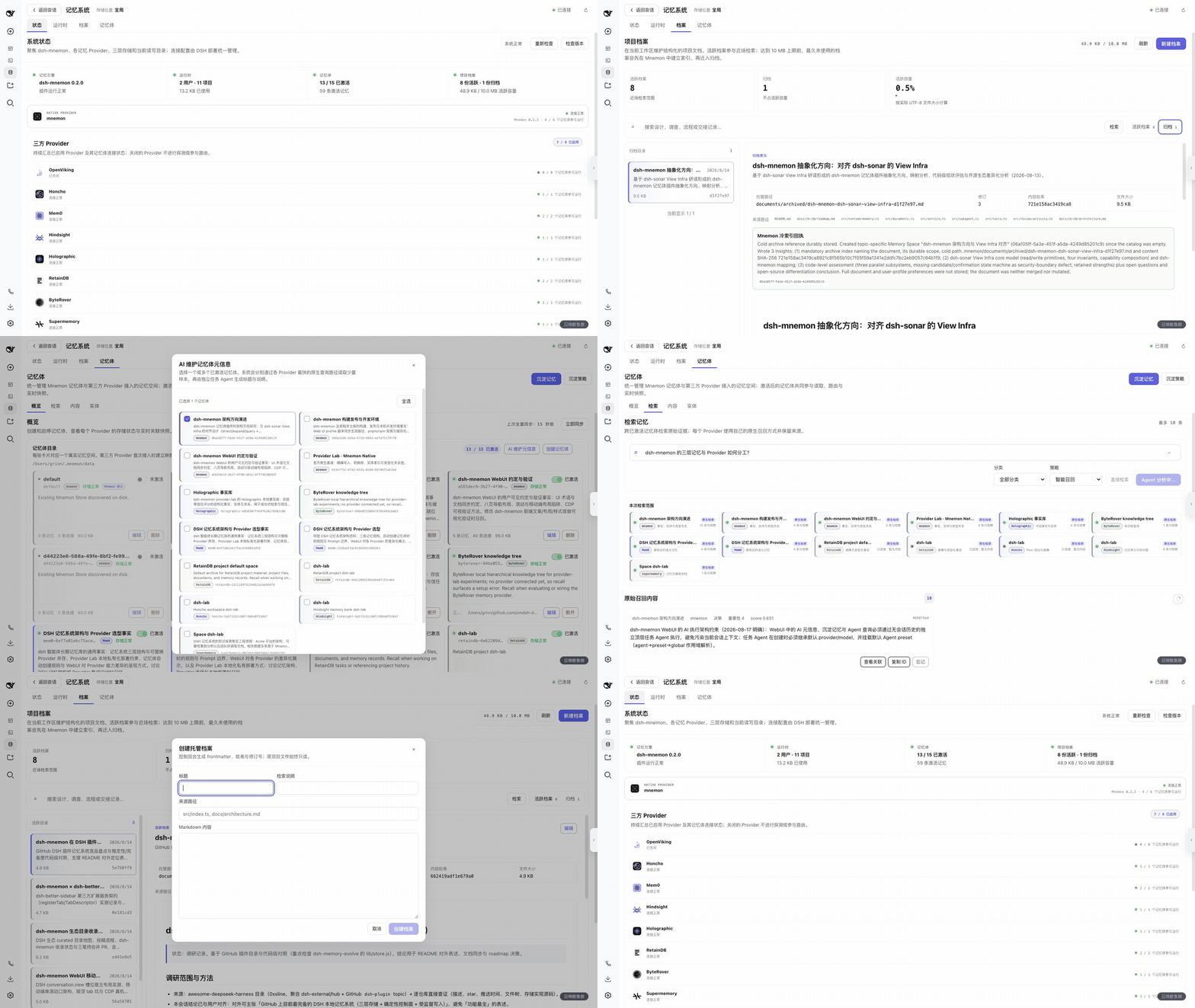
dsh-mnemon is a three-tier, pluggable, Agent-driven memory system for DeepSeek Harness, combining Runtime memory, Project Documents, and replaceable Memory Spaces with nine long-term providers.
An opinionated, zero-infrastructure file-based memory protocol: human-readable markdown files plus a bounded always-loaded index, curation discipline, and no database or embeddings.