session-reader-plugin
Run the following command in DeepSeek Harness:
dsh plugin install Artificialwhale/session-reader-plugin
Paste the following prompt into your AI chat to install this plugin:
Open the DeepSeek Harness plugin marketplace, search for session-reader-plugin, verify the repository at https://github.com/Artificialwhale/session-reader-plugin, then click Install; or run `dsh plugin install Artificialwhale/session-reader-plugin` in your terminal and restart DSH to activate it.
About this plugin
In multi-session workflows, an agent in one conversation often needs to inspect another session's context to continue a discussion, and without cross-session read access this means manual copy-paste. session-reader-plugin lets an agent read other DSH sessions directly, in a strictly read-only and bounded fashion. Core capabilities include the session_list tool (enumerate sessions by id, workspace, or archive status) and the session_read tool with four modes — io (messages and tool calls/results), thinking (reasoning chunks), surface (post-compaction model-visible messages), and raw (pre-compaction event stream). The plugin also ships /sessions list and /sessions read slash commands that produce output without consuming a model turn, making them ideal for scripted queries. Built as pure JavaScript with zero native or build dependencies, it activates automatically once installed alongside DSH. It is a natural fit for power users juggling concurrent sessions, multi-step automation pipelines that need contextual continuity, and anyone looking to break down information silos between conversations.
Use Cases
- An agent pulls tool-call results from a sibling session to keep a discussion on track
- Use /sessions read raw to dump pre-compaction events for debugging agent behaviour
- List unarchived sessions in a workspace, then pick one to inspect message or thinking mode
Best For
- Power users juggling multiple concurrent DSH sessions and needing cross-session context
- Developers building multi-step automation pipelines who want programmatic session inspection
- Researchers debugging agent reasoning and compaction who need raw event-stream access
Related Plugins
Traceable, searchable cross-session memory for AI agents that turns conversation knowledge into a typed knowledge graph and recalls relevant subgraphs instead of replaying full history, natively integrated with DeepSeek Harness.
Gives DSH AI cross-session long-term memory, to-do and skill management, plus multi-session orchestration, external AI delegation, and an infinite canvas that grows with you.
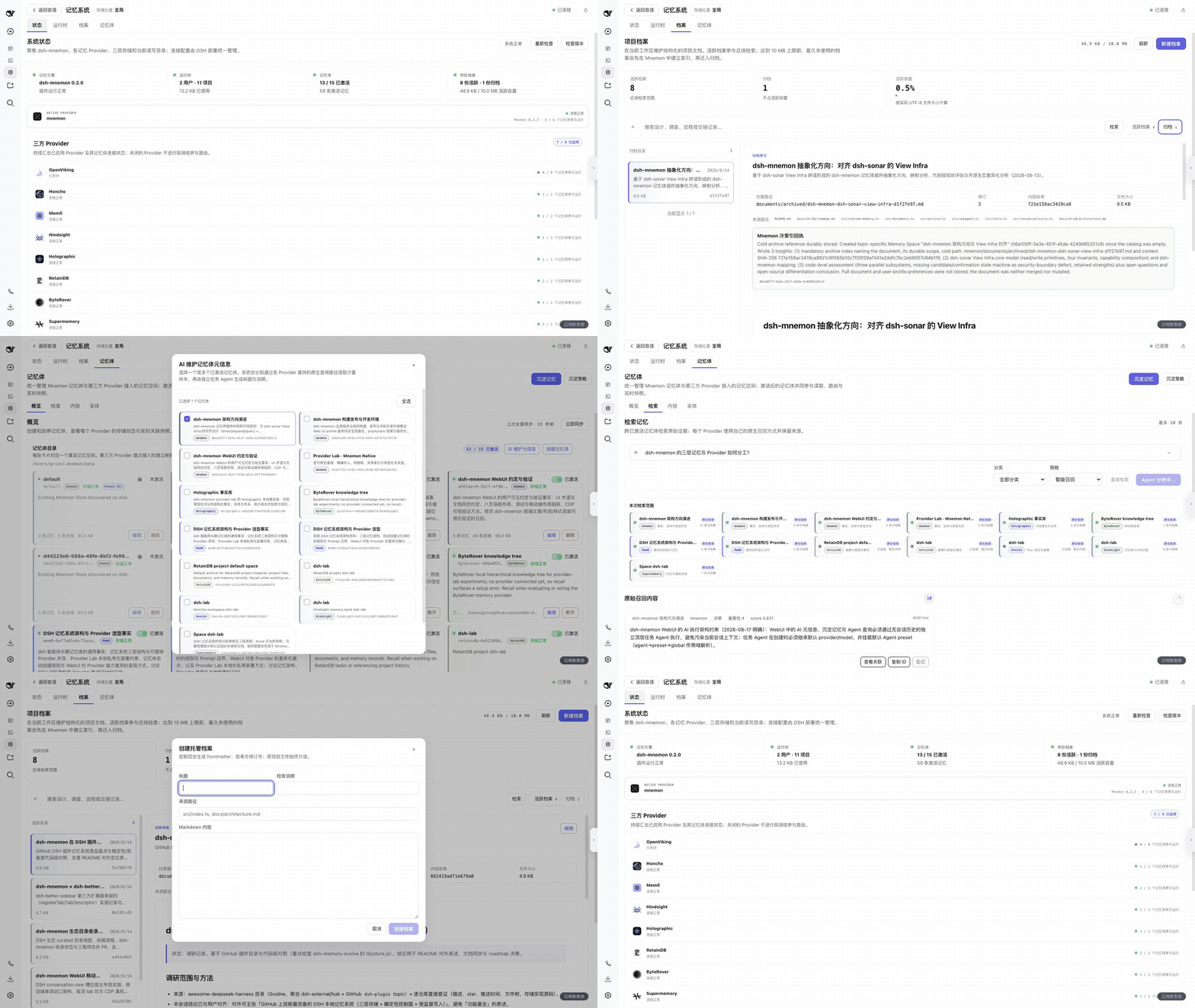
dsh-mnemon is a three-tier, pluggable, Agent-driven memory system for DeepSeek Harness, combining Runtime memory, Project Documents, and replaceable Memory Spaces with nine long-term providers.
An opinionated, zero-infrastructure file-based memory protocol: human-readable markdown files plus a bounded always-loaded index, curation discipline, and no database or embeddings.