dsh-xray
Run the following command in DeepSeek Harness:
dsh plugin install alloevil/dsh-xray
Paste the following prompt into your AI chat to install this plugin:
Run dsh plugin install alloevil/dsh-xray inside DeepSeek Harness to install the plugin; source repository: https://github.com/alloevil/dsh-xray.
About this plugin
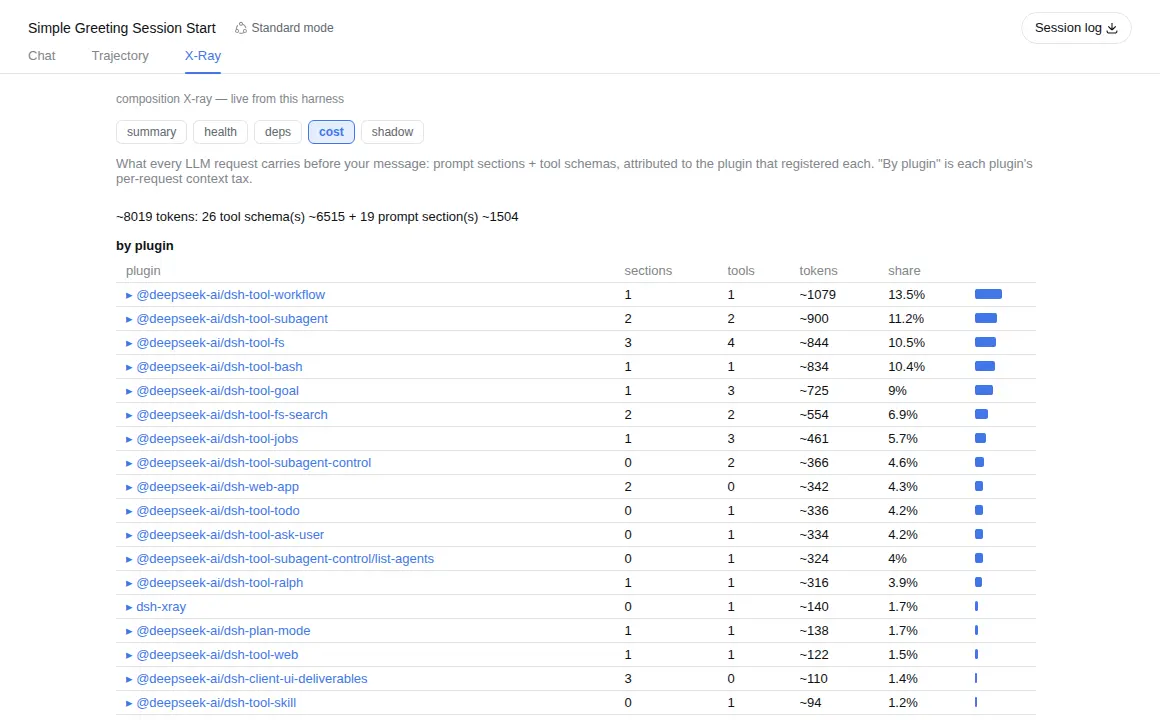
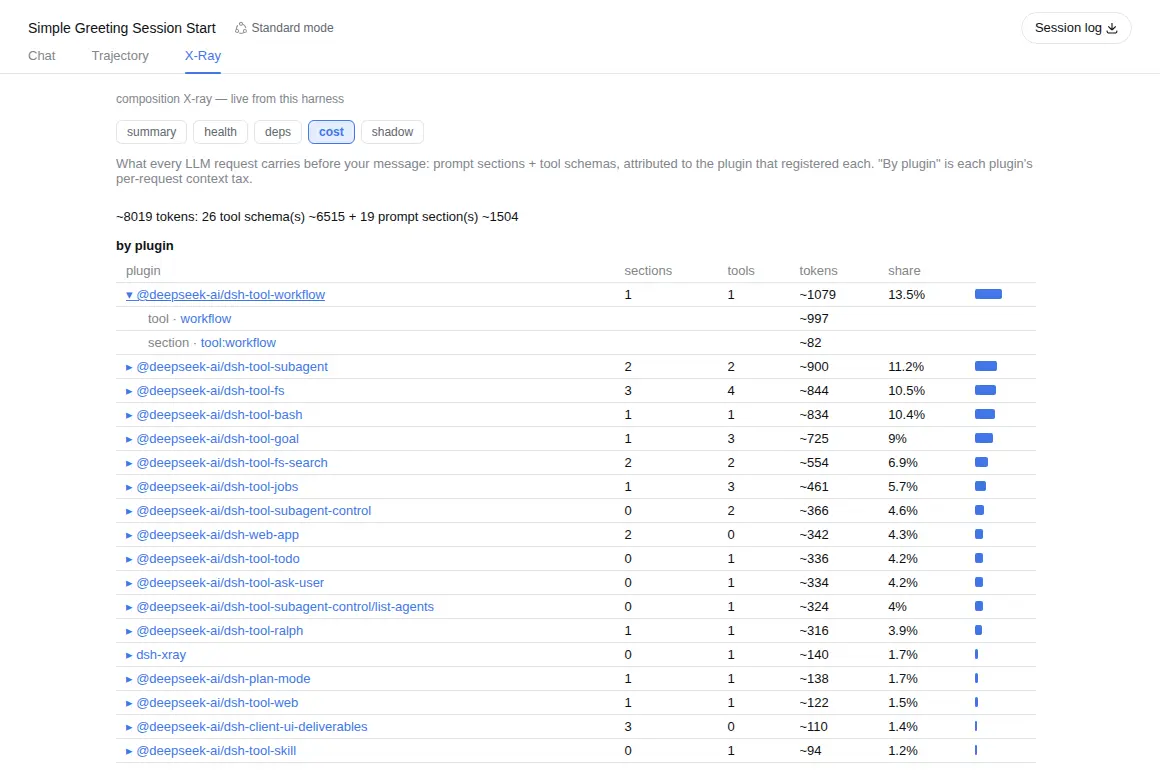
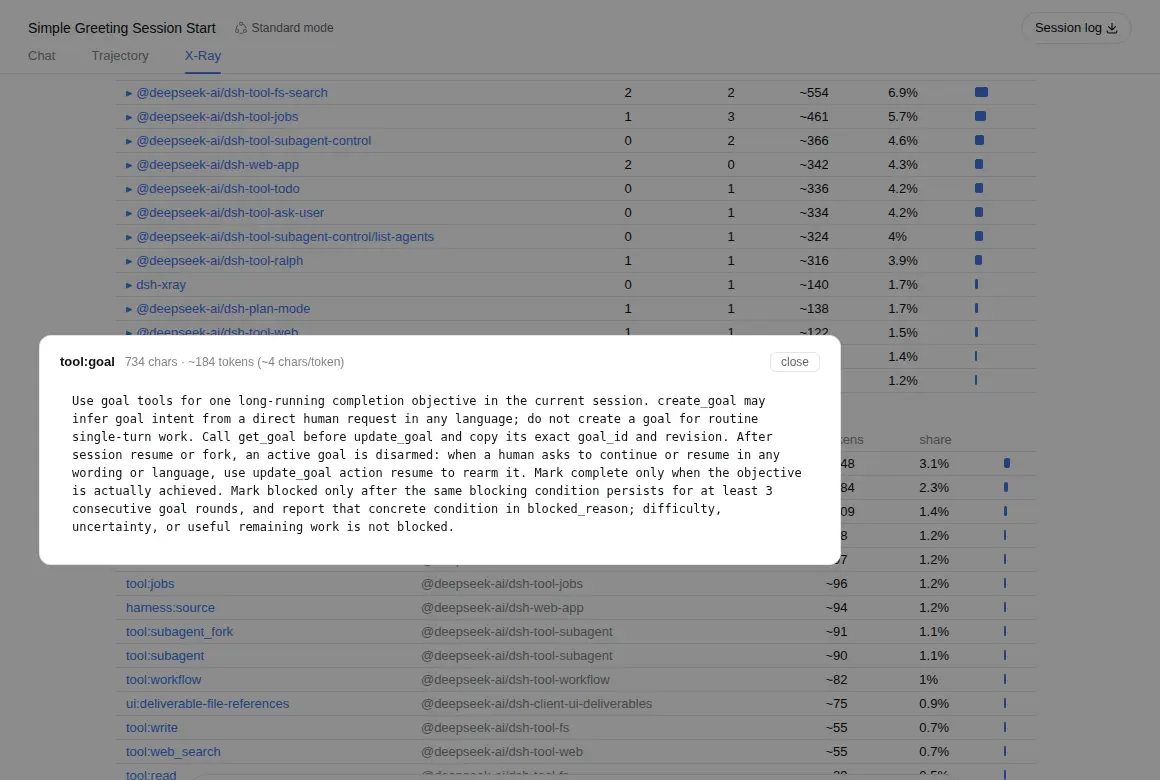
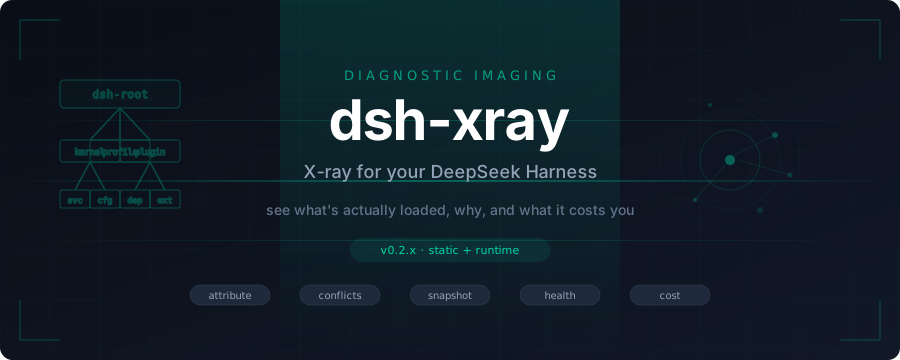
Every plugin you mount quietly bills every single LLM request—prompt sections, tool schemas, skill catalog lines, tokens stacking up silently—yet no existing tool can tell you who registered what, what it costs per request, or whether disabling it is safe. dsh-xray is that missing X-ray: a tab sitting beside Chat and Trajectory inside a running DeepSeek Harness that itemizes the context bill down to the exact text of every entry, turning a number you once trusted by default into a fact you checked in three clicks.
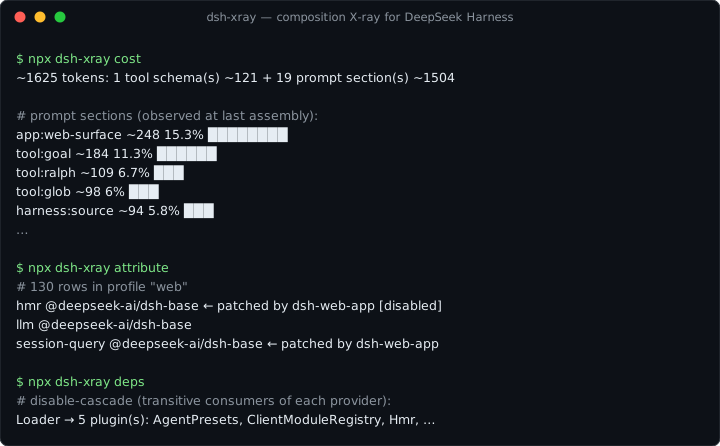
Its capabilities span the full static-to-runtime spectrum. A per-plugin rollup ranks each contributor's request tax; a dedicated skill view prices every skill twice (resident catalog line versus per-load body); a per-request ledger tags system and tools byte-stability (KV-cache-friendly versus prefix-broken) with a delta-previous growth column, while separating compaction calls from chat. Static tools—layer attribution, declared-versus-actual diff, conflict detection, composition snapshot with drift alerting, service dependency graph, and a heuristic capability audit—work even when the harness cannot boot. All surfaces (native GUI tab, standalone /xray page, CLI) carry the same data, and the mounted agent tool lets an LLM answer what it has, who provides a given service, and why a feature is unavailable, about its own composition.
It is built for DSH users managing more than a handful of plugins who want to know exactly who is taxing their context; maintainers wiring CI guards around composition drift and declared-versus-runtime mismatches (every CI-relevant command exits 1 on detection); and any team where token budgets matter enough that feels-more-expensive must become this-line-costs-312-tokens, registered-by-foo, safe-to-disable. dsh-xray only reads: it never executes plugin code, never persists session text, and its audit is a pattern scan over source, not a verdict. It hands you a clear diagnostic image, not a surgery.
Screenshots



Use Cases
- Trace the exact text and token cost each plugin injects into every LLM request
- Gate CI on composition snapshot drift and declared-vs-runtime mismatches
- Diagnose service shadowing, config-row conflicts, and transitive disable cascades
Best For
- Engineers managing multi-plugin DSH workloads with token budget concerns
- Platform maintainers guarding composition consistency in CI pipelines
- Developers who want agents to self-introspect capabilities and dependencies
Related Plugins
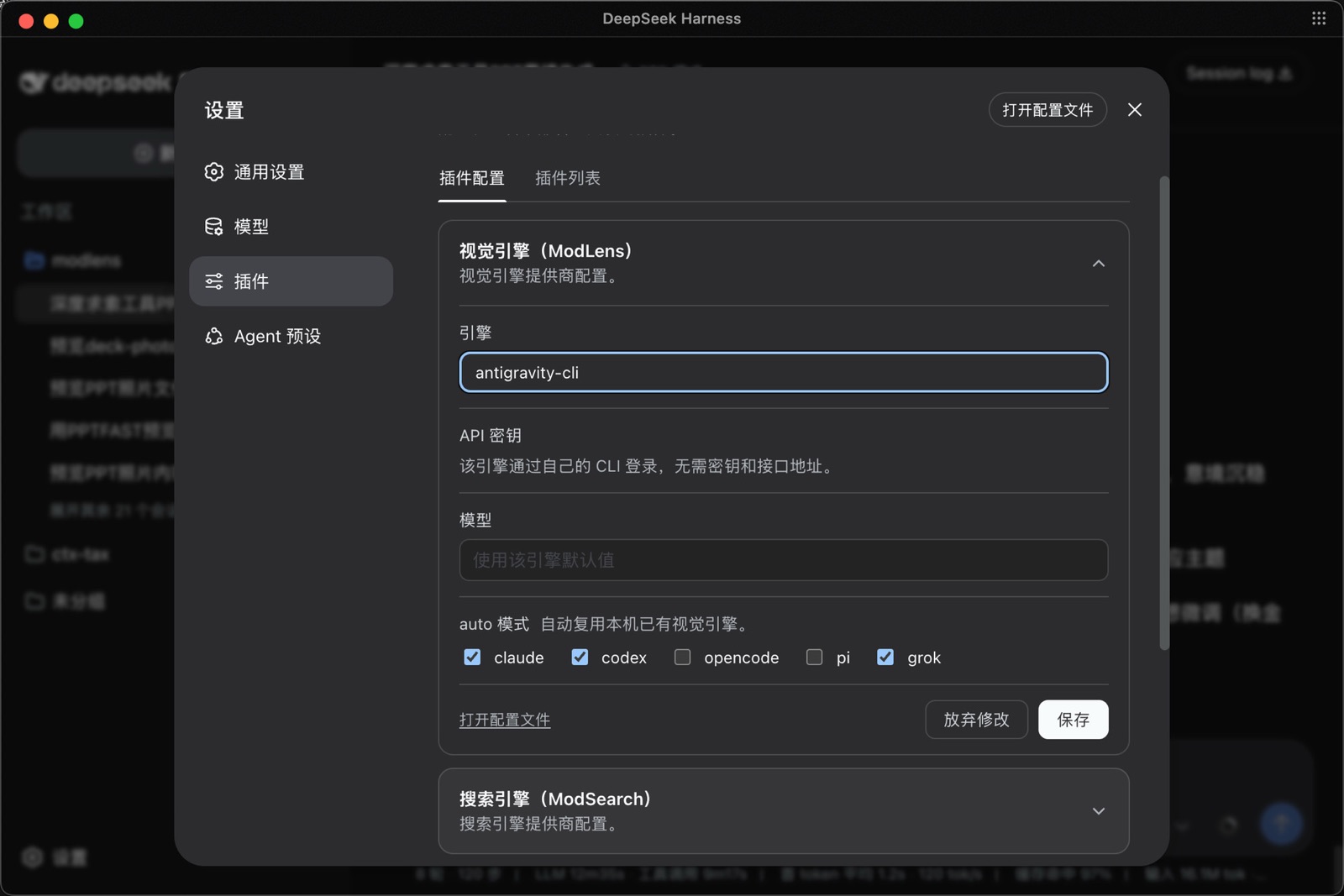
ModLens is a vision plugin for DeepSeek Harness that gives text-only models sight by reading images pasted directly into chat, with zero-config setup and multiple vision engines.
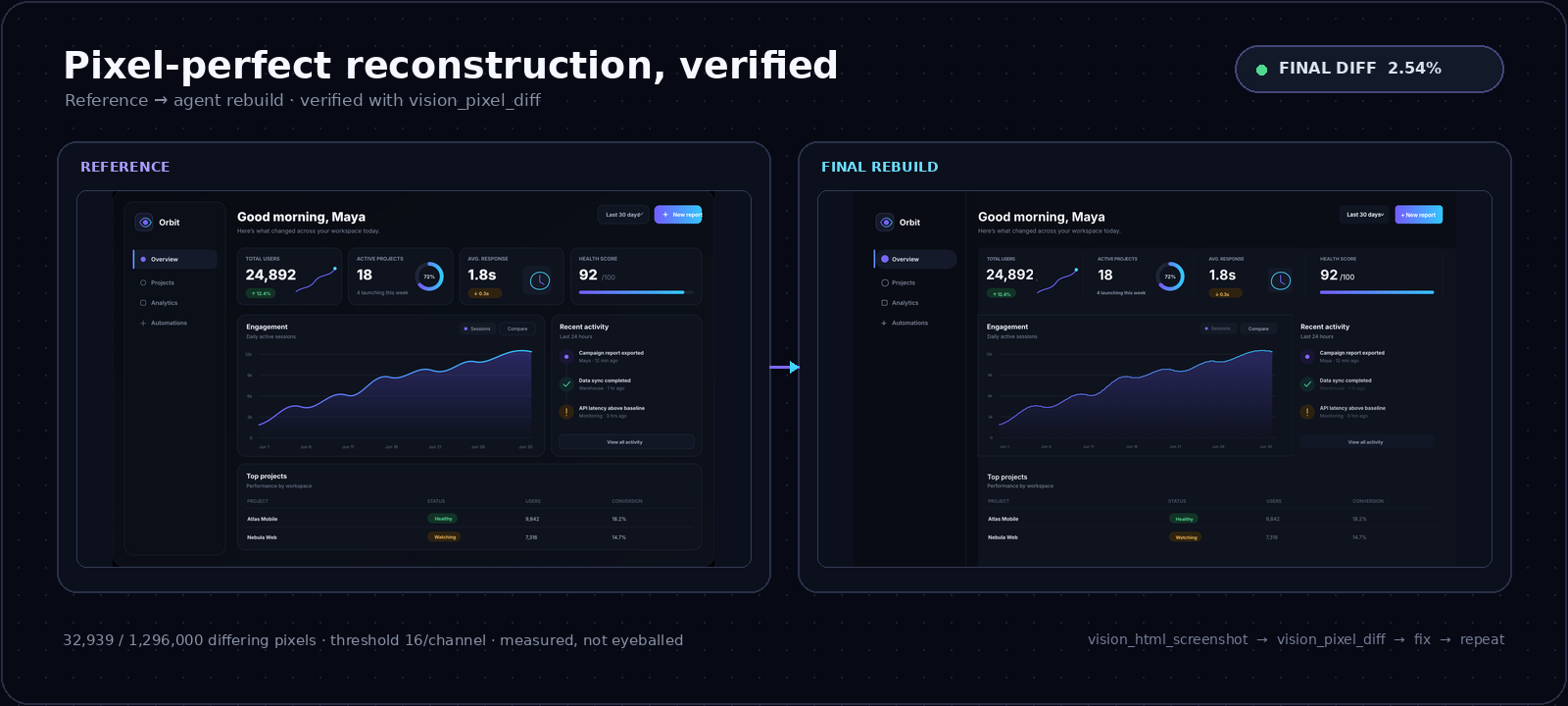
On-demand vision for text-only DeepSeek Harness agents: built-in free keyless vision chain and 14 vision tools, routing image turns as tool calls to vision models with pixel fidelity, no Python needed, one-command install.
Give text-only models in DeepSeek Harness eyes, enabling image Q&A, long-screenshot OCR, UI restoration, and GUI visual tasks.
An armor-breaking plugin for DeepSeek: rewrites instruction priority, expands refusal-blocked phrases, persists across sessions, and shows a green active indicator.