dsh-branch-visualizer
Run the following command in DeepSeek Harness:
dsh plugin install 111222cjyq/dsh-branch-visualizer
Paste the following prompt into your AI chat to install this plugin:
To install this plugin in DeepSeek Harness, run the command `dsh plugin install 111222cjyq/dsh-branch-visualizer` in your terminal. Source: https://github.com/111222cjyq/dsh-branch-visualizer
About this plugin
As you engage in complex conversations or multi-agent collaboration within DeepSeek Harness, managing the growing tree of sessions and sub-agents can become overwhelming. DSH Branch Visualizer solves this by transforming native session hierarchies into interactive, draggable tree graphs, offering a clear visual map of your dialogue evolution. It moves beyond a static list, providing a structured, navigable interface that makes tracking complex branch structures effortless.
The plugin excels as a full-featured workspace. It supports intuitive canvas operations like panning, zooming, and box selection, along with practical utilities such as node jumping, renaming, and batch archiving. With intelligent performance safeguards and state detection (running, idle, cold), it ensures smooth operation even with large datasets, making it a reliable tool for both daily session management and deep audits of conversation history.
Designed specifically for users who need granular control over dialogue histories and agent architectures. Whether you are managing long chains of dialogue, orchestrating multi-layered agents, or simply need to archive and retrieve past sessions efficiently, this visualizer is your ideal solution. By visualizing complex memory structures, it significantly reduces cognitive load, ensuring that every session jump and status check remains intuitive and accessible.
Use Cases
- Quickly visualize the complete branch structure of conversations.
- Trace execution paths across multiple sub-agents.
- Batch archive and organize large volumes of historical sessions.
Best For
- Users needing to organize complex conversation histories.
- Researchers analyzing multi-agent interaction patterns.
- Project managers managing long dialogue chains.
Related Plugins
Traceable, searchable cross-session memory for AI agents that turns conversation knowledge into a typed knowledge graph and recalls relevant subgraphs instead of replaying full history, natively integrated with DeepSeek Harness.
Gives DSH AI cross-session long-term memory, to-do and skill management, plus multi-session orchestration, external AI delegation, and an infinite canvas that grows with you.
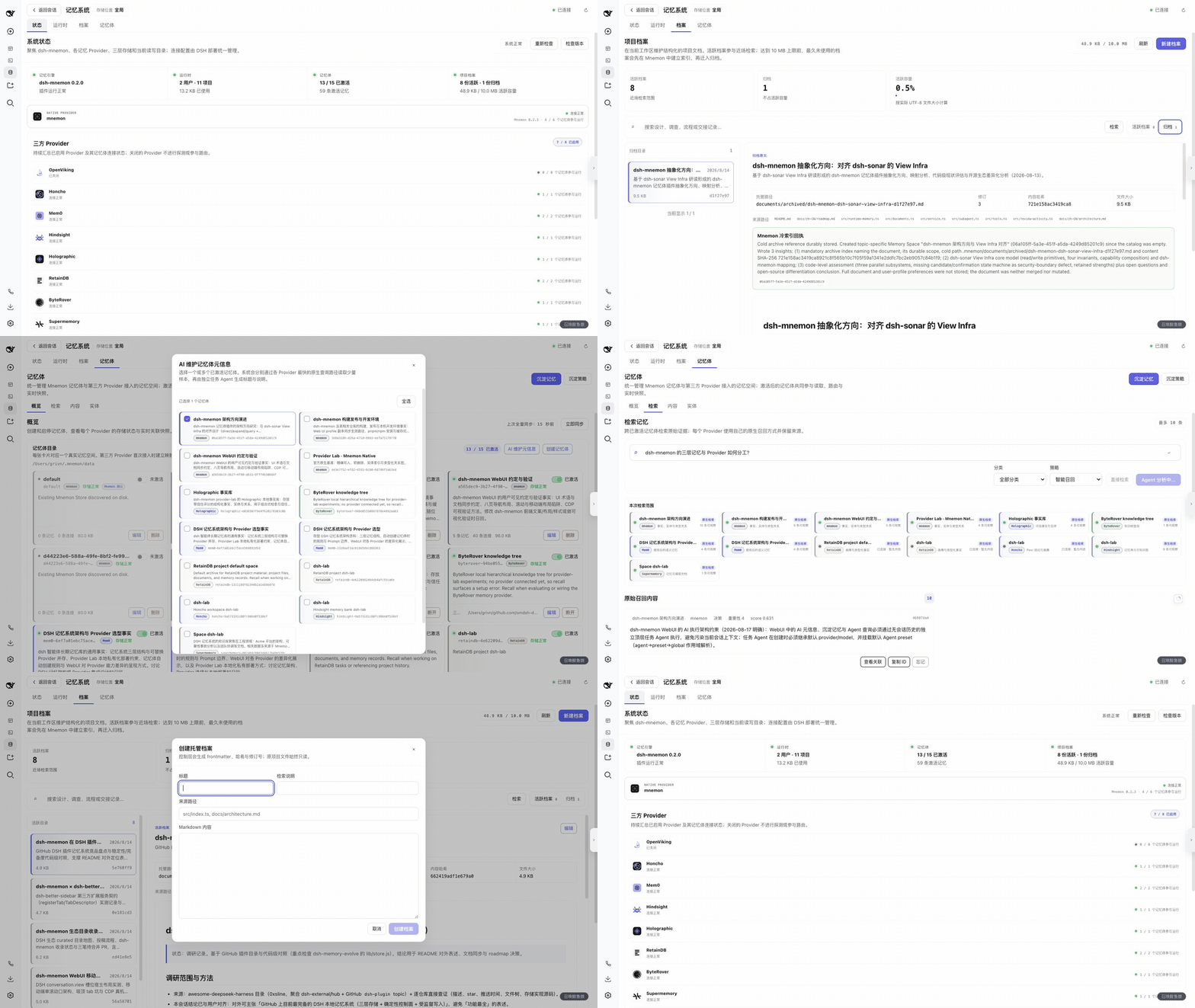
dsh-mnemon is a three-tier, pluggable, Agent-driven memory system for DeepSeek Harness, combining Runtime memory, Project Documents, and replaceable Memory Spaces with nine long-term providers.
An opinionated, zero-infrastructure file-based memory protocol: human-readable markdown files plus a bounded always-loaded index, curation discipline, and no database or embeddings.