knowlp-rag
Run the following command in DeepSeek Harness:
dsh plugin install wly8691-jpg/knowlp-rag
Paste the following prompt into your AI chat to install this plugin:
To install the KnowLP-RAG plugin in DeepSeek Harness, run the command dsh plugin install wly8691-jpg/knowlp-rag. The full source code is available at https://github.com/wly8691-jpg/knowlp-rag.
About this plugin
Managing Markdown notes often suffers from inefficient retrieval, as traditional tools like grep or naive vector stores lack contextual understanding, yielding redundant or irrelevant results. The KnowLP-RAG plugin addresses this by transforming notes into a dynamic knowledge graph through dual-graph retrieval, delivering precise reading paths and what you should read next.
Its core capabilities feature a dual-graph retrieval system: the P-Agent handles dependency chains to reveal logical connections between notes; the S-Agent offers similar substitutes, broadening search dimensions. A decay-based forgetting mechanism adjusts note weights based on usage—frequently accessed notes strengthen while unused ones decay, mimicking the "use it or lose it" learning principle. It supports Chinese notes out-of-the-box, requires no GPU, and improves via user feedback loops.
This plugin is ideal for knowledge workers who regularly use Markdown for documentation, such as developers, researchers, or content creators. Whether managing project docs, academic notes, or personal knowledge bases, it provides intelligent retrieval and substitution suggestions, minimizing search time and enhancing knowledge coherence. It's a lightweight yet powerful solution for teams or individuals seeking efficient knowledge management tools.
Use Cases
- Retrieval and correlation discovery in Markdown note vaults.
- Providing context-aware reading paths for AI tools like Claude Code.
- Implementing dynamic weight adjustment with 'use-it-or-lose-it' in knowledge management.
Best For
- Developers and programmers for managing project documentation and technical notes.
- Researchers and students for organizing academic materials and study notes.
- Knowledge workers such as content creators or project managers needing efficient knowledge retrieval.
Related Plugins

Memory layer for coding agents that indexes local session history and auto-recalls relevant context before edits, commands, and failures, with no manual search needed.
Traceable, searchable cross-session memory for AI agents that turns conversation knowledge into a typed knowledge graph and recalls relevant subgraphs instead of replaying full history, natively integrated with DeepSeek Harness.
Gives DSH AI cross-session long-term memory, to-do and skill management, plus multi-session orchestration, external AI delegation, and an infinite canvas that grows with you.
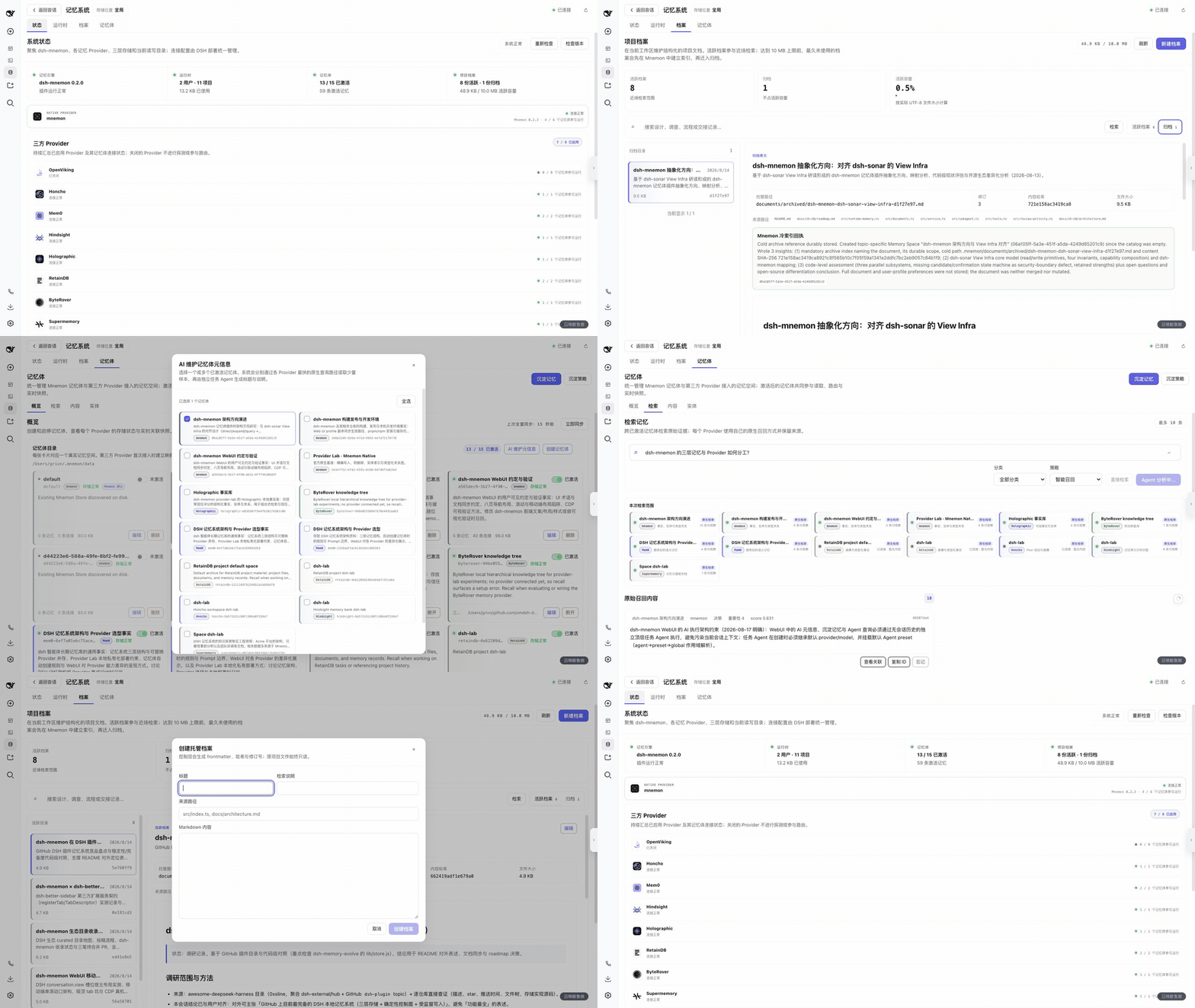
dsh-mnemon is a three-tier, pluggable, Agent-driven memory system for DeepSeek Harness, combining Runtime memory, Project Documents, and replaceable Memory Spaces with nine long-term providers.