dsh-memory
Run the following command in DeepSeek Harness:
dsh plugin install Max-Null/dsh-memory
Paste the following prompt into your AI chat to install this plugin:
To install the dsh-memory plugin in DeepSeek Harness, run the command: dsh plugin install Max-Null/dsh-memory, and refer to the project repository: https://github.com/Max-Null/dsh-memory.
About this plugin
When using DeepSeek Harness for long conversations or multi-turn tasks, models often lack persistent memory. Important context, preferences, or project consensus can be lost when a session ends, requiring constant re-iteration. The dsh-memory plugin addresses this core pain point by providing a transparent, controllable cross-session plaintext memory system. Its core capability lies in ensuring every piece of memory is clearly visible, editable, and revocable, granting the user absolute ownership over the content.
This plugin operates on the principle that 'humans are the owners.' The model can only suggest memories; they only take effect after explicit human confirmation. It uses plaintext JSON storage, eliminating 'silent reefs' and making all memory entries completely legible. For retrieval, it employs efficient BM25 algorithm (with optimized CJK search accuracy) and optionally integrates semantic vectors for fast, accurate recall. Memories are structured into a 'global' layer for personal preferences and a 'project' layer that can be shared via a repository, facilitating team consensus.
If you are a user who relies on DeepSeek Harness for in-depth creation, project development, or complex research and wants the model to reliably learn and remember your preferences, project specifications, or historical decisions—while demanding complete control over this information—then dsh-memory is an ideal choice. It transforms memory from a 'black box' into an 'open notebook,' making long-term human-AI collaboration natural and reliable.
Use Cases
- Scenarios requiring saving and retrieving project background, design decisions, or personal preferences across sessions.
- Scenarios in team collaboration where project consensus (e.g., coding standards) needs to be shared and solidified in the repository.
- Scenarios where one is skeptical of the model's autonomous memory and requires it to be fully transparent, auditable, and deletable at any time.
Best For
- Developers, researchers, or creators who need to collaborate with AI over the long term.
- Users who prioritize data privacy and control, and do not want memory to become a 'black box.'
- Professionals working on multiple projects or repositories who need to separate and manage memory for different contexts.
Related Plugins

Memory layer for coding agents that indexes local session history and auto-recalls relevant context before edits, commands, and failures, with no manual search needed.
Traceable, searchable cross-session memory for AI agents that turns conversation knowledge into a typed knowledge graph and recalls relevant subgraphs instead of replaying full history, natively integrated with DeepSeek Harness.
Gives DSH AI cross-session long-term memory, to-do and skill management, plus multi-session orchestration, external AI delegation, and an infinite canvas that grows with you.
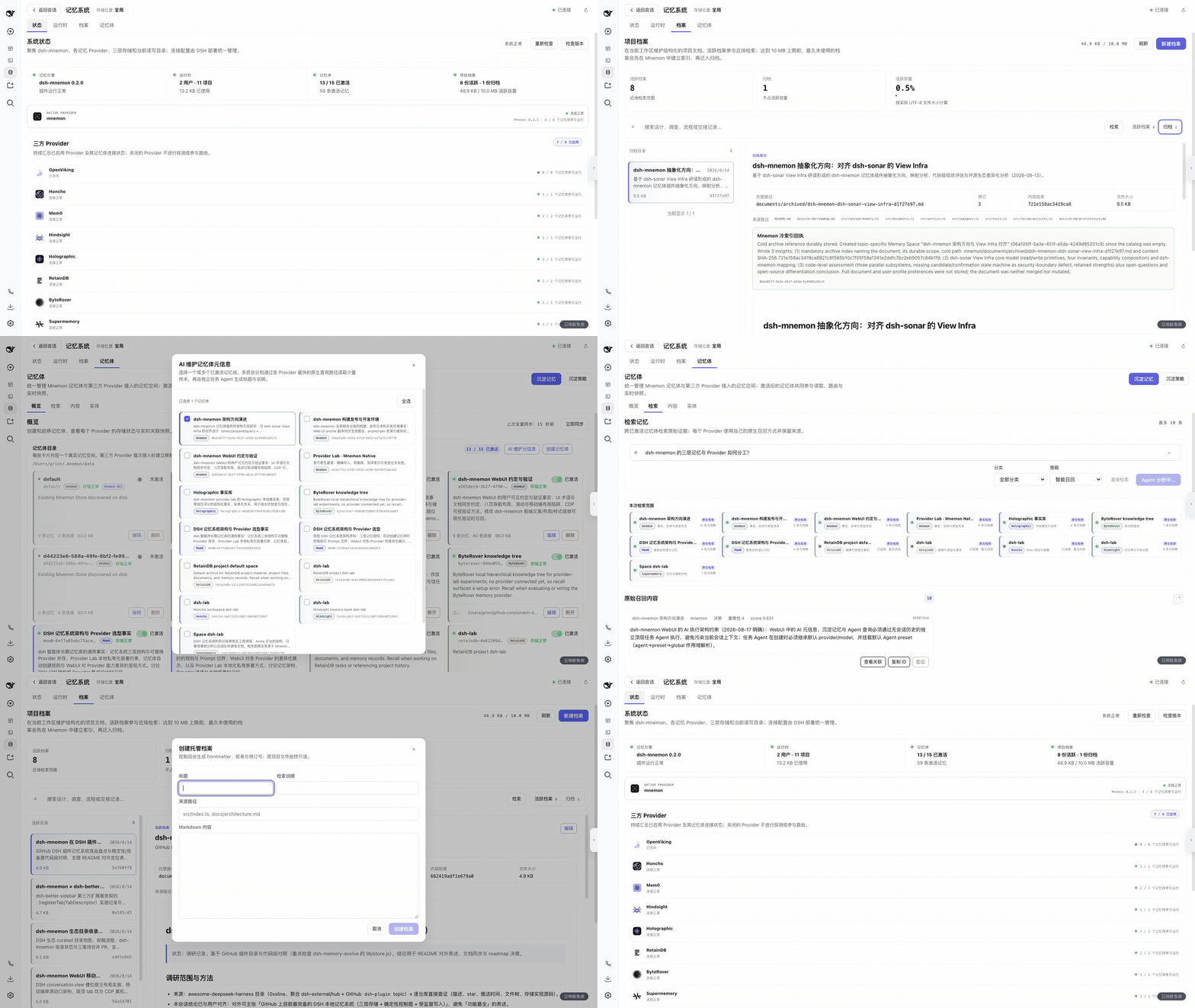
dsh-mnemon is a three-tier, pluggable, Agent-driven memory system for DeepSeek Harness, combining Runtime memory, Project Documents, and replaceable Memory Spaces with nine long-term providers.