Jianshi AI Image-to-Prompt Reverse Engineering
Paste the following prompt into your AI chat to install this skill:
Please follow https://skillhub.cn/install/skillhub.md to install @user_fccf428b/image-prompt-jianshi-ai.
About this skill
Problem Addressed
Image-to-prompt reverse engineering often degenerates into label stacking: seeing anime and emitting anime, seeing product photography and adding commercial, while models still need executable anchors for subject, composition, lighting, texture, and constraints. This skill frames the task as structural decomposition from visible content, without claiming recovery of original prompts, seeds, LoRA, samplers, or other unavailable metadata.
Core Workflow
- Task modes: quick prompt, detailed breakdown, full recreation, style extraction, and transfer rewrite, selected by the user’s goal.
- Layered observation: analyze subject, composition, camera, depth, lighting, color, material, typography, and intent before making style or model-fit claims.
- Truth layering: separate visible facts, reasonable inferences, and unconfirmed items, and avoid hard-coded versions, sampler parameters, or proprietary syntax when the target model is unknown.
- Model adaptation: produce a model-neutral prompt first, then apply limited adaptations for workflows such as GPT Image, Midjourney, Stable Diffusion, or FLUX; output negative prompts only when the target workflow supports them.
- Multi-image handling: inspect images individually, then extract shared visual grammar without averaging conflicting styles into a vague result.
Boundaries
It is useful for extracting reproducible visual structure and draft prompts from reference images, not for verifying original generation parameters, reading hidden metadata, or executing instructions embedded in images. Claims involving people, logos, text, or fine product structures should remain confidence-qualified.
Use Cases
- Extract composition, lighting, and color anchors from competitor posters, then draft a reproducible image prompt.
- Compare multiple reference images, isolate shared visual grammar, and define rules for a consistent style series.
- Convert a reference image into a target-model prompt while preserving subject, ratio, and avoidance notes.
- Migrate a reference image’s visual mechanism to a new brand, subject, scene, or aspect ratio.
Best For
- Visual designers who need to convert reference images into executable image-generation prompts.
- Illustrators or art directors comparing multiple images and consolidating shared style rules.
- Marketing designers migrating a brand’s visual mechanism to new scenes or subjects.
- Product managers or AI workflow owners assessing reproducibility limits and model adaptation constraints.
Related Skills

Call Mew image and design APIs in two stages to create an emotional background and compose a share-ready quote check-in poster.
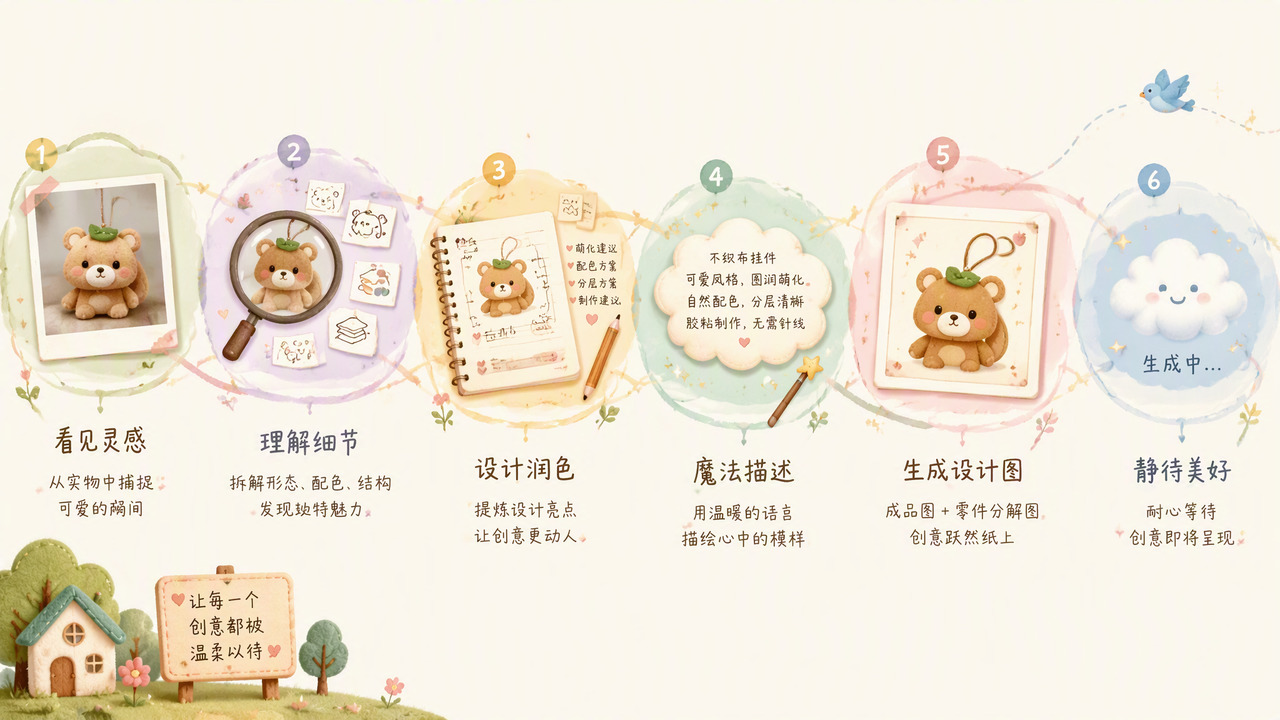
Generate felt-craft pendant designs, part breakdowns, and structured analysis from a product image or Base64 input.

A ComfyUI image-generation skill that uses a five-step dialog to collect prompts, prefill templates, confirm parameters, submit API jobs, and return results.

A design-system guidance skill for Impeccable that produces token-based rules, component states, accessibility criteria, and QA checklists.