
Local Audio to SRT Transcription Tool
Paste the following prompt into your AI chat to install this skill:
Please follow the guide at https://skillhub.cn/install/skillhub.md to install @user_af21af52/audio2srt into your AI assistant.
About this skill
Problem
Deploying an audio-to-subtitle workflow on Apple Silicon often fails less on the model and more on project setup: cloning source, installing frontend and backend dependencies, and wiring the first local run. When network access to a repository is unstable, or when the user explicitly avoids git-based deployment, manually assembling the Audio2SRT GUI is error-prone. This skill addresses that case by embedding the project templates and generating a runnable local web tool from scratch.
How It Works
The skill targets MLX Whisper transcription and Qwen translation models. It typically confirms the destination directory, then writes configuration, backend service, frontend components, and startup scripts in dependency order. It also prepares the models/ directory and ensures the startup script is executable. On launch, the workflow downloads missing models from ModelScope, starts the Python backend and the Vite frontend, and exposes a local interface for uploading audio, transcribing it, and translating the result. The key benefit is deterministic local generation from embedded templates rather than pulling and adapting an external repository.
Boundaries
It is scoped to macOS 14.0+ on Apple Silicon and assumes a Python and Node.js environment. First run requires downloading models of roughly 4GB+, so initial startup can be slow. If the user specifically wants to clone an existing Gitee project, a deploy-style skill is more appropriate. If the task is a one-off transcription without a web interface, a simpler local CLI may be better.
Use Cases
- On macOS Apple Silicon, generate a local web GUI for meeting audio that uploads, transcribes, and translates it into subtitle files.
- When cloning from Gitee is inconvenient, write embedded templates into a target directory to set up an offline-initialized transcription tool.
- Add a local audio-to-SRT step into content production, using MLX Whisper to transcribe audio and Qwen to translate the output.
- After resolving dependency or port issues, start the local 3000 frontend and 8765 backend to verify model download and transcription APIs.
Best For
- Audio/video production engineers who want to convert local recordings into editable subtitle files quickly.
- Local AI app developers who need to generate a Whisper transcription GUI offline on Apple Silicon.
- Platform engineers maintaining internal toolchains who prefer embedded templates to reduce repository cloning differences.
- Product engineers handling multilingual meeting records who want local models to transcribe speech into subtitles and translate them.
Related Skills

Call Mew image and design APIs in two stages to create an emotional background and compose a share-ready quote check-in poster.
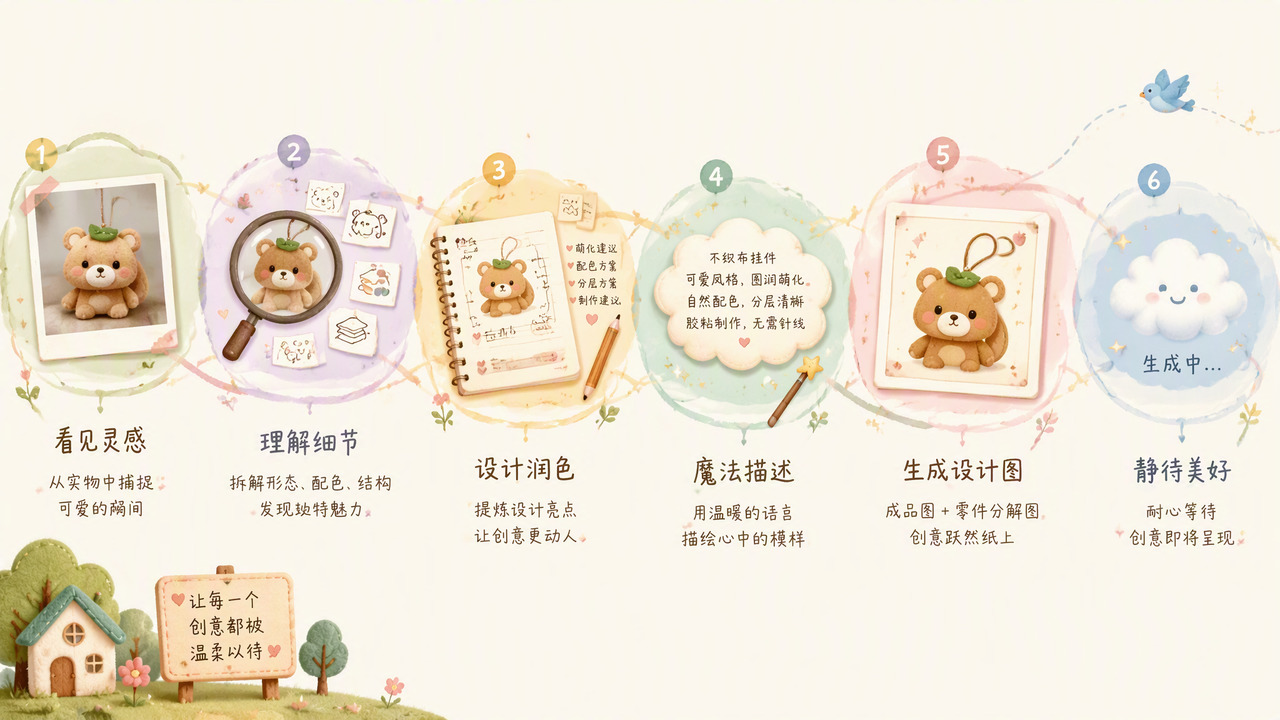
Generate felt-craft pendant designs, part breakdowns, and structured analysis from a product image or Base64 input.

A ComfyUI image-generation skill that uses a five-step dialog to collect prompts, prefill templates, confirm parameters, submit API jobs, and return results.

A design-system guidance skill for Impeccable that produces token-based rules, component states, accessibility criteria, and QA checklists.