dsh-rescue
Run the following command in DeepSeek Harness:
dsh plugin install Iliyasfiel/dsh-rescue
Paste the following prompt into your AI chat to install this plugin:
Run dsh plugin install Iliyasfiel/dsh-rescue in your terminal to install this plugin (source code: https://github.com/Iliyasfiel/dsh-rescue).
About this plugin
DeepSeek Harness plugins are declared as bundle patch layers in a profile manifest and load in strict order at boot with fail-loud semantics — a single broken third-party bundle refuses the entire profile. After a version upgrade, inter-plugin conflicts are a realistic risk, and at that point the GUI simply will not open, leaving no in-app interface to triage the problem. dsh-rescue is the escape route for exactly that dead end.
Its mechanism is deliberately simple: it operates outside the plugin stack and edits the profile manifest directly, stripping every third-party bundle layer (in-box core layers are always kept) so DSH can boot on a pure core and self-repair. Once the fix is done, a single exit command restores the original stack. The process is transactional — a backup and state file are written before the manifest is touched, and a failed rewrite rolls back cleanly. Reconciliation on exit ensures that any plugin you manually removed during the rescue window stays removed rather than being resurrected into an unresolvable layer. It runs on plain Node with zero dependencies and works fully offline.
If you maintain multiple third-party DSH plugins, follow version upgrades closely, or work in offline environments, dsh-rescue is a quiet safety net: it changes no plugin configuration, introduces no extra runtime, and simply gives you one reliable path back to a working desktop when everything else has failed.
Use Cases
- A version upgrade causes third-party plugin conflicts and the DSH GUI fails to boot entirely
- The plugin stack is corrupted in an offline environment with no network for normal repair
- You need to quickly strip faulty bundle layers and restore core functionality
Best For
- Developers who maintain multiple third-party DSH plugins
- Users running DSH in offline or restricted-network environments
- Ops engineers seeking a zero-dependency, transactional self-recovery workflow
Related Plugins
A service-oriented sidebar framework for DSH, offering a full workbench with file explorer, embedded browser, real terminal, Git panel, and extensible plugin services.
A beautiful, practical Claude Code-style TUI plugin with pixel whale top bar, flowing glow title, real-time status line, streaming thought expansion, time rewind, context progress bar and TPS gauge — zero core changes.
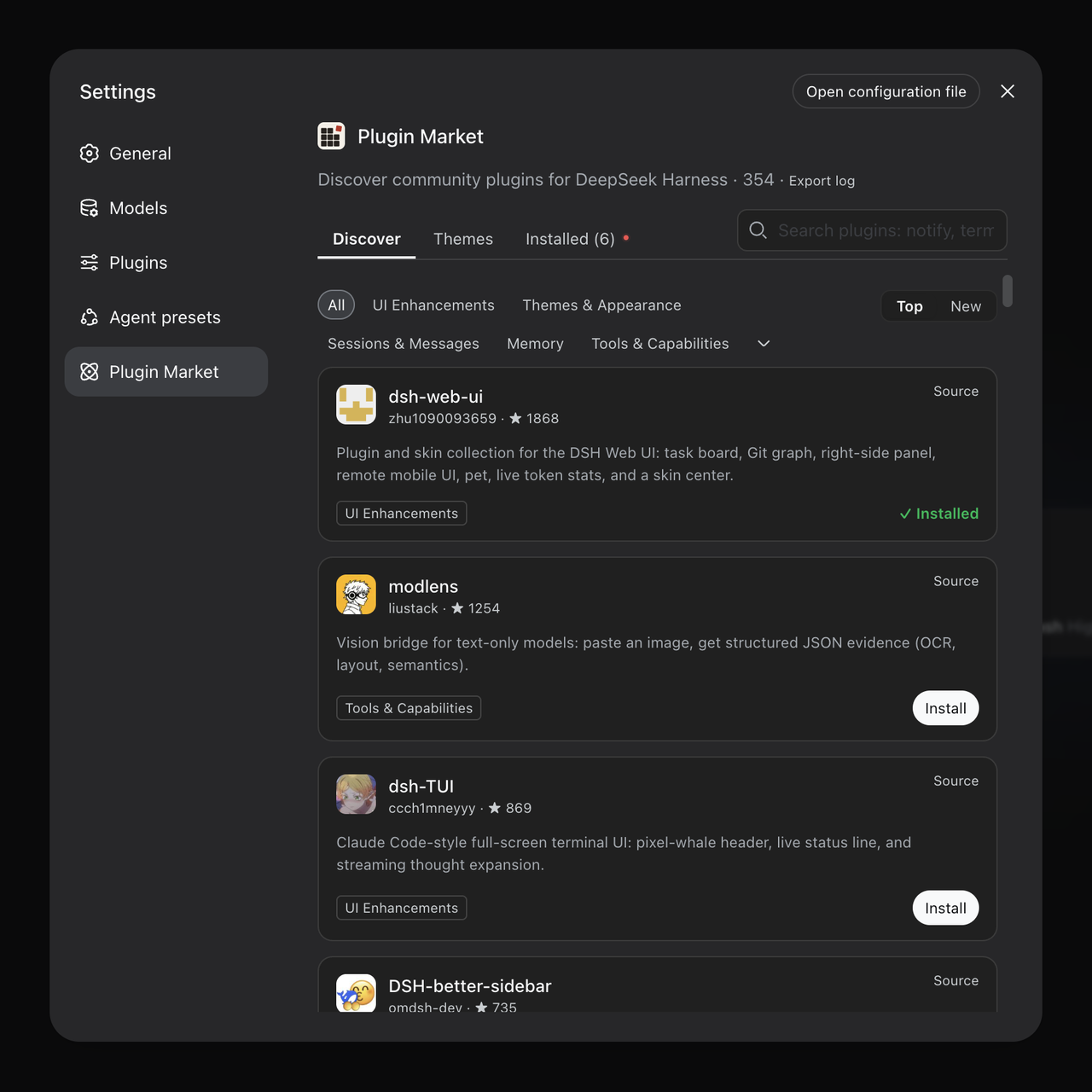
The plugin market for DeepSeek Harness: browse/search/one-click install community plugins and themes, with updates, backup/restore, hot disable, diagnostics, and AI fix.

A persistent whale widget on the DSH web UI that shows DeepSeek balance, today's usage, and per-turn cost, with drag-and-snap and sound effects.