cordis-plugin-graph
Run the following command in DeepSeek Harness:
dsh plugin install cordisplugins/cordis-plugin-graph
Paste the following prompt into your AI chat to install this plugin:
Install this plugin in DeepSeek Harness by running dsh plugin install cordisplugins/cordis-plugin-graph; the full source code is available at https://github.com/cordisplugins/cordis-plugin-graph .
About this plugin
Cordis plugin composition is far more intricate at runtime than a static package dependency tree can convey. Which provider actually resolved a given inject, which Loader entries were manually disabled, and how tool calls flow through plugin fibers during an agent task—none of this is visible in an npm graph. cordis-plugin-graph addresses exactly this gap: it adds a Plugin graph tab under Settings → Plugins that renders the live Cordis runtime as a zoomable, interactive Cytoscape visualization.
The graph offers a two-plane toggle. The client plane inspects the renderer context in-process—every dsh-client-ui-* plugin, the slot renderer, connection, theme, locale, and settings. The host plane polls a same-origin route to expose the engine context: sessions, agents, tools, model adapters, and persistence, degrading gracefully to client-only where no web server is reachable. Nodes represent plugin fibers, coloured by lifecycle phase (active, pending, loading, failed, unloading, disposed, disabled) and sized by the number of services provided. Edges are individually toggleable: requires (hard inject to the resolving fiber), provides to (its reverse), and nested in (Loader-tree composition). While the host plane is active, a live feed of recent tool executions drives a pulse animation on the corresponding tool node, so running an agent task lets you watch it traverse the graph in real time.
The plugin relies exclusively on upstream public APIs—settings.plugins.tab, the @deepseek-ai/cordis context interface, and optional tools / webServer scoped injects—making it portable across any web-profile deployment, whether ACRYL Desktop or stock DSH Desktop. It is built for Cordis developers and architects who need to trace inject resolution paths, understand Loader composition hierarchies, or observe inter-plugin collaboration while an agent task is executing.
Use Cases
- Trace inject resolution paths to see which provider actually resolved each dependency
- Watch tool calls flow through plugin fibers in real time while an agent task runs
- Understand Loader composition hierarchy and current lifecycle state of every plugin
Best For
- Engineers developing or maintaining Cordis plugins
- Architects debugging inject resolution and Loader composition hierarchies
- Maintainers investigating plugin lifecycle failures or unexpected runtime states
Related Plugins
A service-oriented sidebar framework for DSH, offering a full workbench with file explorer, embedded browser, real terminal, Git panel, and extensible plugin services.
A beautiful, practical Claude Code-style TUI plugin with pixel whale top bar, flowing glow title, real-time status line, streaming thought expansion, time rewind, context progress bar and TPS gauge — zero core changes.
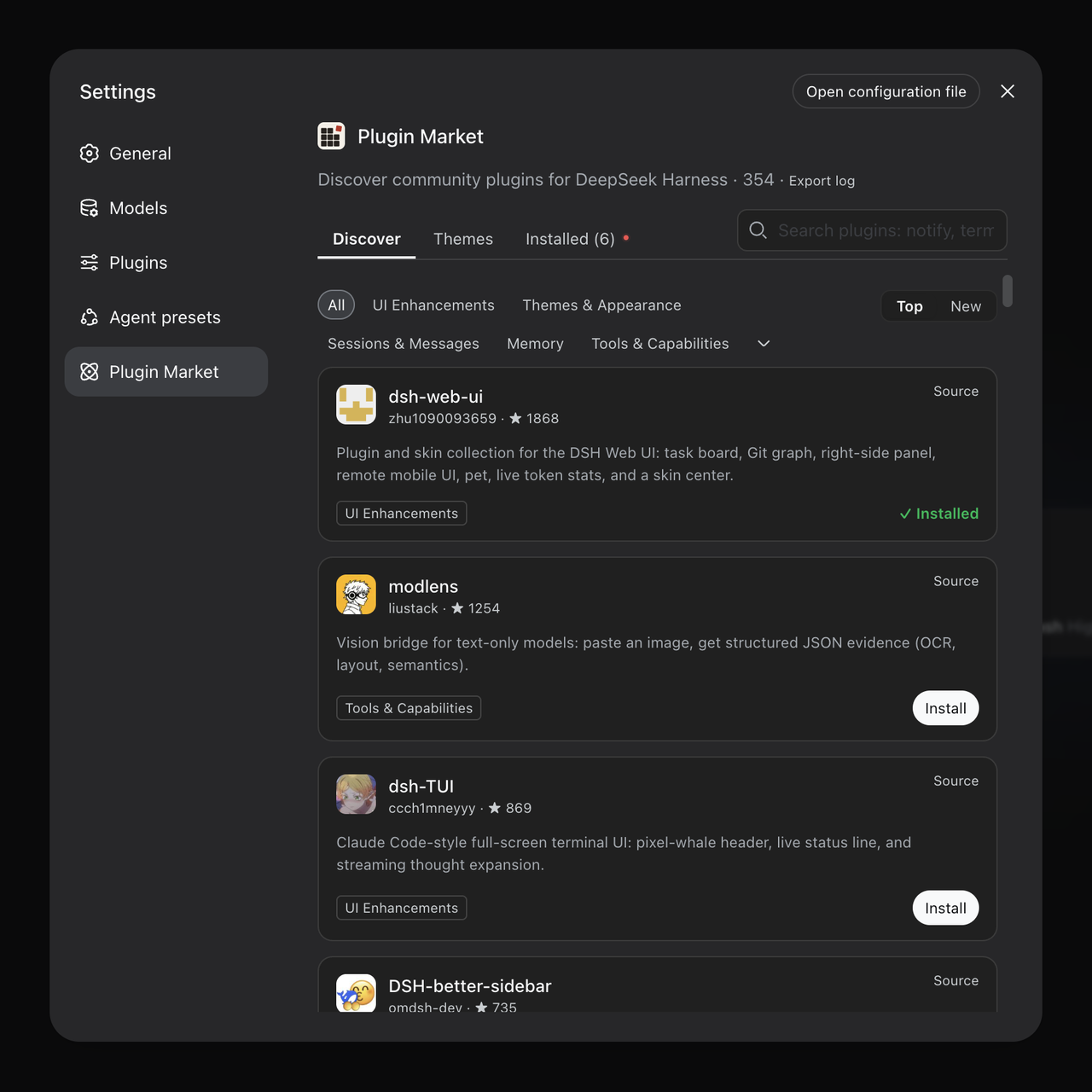
The plugin market for DeepSeek Harness: browse/search/one-click install community plugins and themes, with updates, backup/restore, hot disable, diagnostics, and AI fix.

A persistent whale widget on the DSH web UI that shows DeepSeek balance, today's usage, and per-turn cost, with drag-and-snap and sound effects.