dsh-workspace-merge
Run the following command in DeepSeek Harness:
dsh plugin install LoserForLoser/dsh-workspace-merge
Paste the following prompt into your AI chat to install this plugin:
In DeepSeek Harness, run dsh plugin install LoserForLoser/dsh-workspace-merge in the terminal to install this plugin; the source repository is available at https://github.com/LoserForLoser/dsh-workspace-merge .
About this plugin
A DSH session is anchored to exactly one working directory, yet in practice the PC and mobile clients of one product, an iOS app and its HarmonyOS twin, or a shared library and its consumers, tend to live in sibling directories. Making the same relative-path change in two repos quickly degenerates into absolute paths and repeated calls that silently drift apart.
This plugin introduces a named workspace group — an ordered list of local project roots — and eight ws_* tools (ws_ls, ws_read, ws_diff, ws_edit, ws_write, ws_groups, ws_group_set, ws_group_remove). You supply one relative path and the plugin executes the same operation across every root in the group, returning an explicit per-root status: changed, unchanged, not-found, denied, and more. A partial application is always visible, never swallowed. ws_edit follows the built-in edit rule, both ws_edit and ws_write support dry_run for preview, and you can narrow a call to a single project by root id.
If you maintain two or three sibling repositories that must stay in step, and you want one logical change to land in all of them in a single step without bypassing the DSH sandbox policy or the fs-observation event stream, this plugin is built for that workflow.
Use Cases
- PC and mobile clients of one product must be modified in lockstep
- iOS and HarmonyOS apps of the same product need step-synchronized updates
- A shared library and its consumers live in adjacent sibling directories
Best For
- Front-end or full-stack developers maintaining multiple sibling repositories
- Engineering teams managing cross-platform product lines (dual OS, multi-target)
- Shared-library authors serving multiple downstream consumers
Related Plugins
A service-oriented sidebar framework for DSH, offering a full workbench with file explorer, embedded browser, real terminal, Git panel, and extensible plugin services.
A beautiful, practical Claude Code-style TUI plugin with pixel whale top bar, flowing glow title, real-time status line, streaming thought expansion, time rewind, context progress bar and TPS gauge — zero core changes.
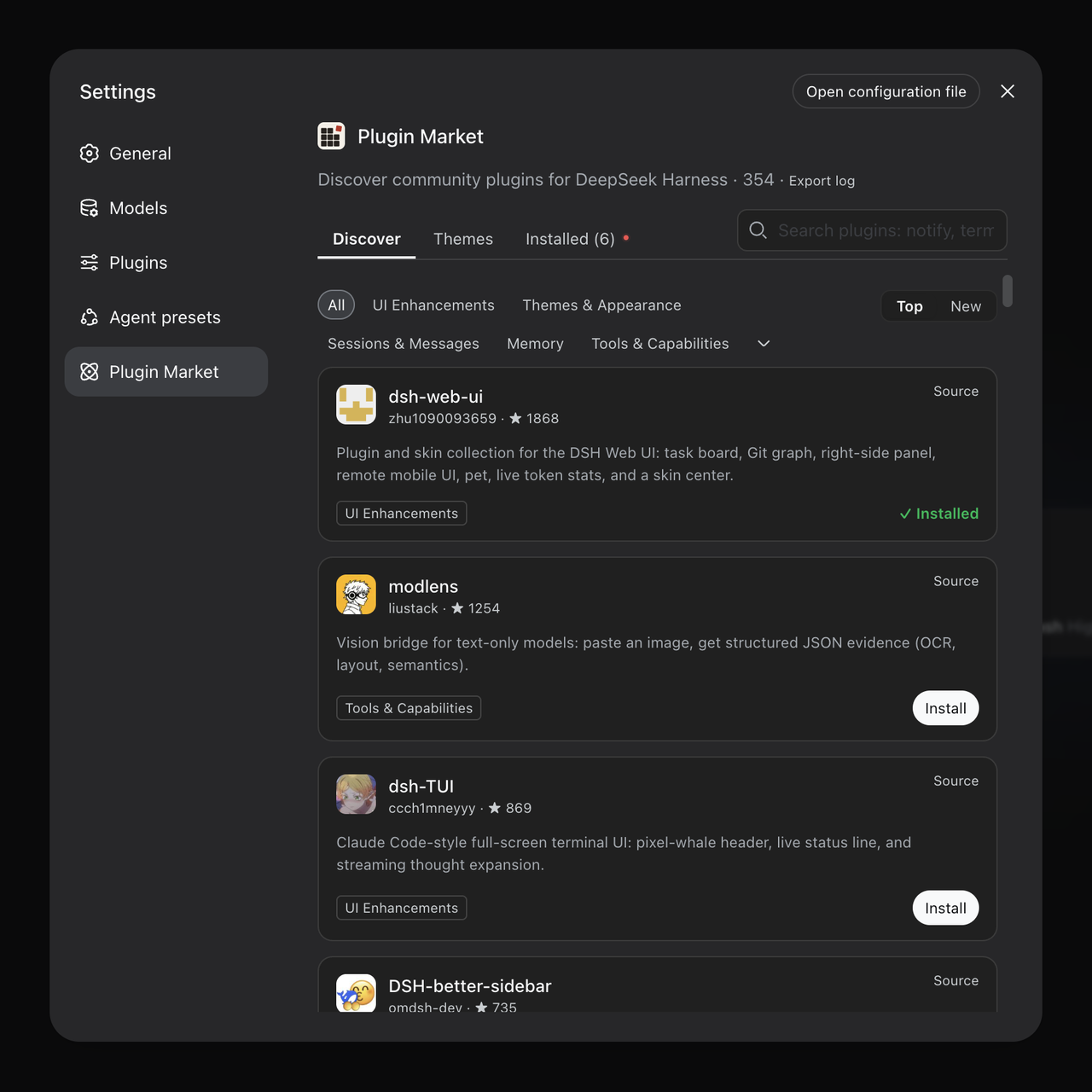
The plugin market for DeepSeek Harness: browse/search/one-click install community plugins and themes, with updates, backup/restore, hot disable, diagnostics, and AI fix.

A persistent whale widget on the DSH web UI that shows DeepSeek balance, today's usage, and per-turn cost, with drag-and-snap and sound effects.