dsh-accounts-ui
Run the following command in DeepSeek Harness:
dsh plugin install kexuejin/dsh-accounts-ui
Paste the following prompt into your AI chat to install this plugin:
Run dsh plugin install kexuejin/dsh-accounts-ui in the DeepSeek Harness terminal to install this plugin; the source code is hosted at https://github.com/kexuejin/dsh-accounts-ui
About this plugin
dsh-accounts manages local credentials such as API keys and TOTP secrets, but it ships only the host side with no dsh.client declaration, so its admin page is a standalone loopback URL you must bookmark and open by hand. Packages like dsh-mnemon and dsh-im all register a settings.section and appear in the Settings sidebar out of the box; dsh-accounts-ui closes that gap by rendering account management natively inside the DSH Settings panel using the framework's Button, Input, Modal, Tag, and StateDot primitives, with theming driven by --dsw-alias-* tokens that adapt to light and dark mode automatically.
The UI covers the full account lifecycle: a list showing id, description, type, domain, TOTP, and a human-readable status; create and edit flows with masked password fields and records pre-filled by id; a two-step confirmation on delete; and write controls that auto-disable under read-only storage. All reads and writes go through dsh-accounts' own /dsh-accounts/api same-origin endpoint with loopback Host and origin checks enforced at the API layer, so credential values never leave the browser.
Ideal for users who already have dsh-accounts installed and want to manage credentials right in the Settings panel, the same way they manage mnemonics or IM bots. Keep in mind this is a transitional patch: the upstream dsh-accounts package is merging its own native settings section (yangwuan55/dsh-accounts#1). Once that lands, uninstall this plugin to avoid two duplicate Accounts entries in the sidebar.
Use Cases
- Create, edit, and delete API keys and TOTP credentials right inside the DSH Settings panel
- Eliminate the need to bookmark and open a standalone loopback admin page
- Browse account lists safely under read-only storage without accidental writes
- Inherit the Settings panel light and dark theme automatically via design tokens
Best For
- Users who already run dsh-accounts and want in-panel credential management
- Developers who prefer not to remember a separate admin URL
- Users in the transition window before upstream ships its native settings section
Related Plugins
A service-oriented sidebar framework for DSH, offering a full workbench with file explorer, embedded browser, real terminal, Git panel, and extensible plugin services.
A beautiful, practical Claude Code-style TUI plugin with pixel whale top bar, flowing glow title, real-time status line, streaming thought expansion, time rewind, context progress bar and TPS gauge — zero core changes.
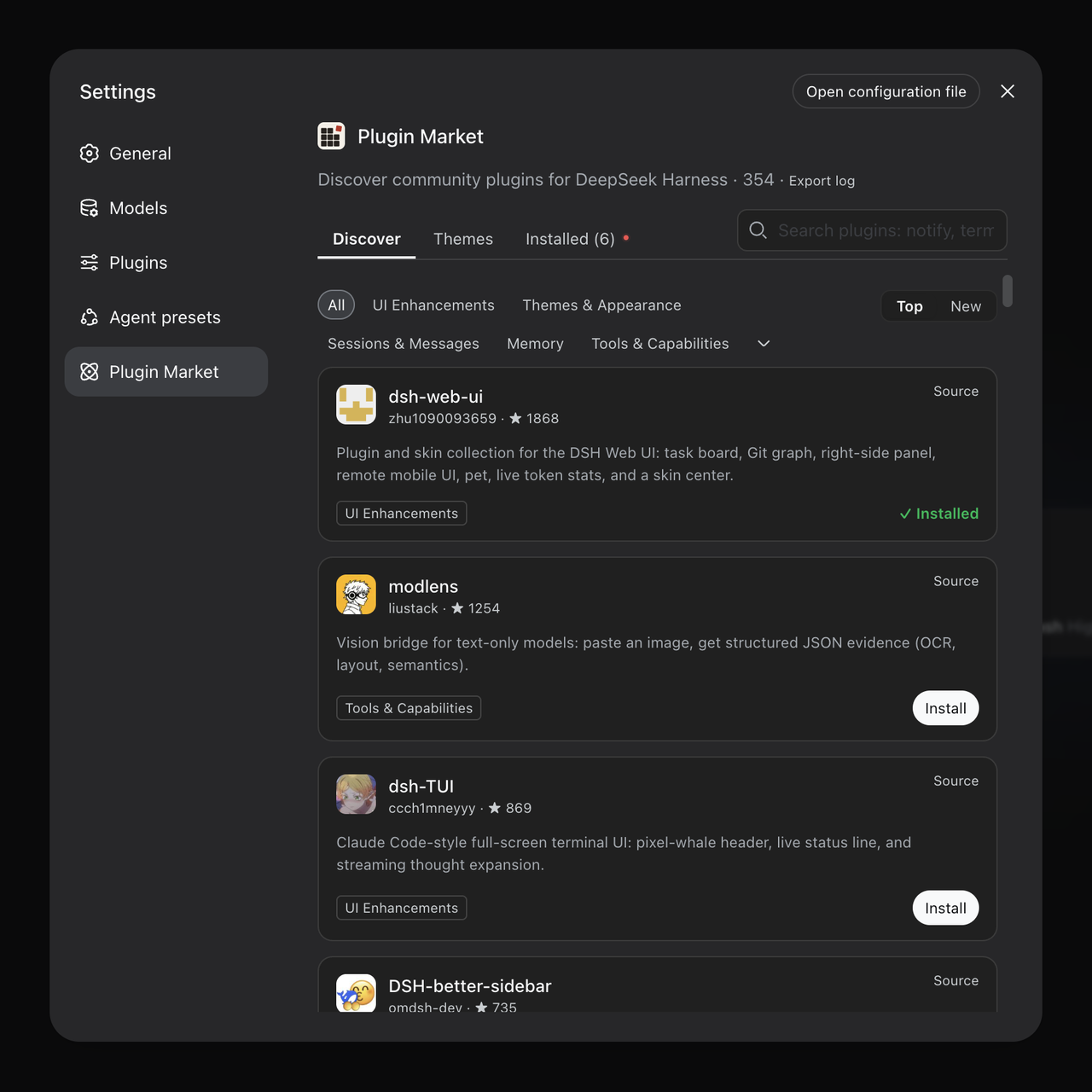
The plugin market for DeepSeek Harness: browse/search/one-click install community plugins and themes, with updates, backup/restore, hot disable, diagnostics, and AI fix.

A persistent whale widget on the DSH web UI that shows DeepSeek balance, today's usage, and per-turn cost, with drag-and-snap and sound effects.