dsh-ui-fortifier
Run the following command in DeepSeek Harness:
dsh plugin install pgnqukezrdxmhjso/dsh-ui-fortifier
Paste the following prompt into your AI chat to install this plugin:
Run dsh plugin install pgnqukezrdxmhjso/dsh-ui-fortifier in the DeepSeek Harness terminal to install; the source repository is https://github.com/pgnqukezrdxmhjso/dsh-ui-fortifier.
About this plugin
DSH's Web UI ships without a handful of small but frequently needed affordances: the model selector gives no hint of which Provider is active, switching Providers and models takes several extra clicks, grabbing a session ID means fiddling in the header, there is no one-click shortcut to open the .dsh folder, and the Settings panel is locked to a fixed size. None of these are deal-breakers, but day in and day out they add up.
dsh-ui-fortifier patches all five gaps with independently toggleable modules managed from a single ui-fortifier tab in Settings. provider-label pins the active Provider name to the left of the model selector; model-picker adds a cascading Provider-to-Model picker right in the input row; session-id-copy drops a one-click copy button into the session header utility group; open-dsh-folder tacks an Open .dsh folder button onto the top-right of the Settings page; and settings-frame makes the panel draggable and resizable. Turn any module off and it vanishes from the interface.
If you juggle multiple Providers and models in the DSH Web UI every day, or simply want the Settings panel to fit your screen instead of the other way around, this is a low-risk drop-in. It registers UI slots and a Settings namespace only, owns no event stream or mutable state, and the stock interface returns the moment the plugin is removed.
Use Cases
- Switch between multiple Providers and models in one cascading action.
- Copy a session ID in a single click for debugging or sharing.
- Resize and reposition the settings panel on large or split-screen displays.
Best For
- Users who manage multiple Providers in the DSH Web UI daily.
- Heavy conversational users who prefer fewer clicks per task.
- Developers running DSH Web UI on high-resolution displays.
Related Plugins
A service-oriented sidebar framework for DSH, offering a full workbench with file explorer, embedded browser, real terminal, Git panel, and extensible plugin services.
A beautiful, practical Claude Code-style TUI plugin with pixel whale top bar, flowing glow title, real-time status line, streaming thought expansion, time rewind, context progress bar and TPS gauge — zero core changes.
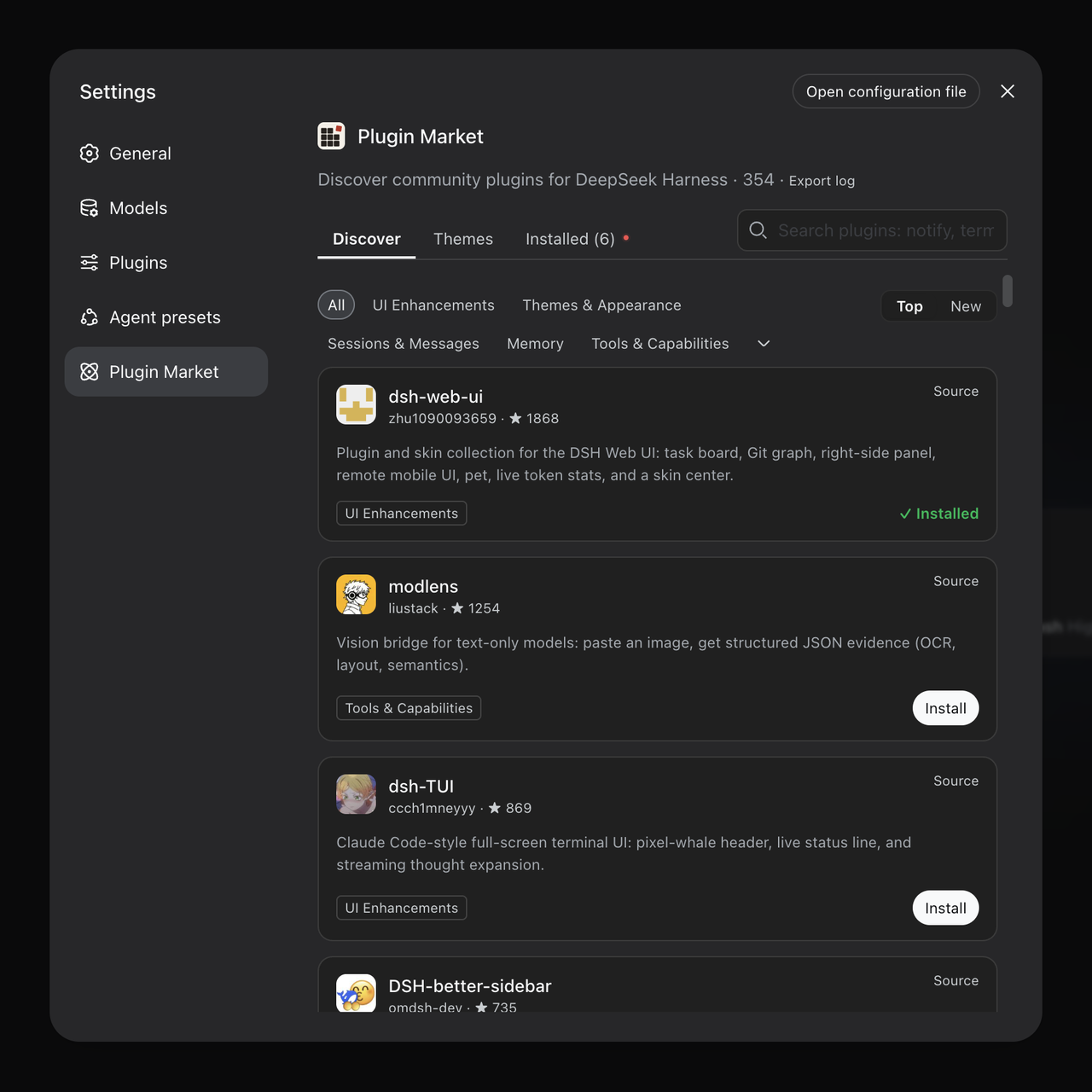
The plugin market for DeepSeek Harness: browse/search/one-click install community plugins and themes, with updates, backup/restore, hot disable, diagnostics, and AI fix.

A persistent whale widget on the DSH web UI that shows DeepSeek balance, today's usage, and per-turn cost, with drag-and-snap and sound effects.