dsh-orbit
Run the following command in DeepSeek Harness:
dsh plugin install KasenRi/dsh-orbit
Paste the following prompt into your AI chat to install this plugin:
Run dsh plugin install KasenRi/dsh-orbit in the DeepSeek Harness terminal to install it; the source repository is https://github.com/KasenRi/dsh-orbit .
About this plugin
Orbit addresses a recurring pain in long AI-driven sessions: when a model freely loops through multi-step work, it can drift off-plan, spin in circles, or lose its place mid-run. Orbit fixes this by splitting the task into a Commander (planning, step review, and final acceptance), an Executor (one step at a time with real tool calls and verification), and a Smart Watchdog (anomaly diagnosis and recovery). Flow control stays with the supervisor; the model never decides what happens next on its own.
Every run is durable and bounded. State is persisted to disk for cold recovery. Loop budget, correction rounds, and Watchdog diagnoses all carry explicit ceilings. Once a run starts, the assigned models and reasoning levels are frozen, so mid-run UI changes only affect the next run. A workspace mutation fence ensures only one legal Orbit driver at a time, Commander and Watchdog receive read-only tool allowlists, and the Executor unlocks only the tools its current step explicitly declares. For high-uncertainty steps, an optional MoA mode dispatches two to four independent candidates, a Judge selects the best, and Orbit deterministically promotes the winner before the Executor runs real tests and the Commander gives final sign-off. SINGLE mode works out of the box; MoA and Browser are opt-in add-ons.
Best suited for DeepSeek Harness users who run multi-step engineering tasks and want auditability, cold-resume capability, and hard boundaries around model autonomy. Install Orbit alone for full SINGLE-mode capability, then layer in MoA or Browser only when a task calls for multi-candidate competition or real browser interaction.
Use Cases
- Multi-step refactoring that needs phased planning, execution, and acceptance without model drift
- Resuming a long-running task from durable state after an interruption without losing context
- High-uncertainty steps that benefit from multi-candidate competition before committing a solution
Best For
- Developers running multi-step engineering tasks in DSH who need hard process boundaries
- Teams that want AI long tasks to be auditable, cold-resumable, and bounded
- Users who prefer supervisor-level control over model autonomy in extended sessions
Related Plugins
A service-oriented sidebar framework for DSH, offering a full workbench with file explorer, embedded browser, real terminal, Git panel, and extensible plugin services.
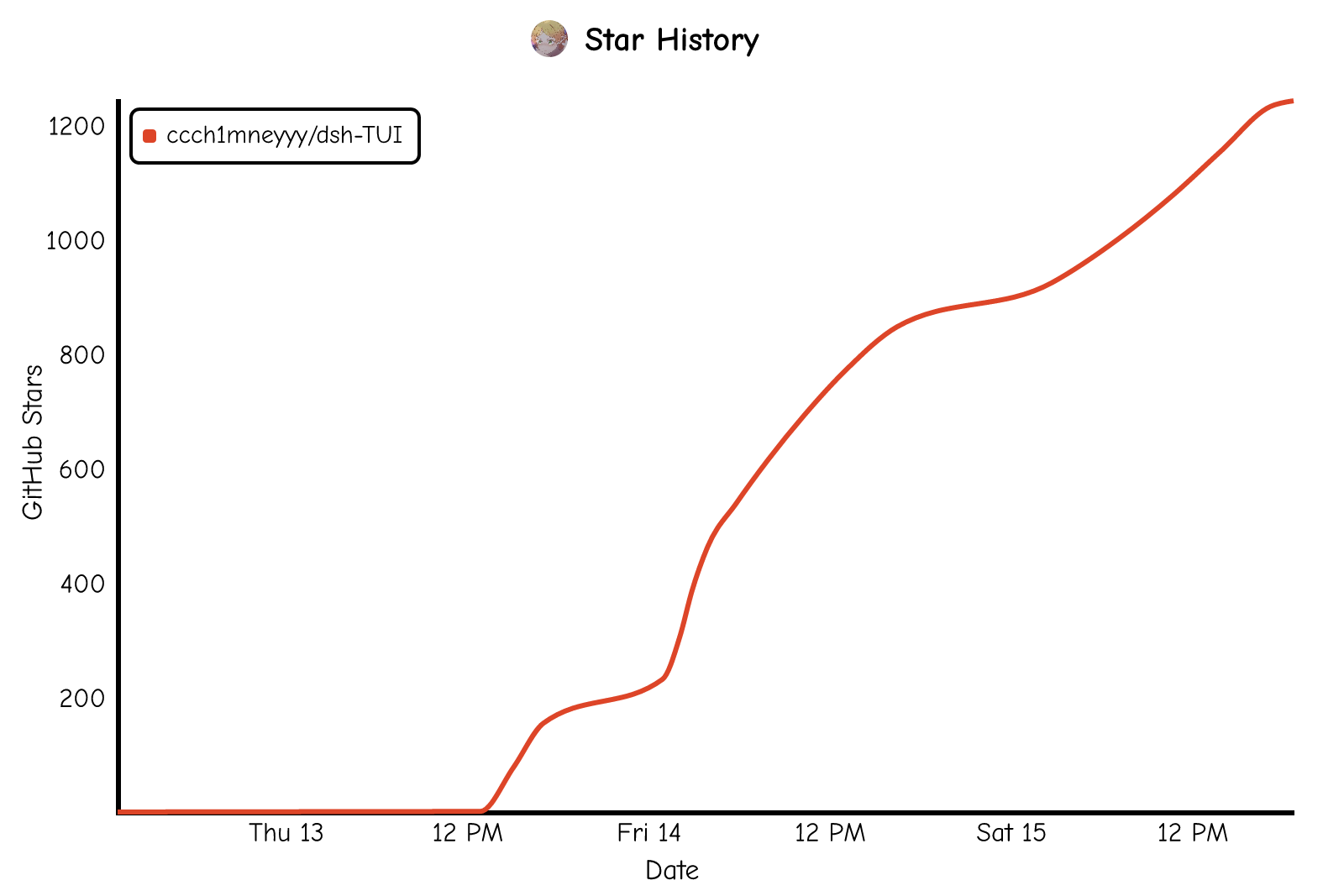
A beautiful, practical Claude Code-style TUI plugin with pixel whale top bar, flowing glow title, real-time status line, streaming thought expansion, time rewind, context progress bar and TPS gauge — zero core changes.
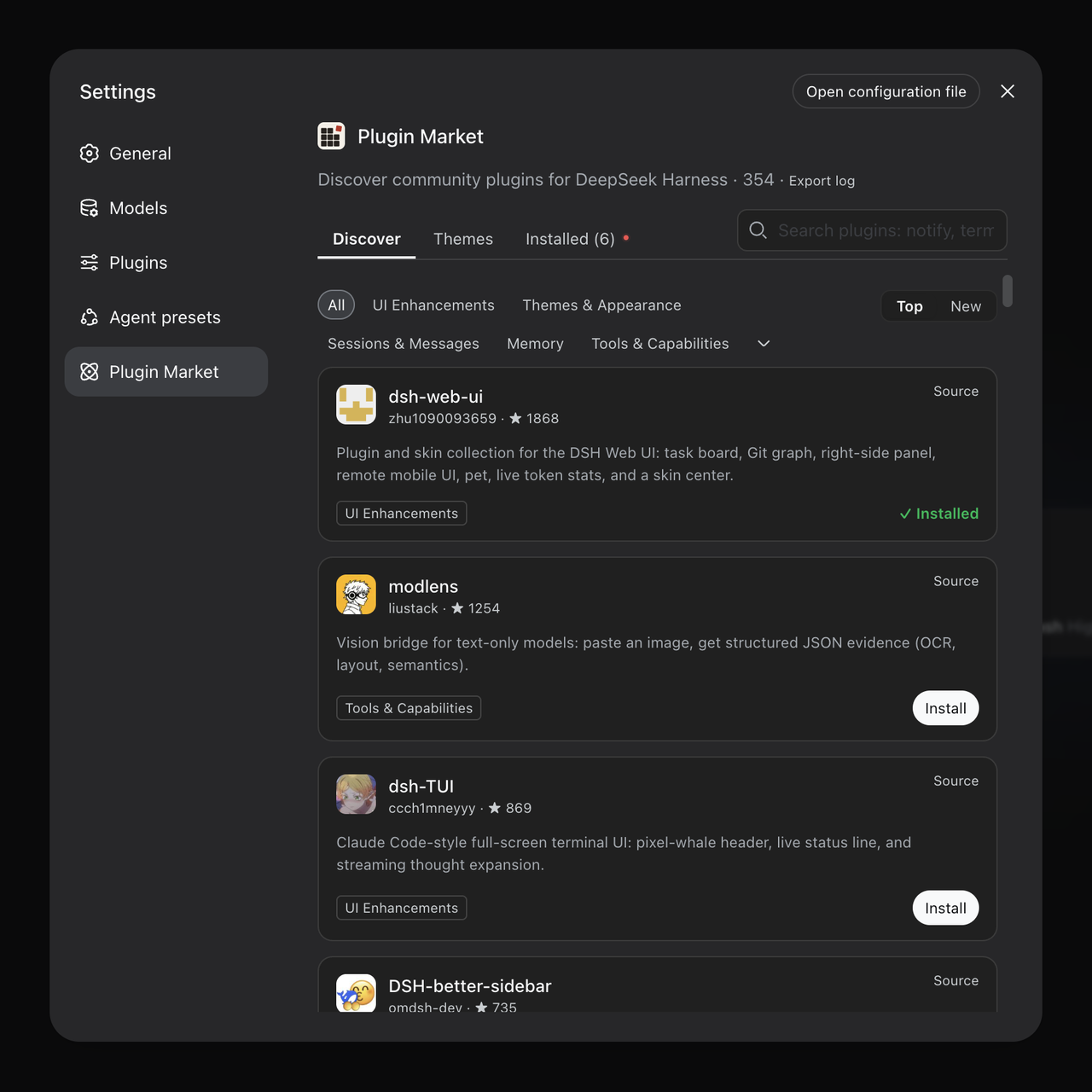
The plugin market for DeepSeek Harness: browse/search/one-click install community plugins and themes, with updates, backup/restore, hot disable, diagnostics, and AI fix.

A persistent whale widget on the DSH web UI that shows DeepSeek balance, today's usage, and per-turn cost, with drag-and-snap and sound effects.