decision-records
Run the following command in DeepSeek Harness:
dsh plugin install ChenneyZhuang/decision-records
Paste the following prompt into your AI chat to install this plugin:
Run dsh plugin install ChenneyZhuang/decision-records in the DeepSeek Harness terminal to install the plugin from https://github.com/ChenneyZhuang/decision-records.
About this plugin
The most expensive time in a team is rarely spent making decisions; it is spent re-litigating them. Every few weeks someone reopens the same question, and the original reasoning has dissolved into chat logs or walked out the door with a colleague who left. decision-records exists to break that loop: a decision without a recorded reason is no decision at all.
The approach is deliberately light. A single decisions.md file, or a section in your existing documentation, with roughly five lines per entry. The core sentence is "Use X because Y; we rejected Z." Three rules do the heavy lifting: the why is the payload (conclusions go stale, reasons age well), records are append-only (reopen a decision by writing a new entry that supersedes the old one, never rewrite history), and you write at the moment of decision (notes written after the meeting reconstruct memory, not reasoning). No templates, no approval workflow, zero dependencies, one SKILL.md file to run.
It shines in multi-person projects where turnover and decision volume make the compounding effect obvious. A solo project will probably only ever need two or three records, and that is fine. But if you have ever sat through the same debate for a fourth time, five disciplined lines are worth the cost of writing them once.
Use Cases
- After picking a technology stack, log the rationale so the same debate does not resurface next quarter
- When refactoring an architecture, append a record in decisions.md that marks which old decision it supersedes
- A new hire reads decisions.md to understand why the project looks the way it does
Best For
- Tech leads who need cross-member, cross-cycle decisions to be traceable
- Open-source maintainers who want contributors to respect design trade-offs rather than reopen them
- Small engineering teams that need knowledge persistence without process overhead
Related Plugins
A service-oriented sidebar framework for DSH, offering a full workbench with file explorer, embedded browser, real terminal, Git panel, and extensible plugin services.
A beautiful, practical Claude Code-style TUI plugin with pixel whale top bar, flowing glow title, real-time status line, streaming thought expansion, time rewind, context progress bar and TPS gauge — zero core changes.
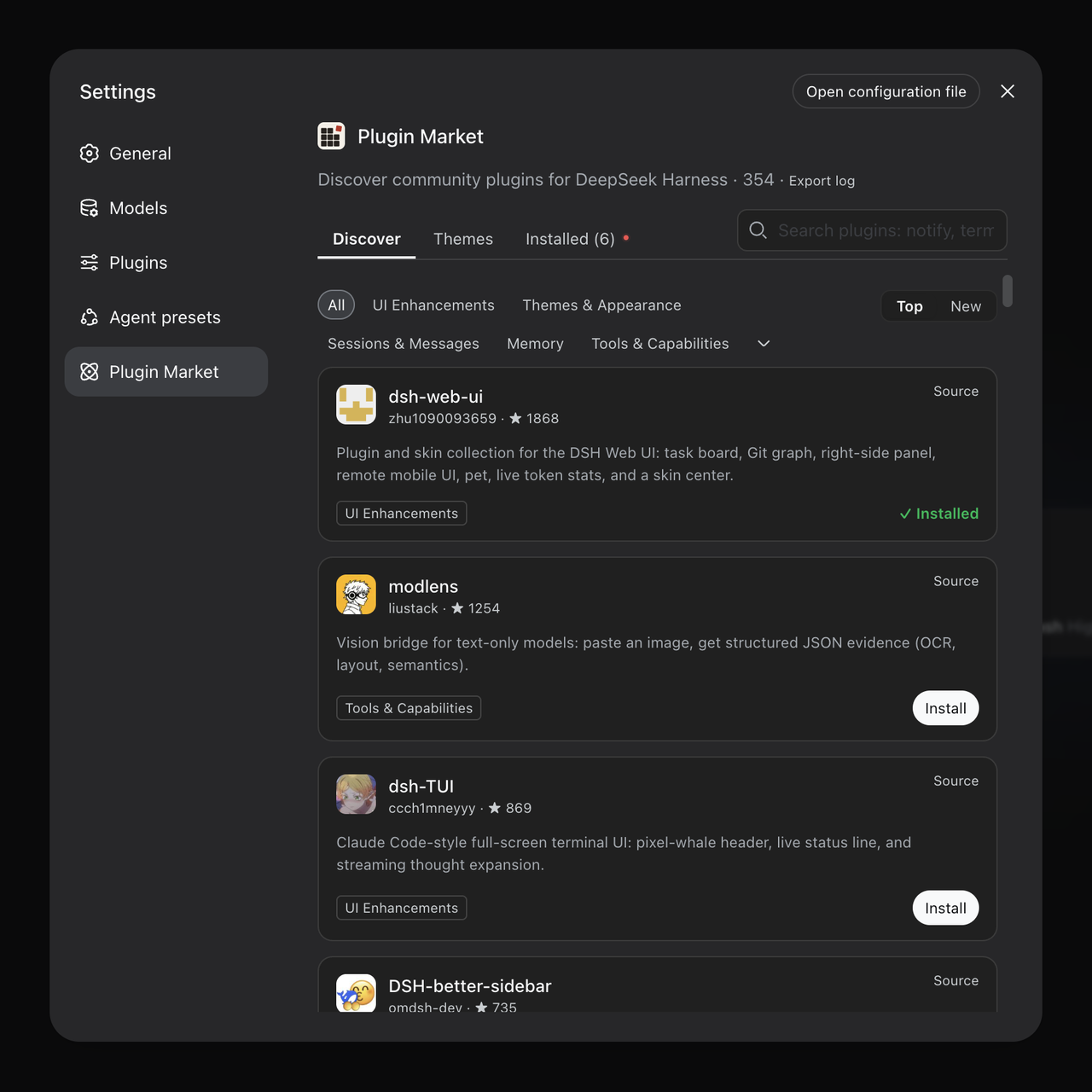
The plugin market for DeepSeek Harness: browse/search/one-click install community plugins and themes, with updates, backup/restore, hot disable, diagnostics, and AI fix.

A persistent whale widget on the DSH web UI that shows DeepSeek balance, today's usage, and per-turn cost, with drag-and-snap and sound effects.