dsh-port-manager
Run the following command in DeepSeek Harness:
dsh plugin install wyzh0117/dsh-port-manager
Paste the following prompt into your AI chat to install this plugin:
Run dsh plugin install wyzh0117/dsh-port-manager in your terminal to install it; the source repository is https://github.com/wyzh0117/dsh-port-manager.
About this plugin
Juggling Vite, Node, Python, and Docker services on one machine means ports quietly collide and externally exposed listeners slip out of memory. Running lsof in a terminal works, but the flat output forces you to chain several commands to figure out which port is bound to loopback versus the LAN, which PID owns it, and where the working directory lives. dsh-port-manager collects all of that into a single native DSH right-sidebar card: one scan, one glance.
Each port card surfaces the port and protocol, bind scope (loopback, LAN, or all interfaces with an orange warning for exposed listeners), a friendly application name with a category badge, PID, user, CPU, memory, working directory, Docker container mapping, and well-known port hints. The toolbar offers search, filters by bind scope and killability, multi-field sort, and 3 s / 10 s / 30 s auto-refresh. Per-port actions include opening the address in the system browser (https for TLS ports), copying the URL or launch command, expanding details with the full command line, parent process chain, and a local HTTP probe that returns status code, Server, Content-Type, page title, and latency; revealing the working directory in Finder; and killing the process after a second confirmation with SIGTERM escalating to SIGKILL if the process is still alive after 1.7 s, or an immediate force -9 if preferred.
The plugin carries zero runtime dependencies: the host half imports only node:* built-ins, so no node_modules is needed and a link install is immediately usable. Security enforcement lives server-side—other users' processes, system accounts, executables under /System or /usr/libexec, and the DSH host's own process ancestry are all refused with a 403 and a lock icon in the UI. It is built for engineers who manage several local dev services, front-end and back-end colleagues who need to identify and free a conflicting port in seconds, and teams that want a guarded kill flow instead of raw shell commands. The interface is in Simplified Chinese. macOS and Linux enjoy full feature parity; Windows is not a supported target because the scanning half has no Windows backend.
Screenshots
Use Cases
- Identify port conflicts across Vite, Node, and Docker services running locally
- Audit externally exposed listeners to confirm no unexpected services bind to LAN or all interfaces
- Kill a blocking process with one click or probe a service HTTP response before restarting
Best For
- Front-end and back-end engineers juggling multiple local dev services
- DevOps and SRE engineers who need to trace port ownership and process lineage quickly
- Teams who prefer a guarded UI-driven kill flow over raw shell commands
Related Plugins
A service-oriented sidebar framework for DSH, offering a full workbench with file explorer, embedded browser, real terminal, Git panel, and extensible plugin services.
A beautiful, practical Claude Code-style TUI plugin with pixel whale top bar, flowing glow title, real-time status line, streaming thought expansion, time rewind, context progress bar and TPS gauge — zero core changes.
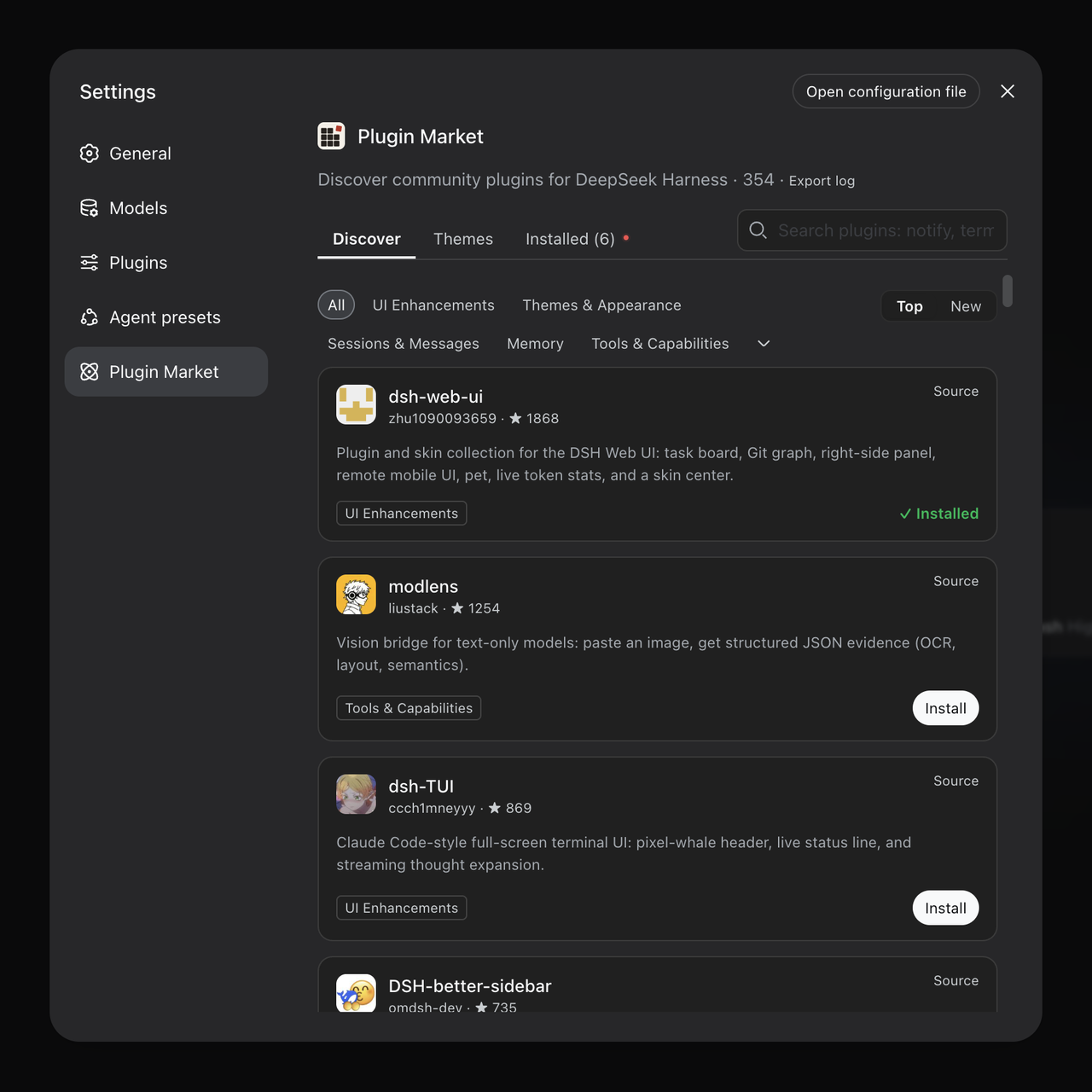
The plugin market for DeepSeek Harness: browse/search/one-click install community plugins and themes, with updates, backup/restore, hot disable, diagnostics, and AI fix.

A persistent whale widget on the DSH web UI that shows DeepSeek balance, today's usage, and per-turn cost, with drag-and-snap and sound effects.