dsh-thinking-summary
Run the following command in DeepSeek Harness:
dsh plugin install lyuwen/dsh-thinking-summary
Paste the following prompt into your AI chat to install this plugin:
In the DeepSeek Harness terminal, run dsh plugin install lyuwen/dsh-thinking-summary (repo: https://github.com/lyuwen/dsh-thinking-summary), then restart dsh web to activate the plugin.
About this plugin
The built-in "Think" row in DeepSeek Harness shows a single scrolling line while the model reasons, and a wall of raw text when expanded. For multi-thousand-token deep-thinking traces, extracting the key conclusions is nearly impossible. dsh-thinking-summary replaces that row with a three-stage collapsible view: collapsed shows a one-line summary of the last completed paragraph, semi-expanded chains per-paragraph summaries on a vertical rail, and fully expanded reveals the raw thinking text. Summaries are produced by a user-selectable model called with thinking disabled, low temperature, and a terse system prompt.
Paragraph splitting is tuned for real-world reasoning streams: blank-line-separated fragments under roughly 160 characters are merged forward into a single unit so that frequent line breaks do not fragment the summary. The in-progress tail always displays a "Thinking…" placeholder until it settles into a completed paragraph. Messages that were already finalized before the plugin mounted keep the plain raw-thinking disclosure unless the host already holds cached summaries.
Ideal for developers and AI engineering teams who work in the Harness web profile and regularly review model reasoning. You can judge whether the model is on track in three seconds, then drill into individual paragraphs or the full raw trace when needed.
Use Cases
- Extract key conclusions from long model reasoning at a glance
- Judge whether an agent reasoning chain is on track during debugging
- Read extended thinking streams in the web profile without scrolling raw text
Best For
- Developers using the DeepSeek Harness web profile
- AI engineering teams that review model reasoning regularly
- Engineers debugging multi-step agent reasoning chains
Related Plugins
A service-oriented sidebar framework for DSH, offering a full workbench with file explorer, embedded browser, real terminal, Git panel, and extensible plugin services.
A beautiful, practical Claude Code-style TUI plugin with pixel whale top bar, flowing glow title, real-time status line, streaming thought expansion, time rewind, context progress bar and TPS gauge — zero core changes.
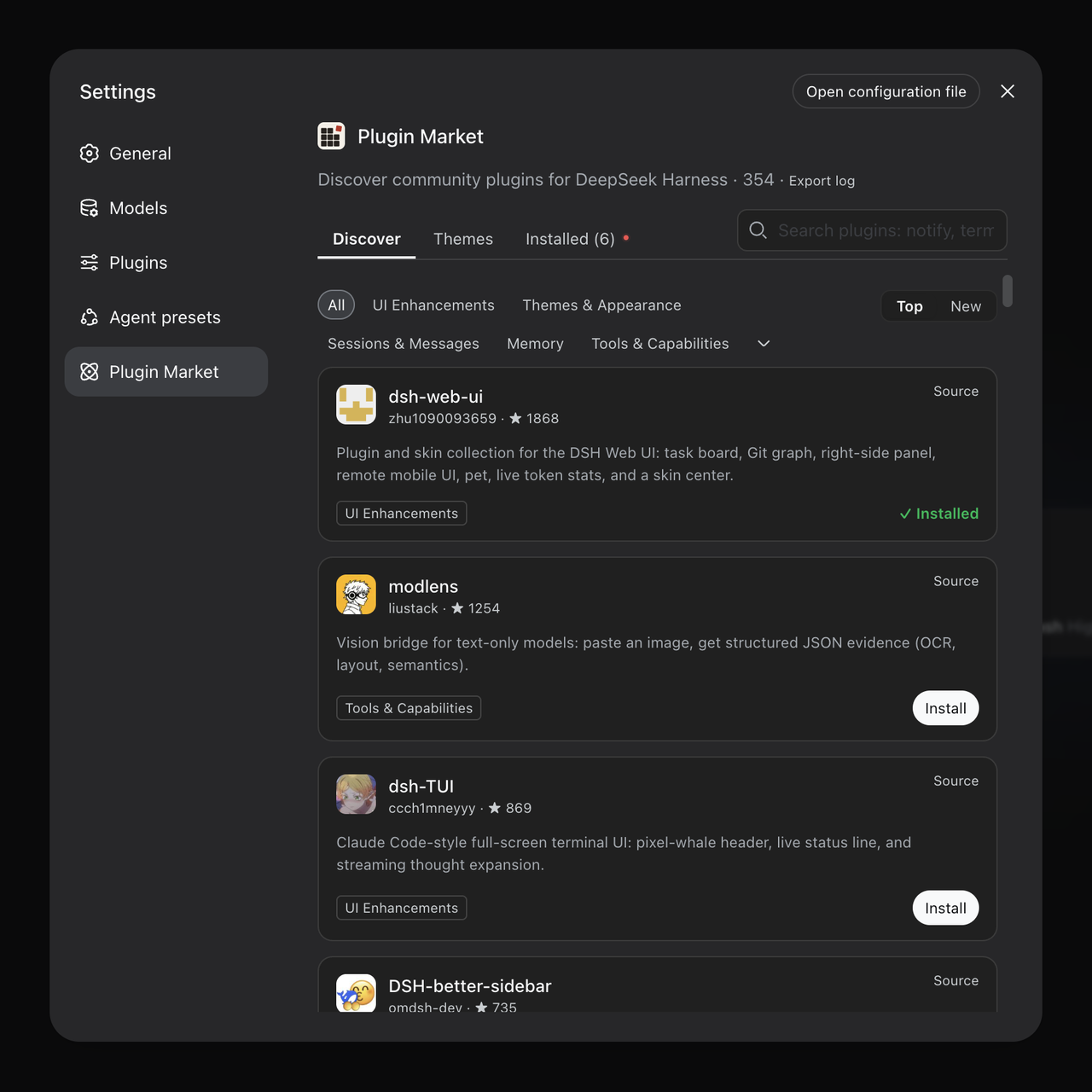
The plugin market for DeepSeek Harness: browse/search/one-click install community plugins and themes, with updates, backup/restore, hot disable, diagnostics, and AI fix.

A persistent whale widget on the DSH web UI that shows DeepSeek balance, today's usage, and per-turn cost, with drag-and-snap and sound effects.