dsh-typelens
Run the following command in DeepSeek Harness:
dsh plugin install fantasyce/dsh-typelens
Paste the following prompt into your AI chat to install this plugin:
Run dsh plugin install fantasyce/dsh-typelens in an environment where pnpm is available, then restart the affected DSH profile; the plugin source is at https://github.com/fantasyce/dsh-typelens
About this plugin
When driving agents through DeepSeek Harness, a recurring friction is that an agent reading a file has no inherent understanding of the surrounding type structure, and an edit produces no immediate diagnostic feedback unless the developer manually invokes an LSP tool. TypeLens removes that extra step: after every successful file read it appends only the complete type declarations needed to understand the visible code, and after every edit it follows with bounded TypeScript diagnostics, new errors first.
All analysis happens locally. TypeLens makes no outbound requests and never persists source-bearing state. Output is ranked, deduplicated, cycle-safe, and never cut mid-signature. Multiple bounds keep results predictable: workspace scope, file size, timeout, recursion depth, result count, cache size, and token ceiling. A built-in circuit breaker pauses automatic analysis after repeated operational failures while still leaving explicit tools and the health endpoint available, so an analysis hiccup can never turn a successful file operation into a failure.
If you write TypeScript, JavaScript, TSX, or JSX through DSH and want agents to automatically gain type context and immediate post-edit diagnostics without remembering to call an LSP tool, TypeLens is a lightweight plugin built for that. It exposes four explicit tools (lookup a type, list bounded types, run diagnostics, inspect configuration and health state), lifecycle hooks, a health API, and a Web settings panel so you can dial in analysis behavior and limits to match your workflow.
Use Cases
- Agents automatically receive full type declarations after every successful file read without invoking an LSP tool
- Bounded TypeScript diagnostics appear immediately after edits, with new errors listed first
- Type semantic context is attached to agent steps entirely locally with no outbound requests
Best For
- Developers who drive agents through DSH to write TypeScript, JavaScript, TSX, or JSX
- Teams that want agents to stop re-reading files or manually requesting type context
- Privacy-sensitive users who prefer fully local analysis with zero outbound requests and fail-open safety
Related Plugins
A service-oriented sidebar framework for DSH, offering a full workbench with file explorer, embedded browser, real terminal, Git panel, and extensible plugin services.
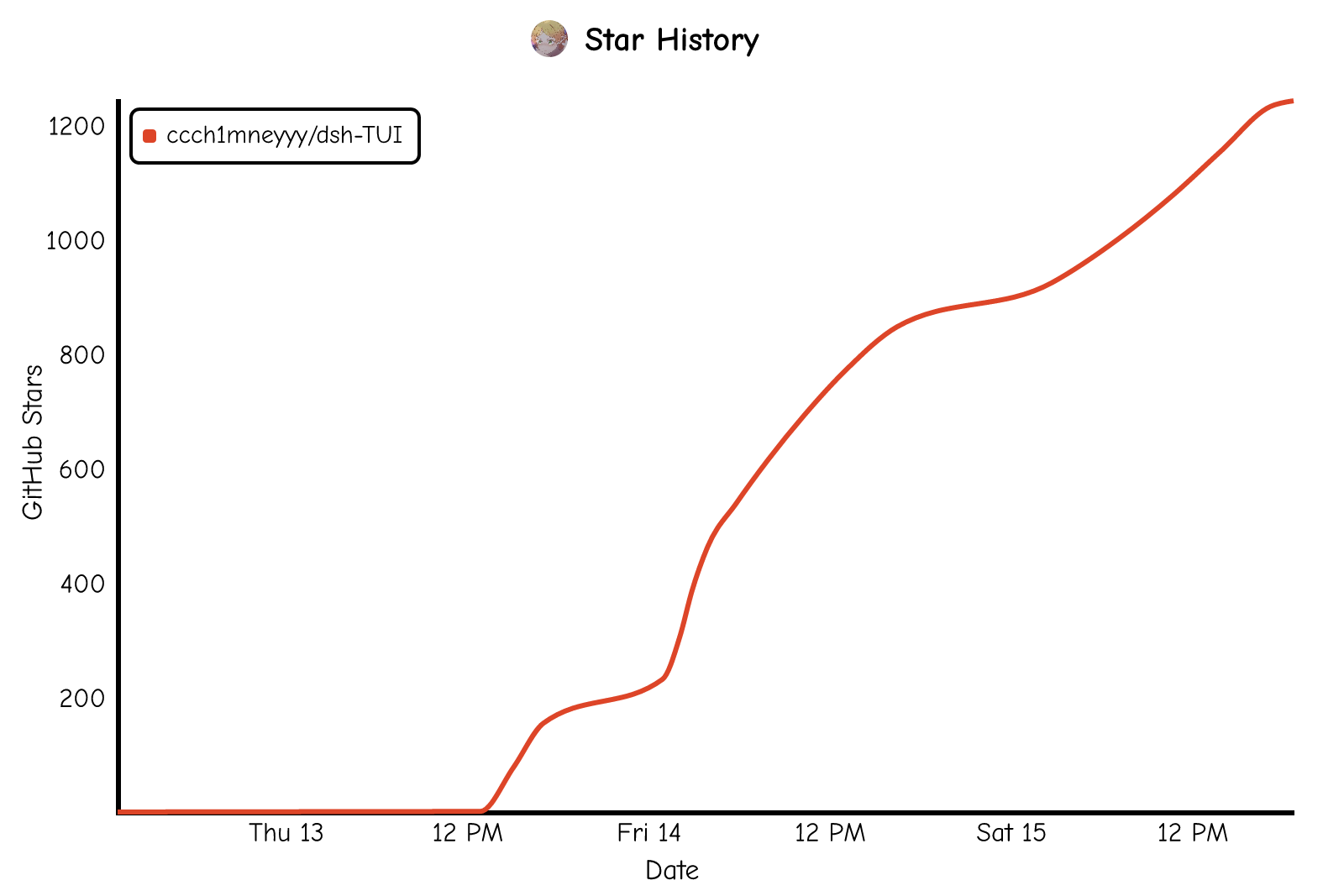
A beautiful, practical Claude Code-style TUI plugin with pixel whale top bar, flowing glow title, real-time status line, streaming thought expansion, time rewind, context progress bar and TPS gauge — zero core changes.
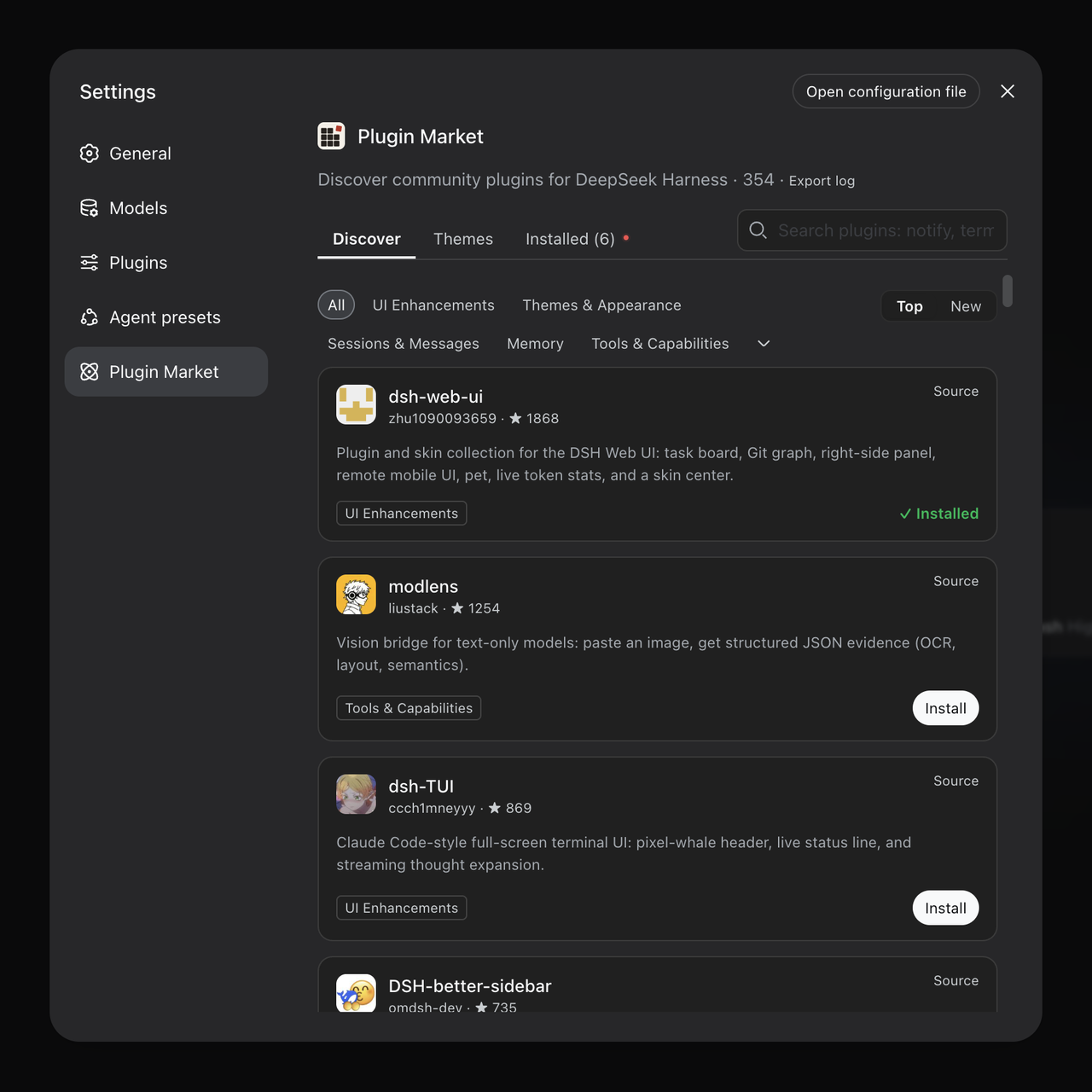
The plugin market for DeepSeek Harness: browse/search/one-click install community plugins and themes, with updates, backup/restore, hot disable, diagnostics, and AI fix.

A persistent whale widget on the DSH web UI that shows DeepSeek balance, today's usage, and per-turn cost, with drag-and-snap and sound effects.