dsh-b2us-chrome-tool
Run the following command in DeepSeek Harness:
dsh plugin install changyinliangbaikai/dsh-b2us-chrome-tool
Paste the following prompt into your AI chat to install this plugin:
Run dsh plugin install changyinliangbaikai/dsh-b2us-chrome-tool to install the plugin in DeepSeek Harness; source code: https://github.com/changyinliangbaikai/dsh-b2us-chrome-tool
About this plugin
The hard part of letting an Agent drive a real browser is not the automation itself but the security boundary that must hold while the Agent clicks, types, and reads pages. dsh-b2us-chrome-tool solves exactly that problem: through a Manifest V3 extension and an authenticated 127.0.0.1 loopback bridge it gives DeepSeek Harness agents control over the Chrome session you already use, while every byte of page data stays locked inside an isolated Browser Worker context that the parent Agent can only see through tightly typed, bounded results.
The capability surface covers the full browser-automation loop. Semantic accessible names, roles, and states replace raw page-source dumps. page.find ranks elements inside the page runtime before anything reaches the model, and page.locator generates CSS and XPath candidates that it proves are unique in the live DOM. Interaction primitives include click, exact-name click, non-sensitive text input, select, scroll, wait, and structured extraction. Screenshots and bounded Fetch or XHR metadata arrive as opaque artifacts with redaction, quotas, and expiry. Browser execution and file delivery are reported so that a failed artifact copy can be retried without repeating a login or form submission.
The plugin is aimed at developers and small teams working in local or trusted environments who want an auditable, recoverable, and bounded layer of browser interaction for their agents. It does not replace a Selenium or Playwright CI pipeline; it gives the Agent a capability that is scoped, observable, and safe by construction, so you enjoy automation without handing over an unlimited DOM handle.
Use Cases
- Agent needs to fill forms, click, and submit within your everyday Chrome session
- Agent needs to screenshot a rendered page and extract structured data
- Agent needs to verify that a CSS or XPath selector uniquely targets an element in the live DOM
Best For
- Developers using DeepSeek Harness in trusted local environments
- Teams that need Agent control over an existing Chrome session instead of a separate automation profile
- Developers building an auditable, bounded browser-interaction layer for DSH agents
Related Plugins
A service-oriented sidebar framework for DSH, offering a full workbench with file explorer, embedded browser, real terminal, Git panel, and extensible plugin services.
A beautiful, practical Claude Code-style TUI plugin with pixel whale top bar, flowing glow title, real-time status line, streaming thought expansion, time rewind, context progress bar and TPS gauge — zero core changes.
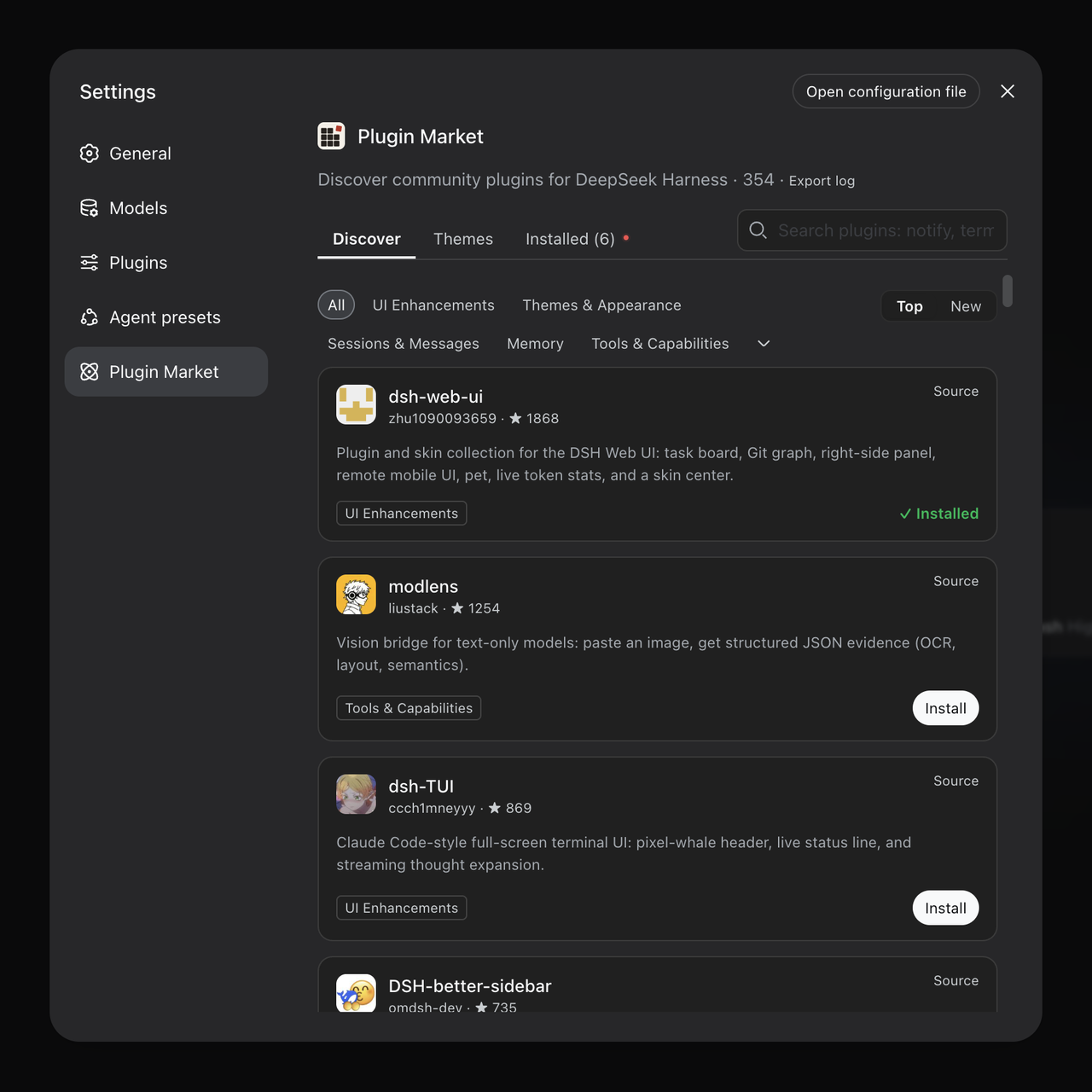
The plugin market for DeepSeek Harness: browse/search/one-click install community plugins and themes, with updates, backup/restore, hot disable, diagnostics, and AI fix.

A persistent whale widget on the DSH web UI that shows DeepSeek balance, today's usage, and per-turn cost, with drag-and-snap and sound effects.