dsh-title-index
Run the following command in DeepSeek Harness:
dsh plugin install gtaifu/dsh-title-index
Paste the following prompt into your AI chat to install this plugin:
Run dsh plugin install gtaifu/dsh-title-index in the DeepSeek Harness terminal to install this plugin; source is at https://github.com/gtaifu/dsh-title-index .
About this plugin
When the dsh Web @-mention candidate list needs to display the latest title for each persisted session, the stock engine decompresses and replays the full session.jsonl.zstd row-by-row. Once a corpus reaches dozens or hundreds of sessions, every keystroke rescans all logs while the built-in LRU holds only five entries. On a real 114-session corpus the top-50 title lookup took roughly 10 seconds, making the @ menu effectively unusable.
dsh-title-index patches the stock session-query-sqlite row with a subclass that overrides only readTitleSnapshots. A disk index keyed by (sessionId, mtimeMs, size) caches folded title snapshots: a hit returns in milliseconds, a miss (new session or appended log) falls through to the stock fold and writes the result back. Live sessions, stock read failures, and a corrupted index all fall back to the original path unchanged. Every other method (listSessions, search, lineage, auth semantics) remains the stock implementation.
Best suited for dsh Web users who maintain a large number of persisted sessions (tens to hundreds) and rely on @-references in daily workflow. Setup is minimal: add one dependency to the profile and declare the bundle after the stock web-app entry.
Use Cases
- Sub-second @-candidate title loads in the dsh Web input box
- @ menu responsiveness after the persisted corpus grows to dozens or hundreds of sessions
- Reusing folded title snapshots across lookups beyond the stock LRU capacity
Best For
- dsh Web users maintaining dozens to hundreds of persisted sessions
- Heavy dsh users who rely on @-references and care about input latency
- Users who want a one-dependency drop-in with zero extra configuration
Related Plugins
A service-oriented sidebar framework for DSH, offering a full workbench with file explorer, embedded browser, real terminal, Git panel, and extensible plugin services.
A beautiful, practical Claude Code-style TUI plugin with pixel whale top bar, flowing glow title, real-time status line, streaming thought expansion, time rewind, context progress bar and TPS gauge — zero core changes.
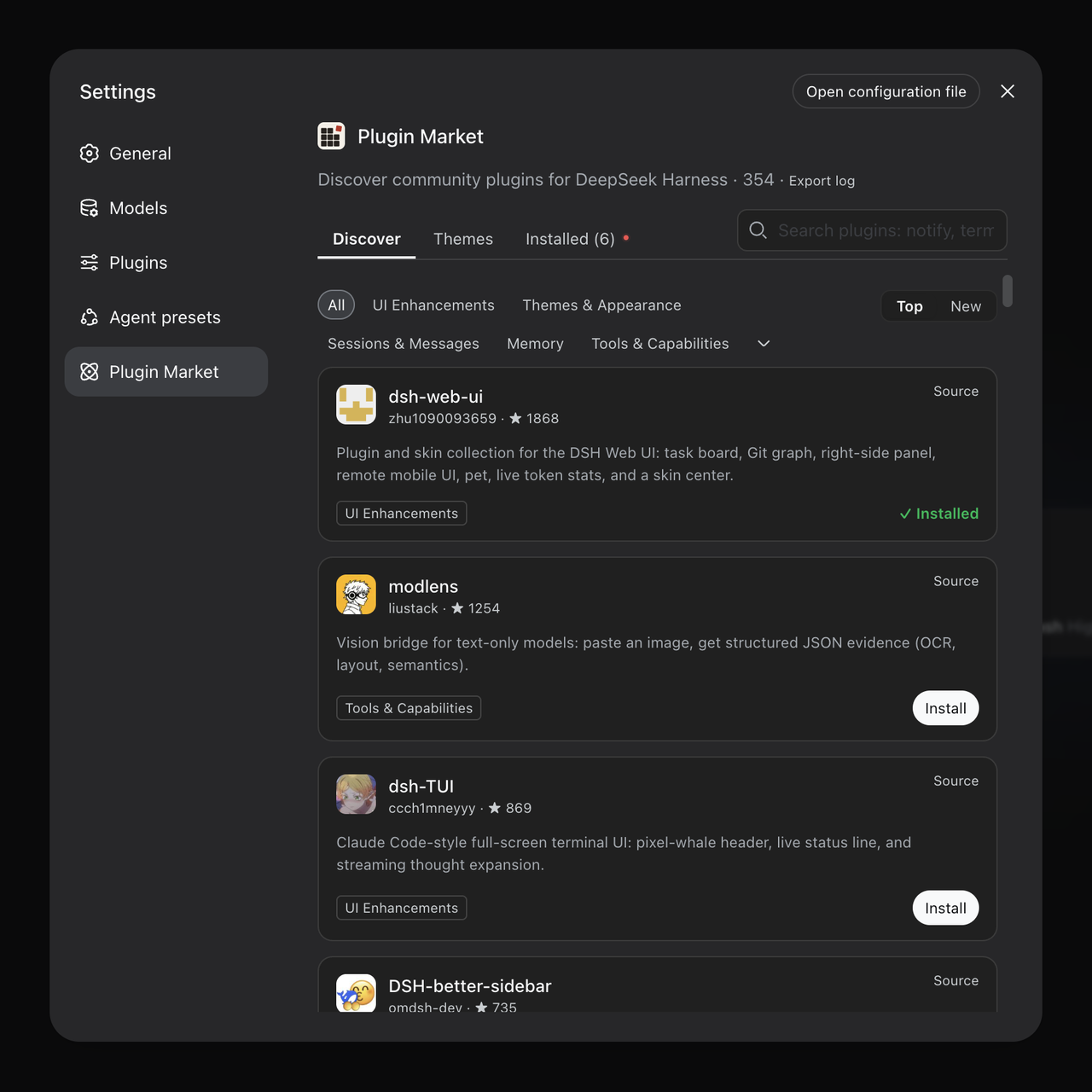
The plugin market for DeepSeek Harness: browse/search/one-click install community plugins and themes, with updates, backup/restore, hot disable, diagnostics, and AI fix.

A persistent whale widget on the DSH web UI that shows DeepSeek balance, today's usage, and per-turn cost, with drag-and-snap and sound effects.