dsh-ballast
Run the following command in DeepSeek Harness:
dsh plugin install xswt442-cmd/dsh-ballast
Paste the following prompt into your AI chat to install this plugin:
Install the dsh-ballast plugin in DeepSeek Harness by running: dsh plugin install xswt442-cmd/dsh-ballast (source: https://github.com/xswt442-cmd/dsh-ballast)
About this plugin
In DSH Web, the context window is a finite resource, yet which messages, tool results, or system instructions are actually consuming your tokens usually boils down to a single opaque number. dsh-ballast cracks that black box open, rendering a per-entry breakdown of token usage, type, timestamp, and a whitespace-collapsed summary for the current surface so you can see at a glance who is eating the window.
Beyond the line-item view, the panel aggregates token share by message type, displays the current routing price, and surfaces a shadow-price delta when the host provides one, flagging where image tokens may have been re-priced through visual processing. A cross-session Top view meters every live session on the current host on demand and sorts by the heaviest entry, making side-by-side comparison straightforward. On RC1 hosts it additionally shows provider usage, next-request window pressure, and an estimated system/tools/messages composition.
The plugin is strictly read-only: it writes no state, deletes no messages, triggers no compaction, and exports no content. It is built for DSH users who need to understand window composition, debug token spend, or make informed context-management decisions. It deliberately does not estimate costs, provide budgets, or predict compaction; its job is simply to tell you who owns how much of the window.
Use Cases
- Identify which entries are consuming the current surface token window
- Compare heaviest entries across live sessions with cross-session ranking
- Debug routing prices and potential visual-token re-pricing deltas
Best For
- DSH users who need transparent visibility into window composition
- Developers debugging context spend and message lifecycle
- Teams focused on context-management strategy rather than cost estimation
Related Plugins
A service-oriented sidebar framework for DSH, offering a full workbench with file explorer, embedded browser, real terminal, Git panel, and extensible plugin services.
A beautiful, practical Claude Code-style TUI plugin with pixel whale top bar, flowing glow title, real-time status line, streaming thought expansion, time rewind, context progress bar and TPS gauge — zero core changes.
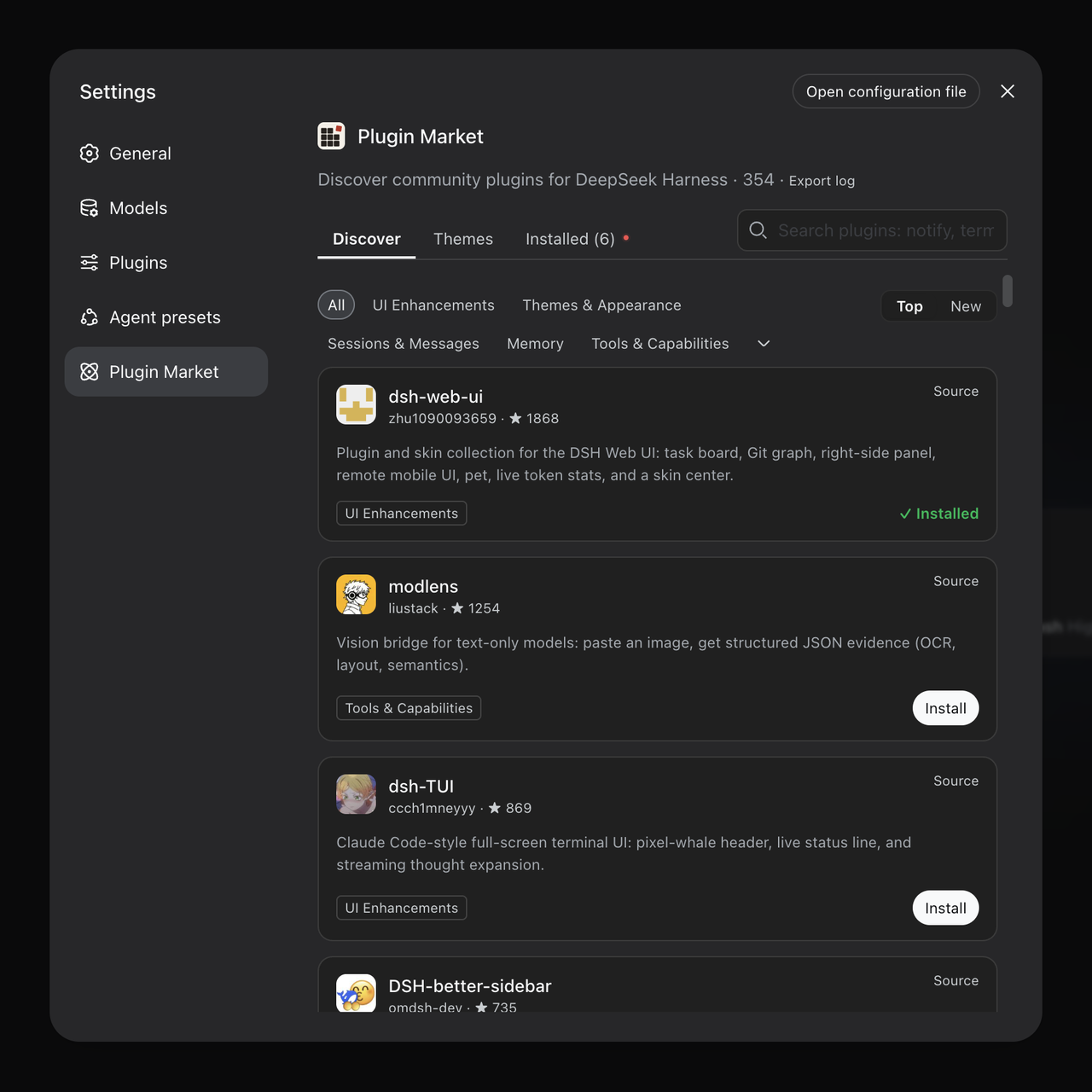
The plugin market for DeepSeek Harness: browse/search/one-click install community plugins and themes, with updates, backup/restore, hot disable, diagnostics, and AI fix.

A persistent whale widget on the DSH web UI that shows DeepSeek balance, today's usage, and per-turn cost, with drag-and-snap and sound effects.