dsh-remote-development
Run the following command in DeepSeek Harness:
dsh plugin install CJYLZS/dsh-remote-development
Paste the following prompt into your AI chat to install this plugin:
Run dsh plugin install CJYLZS/dsh-remote-development in your DeepSeek Harness terminal to install the plugin from https://github.com/CJYLZS/dsh-remote-development, then restart the harness.
About this plugin
DeepSeek Harness agents were confined to the local filesystem: reading files, running commands, searching with ripgrep — all on the machine you sit in front of. Pointing the agent at a project on a remote server meant manually SSHing in, shuttling files back and forth, and losing the very automation that made an agent useful. dsh-remote-development closes that gap with a thin routing layer: register an SSH machine in the Web GUI, pick a remote directory as the session workspace, and the same file, shell, and search tools the model already knows about transparently execute on the far end over SSH. No new model-facing tools are added; the working directory simply becomes the remote path.
Under the hood, three routing providers swap in for the sandbox filesystem, subprocess runtime, and Bash executor. Paths that resolve under a remote root are served through a single shared SFTP subsystem channel per machine — one multiplexed session instead of a channel per call, staying within server-side connection caps. Spawns ride an SSH exec channel; background jobs get a real remote PID managed via a process-group kill protocol. Writes are serialised per file and published atomically (temp file plus rename) with the same permission checks and error codes as the local sandbox. Host keys follow TOFU by default: the first key is recorded, a changed key is rejected as a potential MITM, and verify or off modes are available per machine. Anchor directories are lightweight metadata folders under $DSH_HOME; any path that does not pass through an anchor keeps normal local behaviour, so existing sessions are completely unaffected.
The plugin is aimed at developers and ops engineers who want their agent to work directly on remote build servers, development machines, or jump-host environments without deploying a second IDE or a third-party UI plugin. The SSH stack (ssh2 and its pure-JS dependencies) is bundled at build time, so no C++ toolchain or build-script approval is needed at install — any Linux or macOS profile can add it and restart. Windows remote hosts, persistent terminal sessions, and @ file references are explicitly deferred to later phases.
Use Cases
- Point your agent at a remote build server to edit files, run commands, and search code over SSH
- Open a new remote session on a jump-host or CI runner while keeping all local sessions untouched
- Develop on a remote POSIX machine without deploying VS Code Remote or a second IDE
Best For
- Developers who want their agent to operate on remote Linux build machines or CI runners
- Ops engineers who need agent-assisted troubleshooting on production-adjacent servers
- DeepSeek Harness users who have outgrown the local single-workspace model and need multi-machine workflows
Related Plugins
A service-oriented sidebar framework for DSH, offering a full workbench with file explorer, embedded browser, real terminal, Git panel, and extensible plugin services.
A beautiful, practical Claude Code-style TUI plugin with pixel whale top bar, flowing glow title, real-time status line, streaming thought expansion, time rewind, context progress bar and TPS gauge — zero core changes.
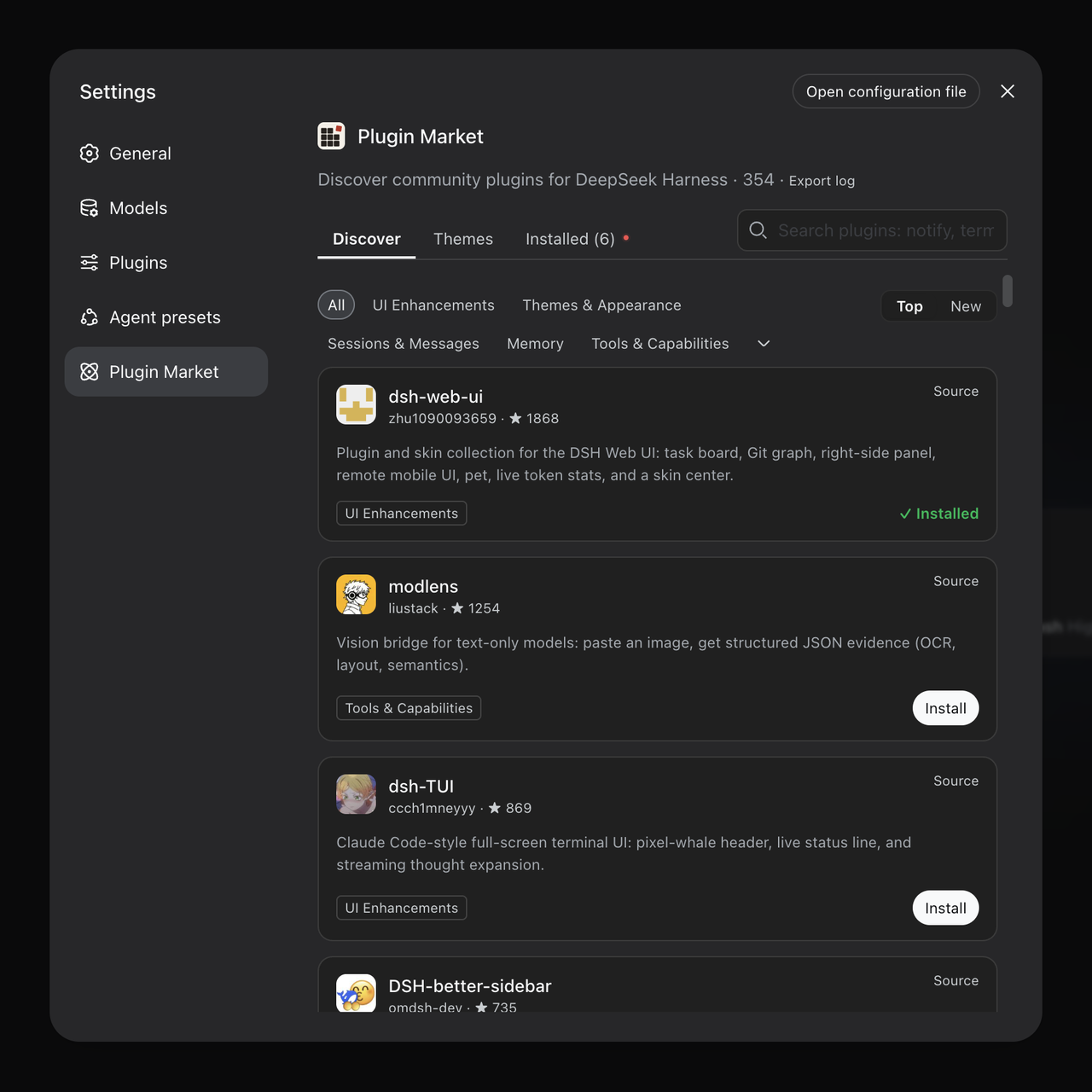
The plugin market for DeepSeek Harness: browse/search/one-click install community plugins and themes, with updates, backup/restore, hot disable, diagnostics, and AI fix.

A persistent whale widget on the DSH web UI that shows DeepSeek balance, today's usage, and per-turn cost, with drag-and-snap and sound effects.