dsh-ssh-plugin
Run the following command in DeepSeek Harness:
dsh plugin install YOLO-LZL/dsh-ssh-plugin
Paste the following prompt into your AI chat to install this plugin:
Launch DeepSeek Harness and run the install command shown above to load this plugin; the source repository is https://github.com/YOLO-LZL/dsh-ssh-plugin .
About this plugin
Running commands on a remote Linux server from inside a DeepSeek Harness conversation used to mean breaking out of the chat, opening a separate terminal, and re-typing hosts and key paths every time. dsh-ssh-plugin brings that step back into the conversation: the model gains an ssh_exec tool so a single line of natural language is enough to run bash commands on a remote host, without switching context.
Three capabilities anchor the plugin. First, key-based authentication with BatchMode=yes guarantees that a missing or unauthorized key fails fast instead of hanging, while the remote command travels through ssh stdin straight into bash -s with no extra quoting layer. Second, the plugin parses your local ~/.ssh/config automatically, so any defined alias can be passed as ssh_exec host with no extra save; connections not in the config are persisted via the ssh_connections tool and bound to a workspace, surviving restarts. Third, every harness service (settings, workspaceRegistry, and others) is optional, so the plugin degrades gracefully when they are absent and ssh_exec still works with explicit arguments.
Ideal for developers, SREs, and ops engineers who routinely inspect or operate remote Linux services from within a conversation. The only prerequisite is that the target machine has key-based access configured. On Windows, the session sandbox policy must be danger-full-access, as a restricted token will block ssh.exe from starting.
Use Cases
- Inspect remote server disk usage and process status via natural language in chat
- Bind frequently used SSH hosts to a workspace to avoid re-entering host and key paths
- Execute remote commands directly using aliases defined in local ~/.ssh/config
Best For
- Developers who frequently operate remote Linux services from a conversation
- SREs and ops engineers needing passwordless SSH inspection
- Workflow users who want to minimize terminal context switching
Related Plugins
A service-oriented sidebar framework for DSH, offering a full workbench with file explorer, embedded browser, real terminal, Git panel, and extensible plugin services.
A beautiful, practical Claude Code-style TUI plugin with pixel whale top bar, flowing glow title, real-time status line, streaming thought expansion, time rewind, context progress bar and TPS gauge — zero core changes.
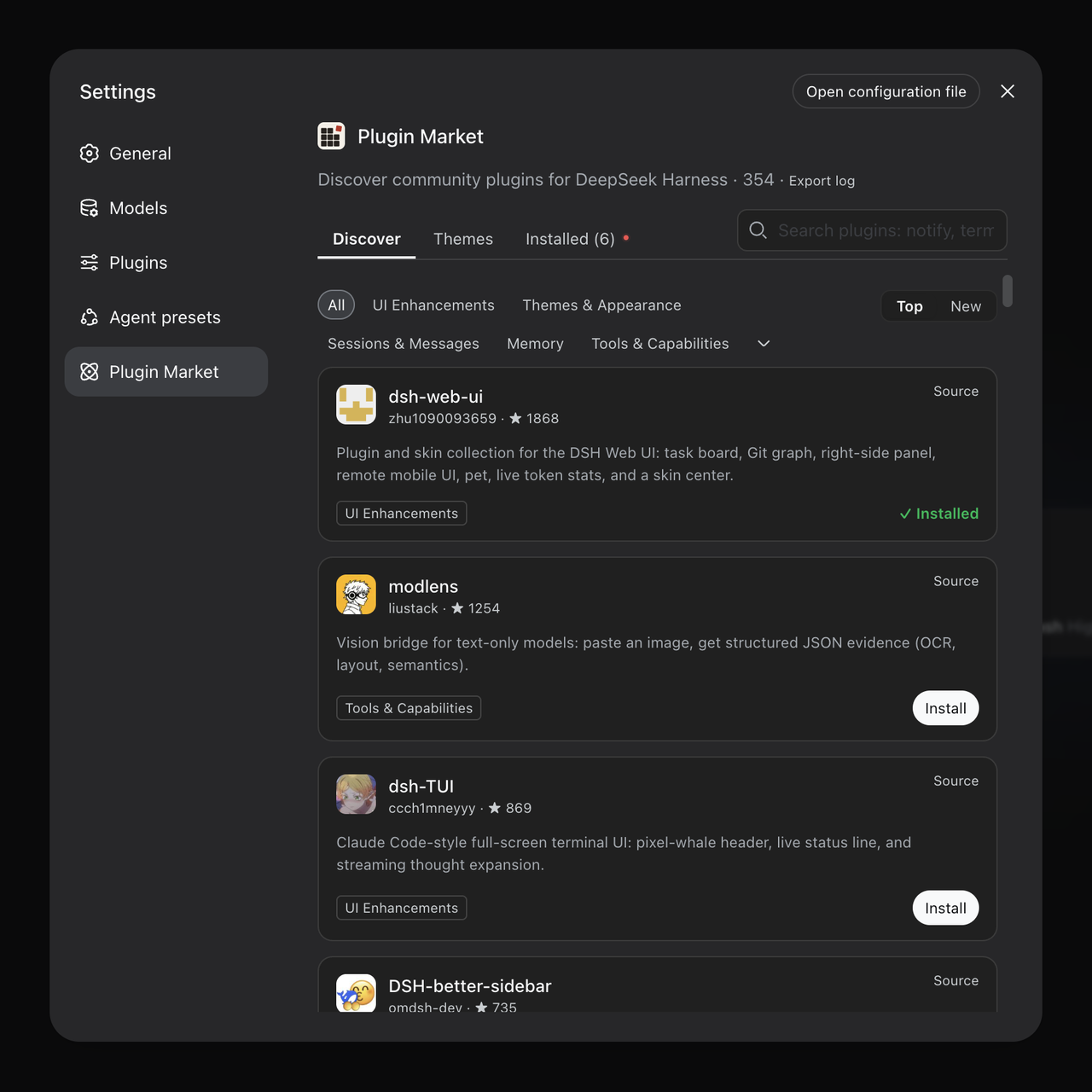
The plugin market for DeepSeek Harness: browse/search/one-click install community plugins and themes, with updates, backup/restore, hot disable, diagnostics, and AI fix.

A persistent whale widget on the DSH web UI that shows DeepSeek balance, today's usage, and per-turn cost, with drag-and-snap and sound effects.