dsh-calendar
Run the following command in DeepSeek Harness:
dsh plugin install necokeine/dsh-calendar
Paste the following prompt into your AI chat to install this plugin:
Run dsh plugin install necokeine/dsh-calendar to add the calendar plugin from https://github.com/necokeine/dsh-calendar to your current profile, then restart dsh web and refresh the page to see the Calendar entry at the bottom of the sidebar.
About this plugin
In DeepSeek Harness, user messages, assistant replies, tool calls, and turn boundaries live inside per-session streams, making it hard to answer "what actually happened on a given day" across all sessions at once. dsh-calendar adds a Calendar entry at the bottom of the sidebar; opening it reveals a full-viewport month grid that aggregates interaction events from every session. Each day cell shows a badge with that day's active-session count, and selecting a day lists one row per session-title, day-scoped duration, event count-collapsible to the raw event list.
The calendar is not a static snapshot. A host-side SSE channel pushes newly appended events into the open view in real time, and startup backfill seeds already-live sessions plus best-effort reads of the persisted log. A 90-day rolling window capped at 2,000 events per day keeps memory bounded, while unknown event types fall back to their type name with no per-type registry to maintain.
If you run multiple concurrent sessions, need to audit interaction history, or want a quick check on whether tool-call volume spiked on a particular day, dsh-calendar gives you a read-only, whole-harness calendar view. It passively indexes durable session events and injects no tools, prompt sections, or model-visible messages, so installing it does not alter model input or KV-cache behavior.
Use Cases
- Review all interaction events across sessions on a specific day
- Trace back dates with heavy tool-call activity
- Watch live events streaming into the open calendar
Best For
- Developers managing multiple concurrent sessions
- Teams that need to audit and review interaction history
- Ops personnel tracking tool-call frequency changes
Related Plugins
A service-oriented sidebar framework for DSH, offering a full workbench with file explorer, embedded browser, real terminal, Git panel, and extensible plugin services.
A beautiful, practical Claude Code-style TUI plugin with pixel whale top bar, flowing glow title, real-time status line, streaming thought expansion, time rewind, context progress bar and TPS gauge — zero core changes.
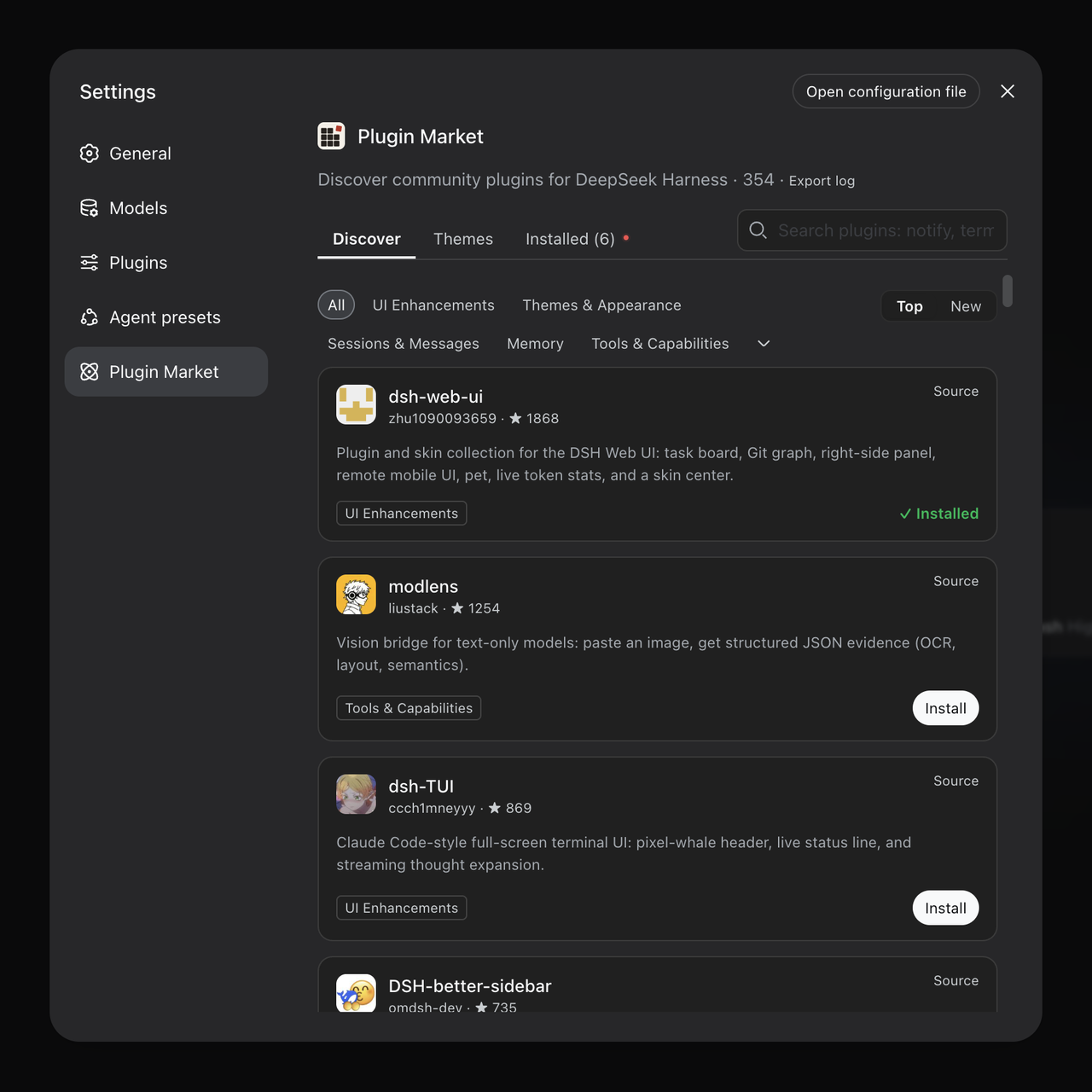
The plugin market for DeepSeek Harness: browse/search/one-click install community plugins and themes, with updates, backup/restore, hot disable, diagnostics, and AI fix.

A persistent whale widget on the DSH web UI that shows DeepSeek balance, today's usage, and per-turn cost, with drag-and-snap and sound effects.