dsh-jj
Run the following command in DeepSeek Harness:
dsh plugin install LosEcher/dsh-jj
Paste the following prompt into your AI chat to install this plugin:
Run dsh plugin install LosEcher/dsh-jj in your terminal to install; the source is available at https://github.com/LosEcher/dsh-jj .
About this plugin
Most AI assistants fall back to a git mindset when doing version control — stage, commit, branch. For developers who have already moved to jj (Jujutsu) as their daily VCS, that mismatch turns every AI-assisted commit or rebase into a forced workaround. dsh-jj closes that gap: it wraps your local jj CLI in a zero-dependency MCP stdio server so the model operates natively inside the jj change-and-bookmark model instead of simulating git.
The server is built on the Node standard library alone, with no third-party runtime dependencies. Every invocation goes through a spawn array, bypassing the shell entirely, which makes argument injection a non-issue. The fourteen tools span the full jj workflow — from jj_status, jj_log, and jj_diff through jj_rebase, jj_push, and jj_bookmark — with a catch-all jj_run for advanced subcommands like split, workspace, and op restore. Dangerous config flags are filtered at the entry point, and the undoable design of jj keeps the blast radius of any mistake small.
If you already manage repositories with jj and want your AI assistant to understand the jj working model rather than degenerate into a git emulator, dsh-jj is purpose-built for that. It also works as a standalone MCP stdio server, so you can plug it into Claude Code or Codex outside the DSH ecosystem.
Use Cases
- Let an AI assistant perform native jj commits, rebases, and bookmark management inside a jj repository
- Plug jj into Claude Code or Codex as a standalone MCP stdio server, independent of DSH
- Replace git emulation with jj's change-and-bookmark model to reduce semantic mismatch in AI workflows
Best For
- Developers who have adopted jj as their daily version control tool
- Engineers who want their AI assistant to understand a non-git VCS model
- Technical users extending their AI toolchain via the MCP protocol
Related Plugins
A service-oriented sidebar framework for DSH, offering a full workbench with file explorer, embedded browser, real terminal, Git panel, and extensible plugin services.
A beautiful, practical Claude Code-style TUI plugin with pixel whale top bar, flowing glow title, real-time status line, streaming thought expansion, time rewind, context progress bar and TPS gauge — zero core changes.
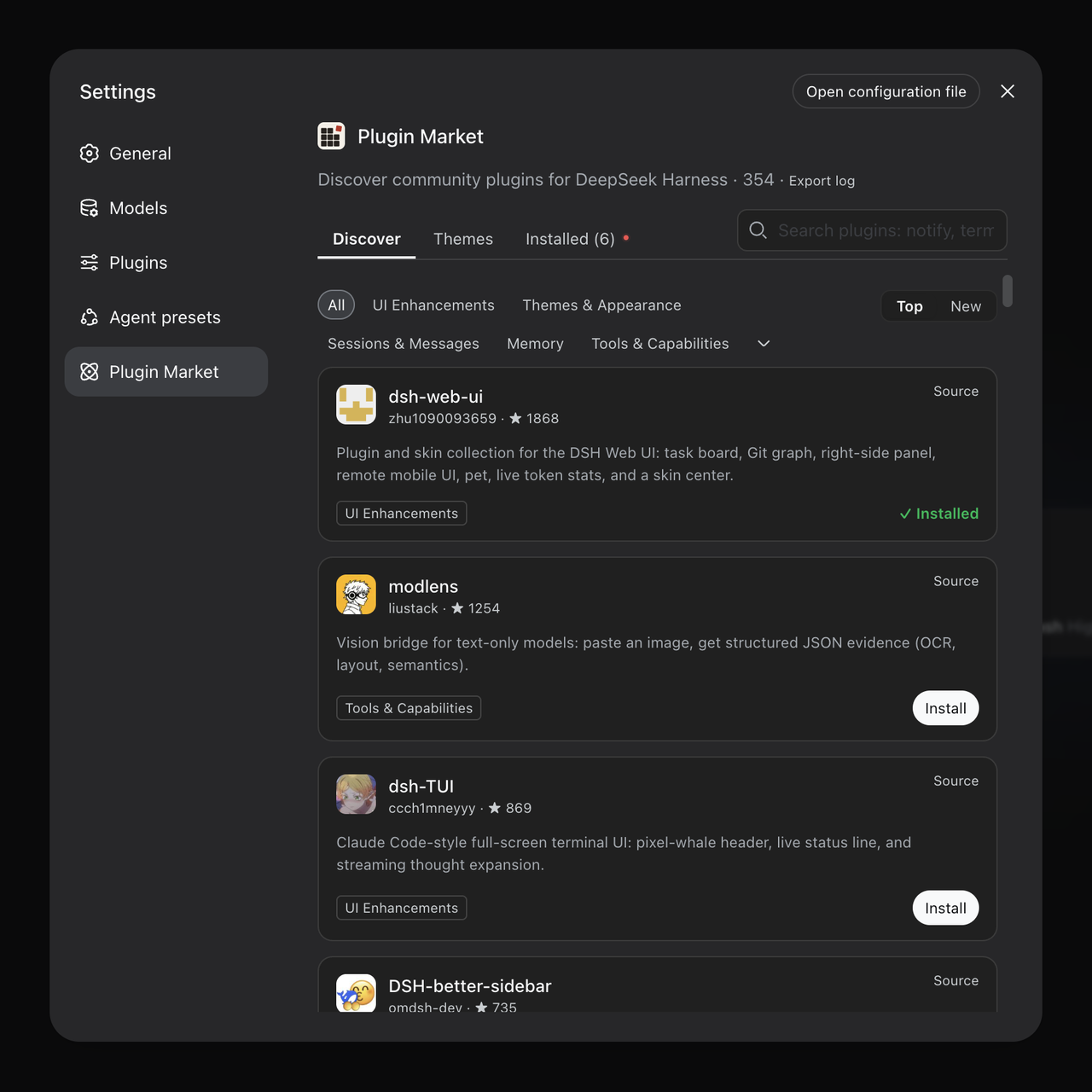
The plugin market for DeepSeek Harness: browse/search/one-click install community plugins and themes, with updates, backup/restore, hot disable, diagnostics, and AI fix.

A persistent whale widget on the DSH web UI that shows DeepSeek balance, today's usage, and per-turn cost, with drag-and-snap and sound effects.