dsh-openai-codex-auth
Run the following command in DeepSeek Harness:
dsh plugin install z331225718/dsh-openai-codex-auth
Paste the following prompt into your AI chat to install this plugin:
In DeepSeek Harness, run dsh plugin install z331225718/dsh-openai-codex-auth to install this plugin; source code at https://github.com/z331225718/dsh-openai-codex-auth
About this plugin
Integrating OpenAI Codex into the DSH pi-ai stack used to mean hand-rolling the OAuth device-code flow, managing credential persistence, and handling concurrent write safety yourself. dsh-openai-codex-auth packages all of that into a standalone, independently versioned plugin: one install command surfaces a ChatGPT device-code login on the Models page, and uninstall cleanly removes the controller and credential contribution without touching the base adapter or adding a second model adapter.
Three capabilities stand out. First, credential storage serializes mutations both in-process and across processes; POSIX files are atomically replaced at mode 0600, and a provider-generation guard prevents a login that finishes after a logout from resurrecting a deleted credential. Second, the interactive-auth controller registers against the pi-ai credential seam and participates in the Models collection snapshot, so an in-flight request keeps its original store while later requests immediately observe load or unload. Third, Browser RPC payloads never carry tokens or raw provider responses; the model request itself sees no authentication material, yielding zero direct token cost and leaving KV-cache behavior entirely to the selected model.
This plugin is best for developers already working inside the DSH pi-ai ecosystem who want a reliable OpenAI Codex connection without maintaining their own OAuth state machine and file-locking logic. Today it exposes device-authorization as the sole login method, and activation requires the installed catalog to correctly surface the openai-codex OAuth entry. If your upstream DSH release has not yet exposed the piAiCredentials contribution interface, installation will fail loudly at startup rather than silently dropping OAuth persistence.
Use Cases
- One-command OpenAI Codex integration inside DSH pi-ai
- Device-code login without hand-rolling the OAuth state machine and file locking
- Securely persisting and managing LLM OAuth credentials across multiple processes
Best For
- AI application developers in the DSH pi-ai ecosystem
- Engineers wanting stable OpenAI Codex access without maintaining their own auth flow
- Framework contributors focused on credential security and cross-process concurrency
Related Plugins
A service-oriented sidebar framework for DSH, offering a full workbench with file explorer, embedded browser, real terminal, Git panel, and extensible plugin services.
A beautiful, practical Claude Code-style TUI plugin with pixel whale top bar, flowing glow title, real-time status line, streaming thought expansion, time rewind, context progress bar and TPS gauge — zero core changes.
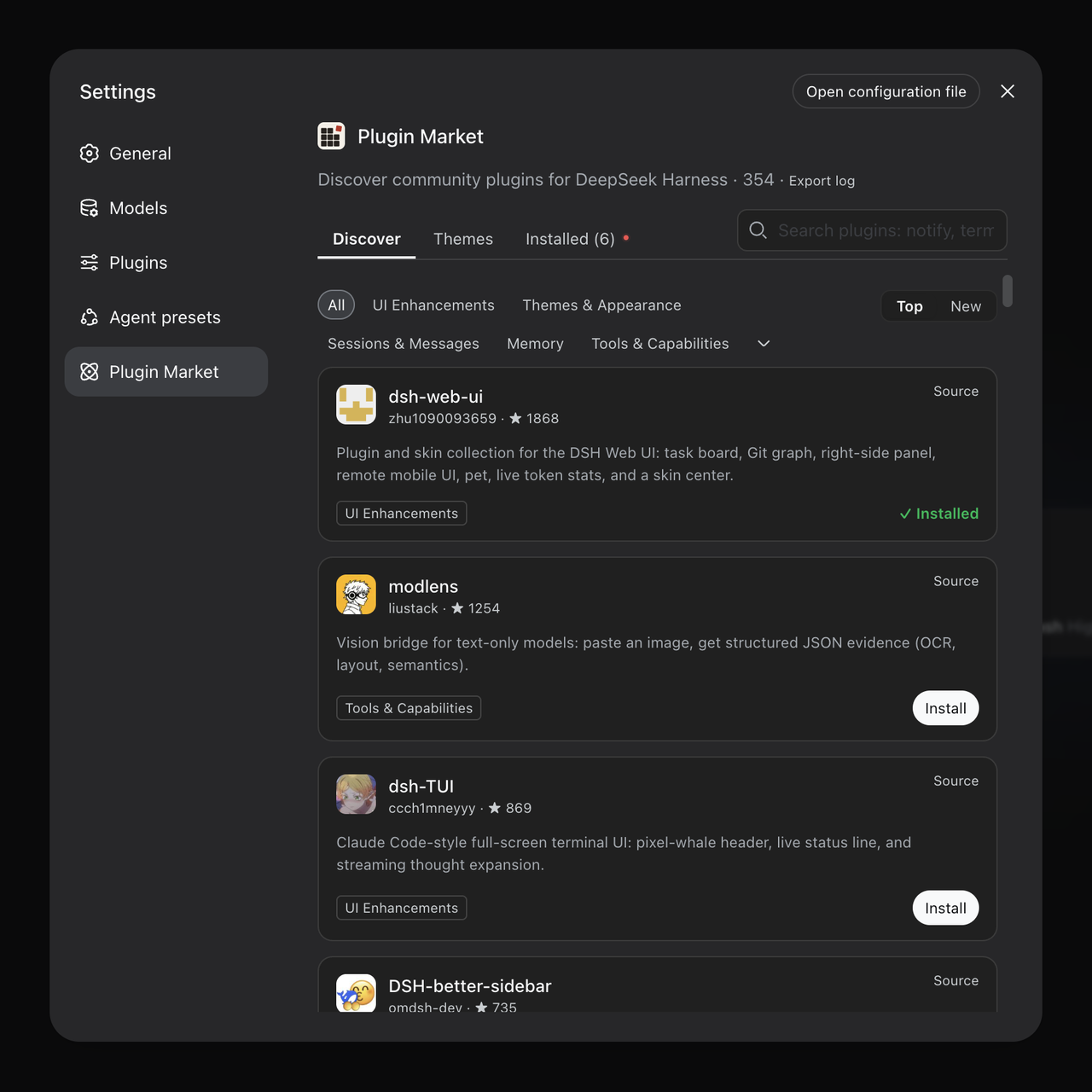
The plugin market for DeepSeek Harness: browse/search/one-click install community plugins and themes, with updates, backup/restore, hot disable, diagnostics, and AI fix.

A persistent whale widget on the DSH web UI that shows DeepSeek balance, today's usage, and per-turn cost, with drag-and-snap and sound effects.