dsh-wolfram-bundle
Run the following command in DeepSeek Harness:
dsh plugin install Zhen-WushuiLingchun/dsh-wolfram-bundle
Paste the following prompt into your AI chat to install this plugin:
Run dsh plugin install Zhen-WushuiLingchun/dsh-wolfram-bundle in a DeepSeek Harness setup to install this plugin; source code is available at https://github.com/Zhen-WushuiLingchun/dsh-wolfram-bundle
About this plugin
If Wolfram Desktop or Engine is already on your machine and you want your AI assistant to evaluate Wolfram code, run tests, or read and write Notebooks directly, dsh-wolfram-bundle is the thin integration layer that makes it happen. It does not rewrite the MCP protocol and does not modify the official Paclet. Instead it fills three gaps: auto-discovering the local kernel, owning the process-tree lifecycle, and routing every side-effectful tool call through DSH's native approval chain. Once loaded, the model sees seven tools prefixed with mcp__wolfram__—arbitrary evaluation, test execution, Markdown-to-Notebook conversion, static inspection, symbol lookup, and more.
Security is the defining constraint. WolframLanguageEvaluator has no sandbox: it can write files, spawn processes, and hit the network. So it defaults to ask and will not fire until a human approves. Unknown tools shipped in future Paclet upgrades follow the same rule—ask first, not later. The supervisor terminates only the process tree it spawned itself; it will never reach for your running Mathematica front-end or servers owned by other clients. Even in the TerminateProcess window on Windows, orphan reclamation requires triple identity verification (image name, command line, creation-time window), and if any check fails the process is left untouched.
The target user is concrete: you run DSH as your daily AI coding assistant, have local Wolfram with AgentTools Paclet 2.2.0 or later, and want the model to safely evaluate a snippet or inspect a Notebook without silently writing files or spawning processes. Requires Node 22 or later; works on Linux, macOS, Windows, and WSL. Clean install, clean uninstall, no global dependencies.
Use Cases
- Evaluate Wolfram code snippets inline during a DSH conversation and inspect the output
- Run .wlt test files through the AI assistant and get a pass/fail report
- Convert Markdown notes to a Wolfram Notebook and write it to disk with one tool call
Best For
- Developers running DSH daily with a local Wolfram Desktop or Engine installed
- Researchers who want AI-assisted Wolfram computation for modeling or engineering tasks
- Teams that require an approval chain to gate AI side-effectful operations and prevent unintended writes
Related Plugins
A service-oriented sidebar framework for DSH, offering a full workbench with file explorer, embedded browser, real terminal, Git panel, and extensible plugin services.
A beautiful, practical Claude Code-style TUI plugin with pixel whale top bar, flowing glow title, real-time status line, streaming thought expansion, time rewind, context progress bar and TPS gauge — zero core changes.
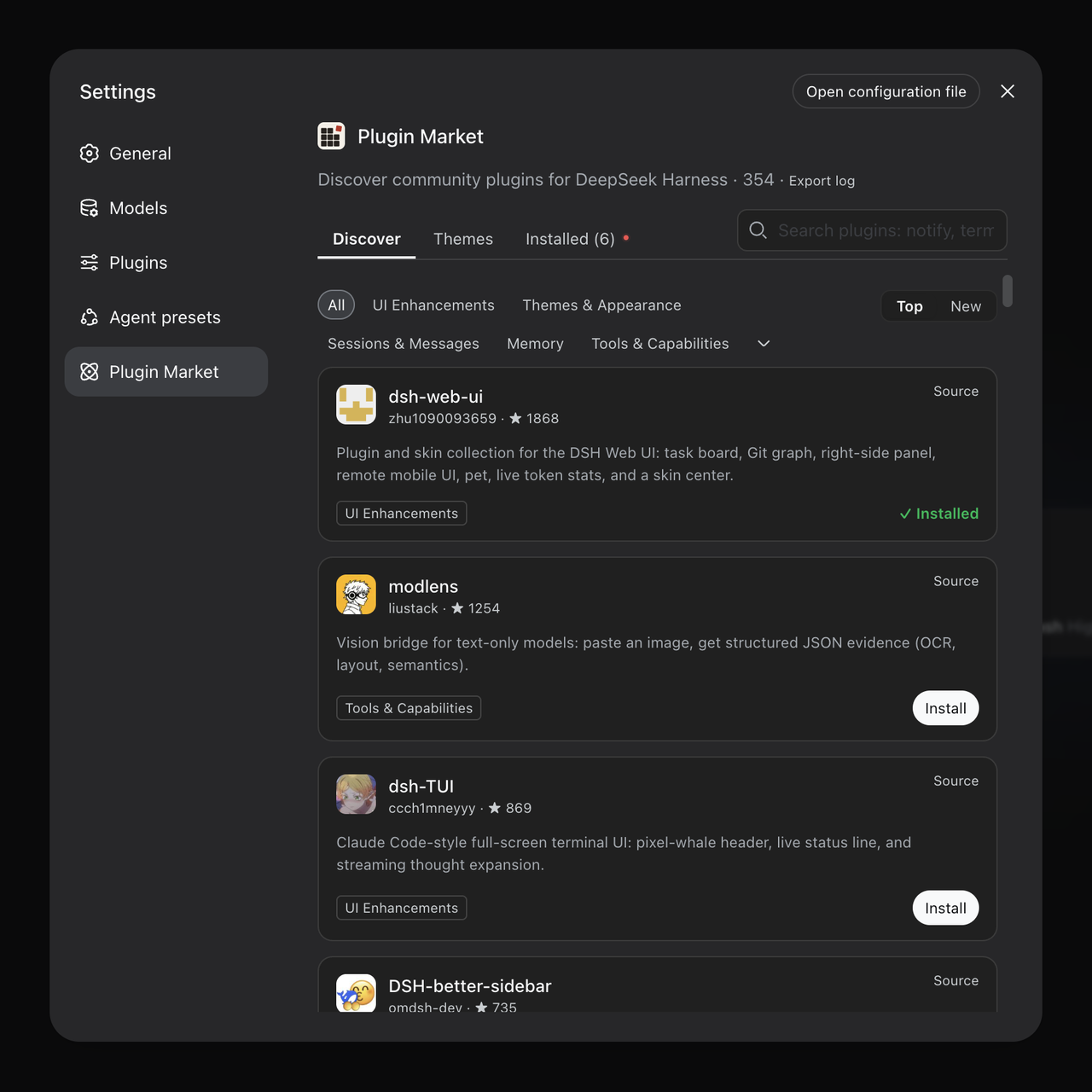
The plugin market for DeepSeek Harness: browse/search/one-click install community plugins and themes, with updates, backup/restore, hot disable, diagnostics, and AI fix.

A persistent whale widget on the DSH web UI that shows DeepSeek balance, today's usage, and per-turn cost, with drag-and-snap and sound effects.