dsh-mcp-servers
Run the following command in DeepSeek Harness:
dsh plugin install meltartica/dsh-mcp-servers
Paste the following prompt into your AI chat to install this plugin:
Run dsh plugin install meltartica/dsh-mcp-servers in the DeepSeek Harness terminal to install; source code is available at https://github.com/meltartica/dsh-mcp-servers.
About this plugin
If you work daily inside DeepSeek Harness and want to call external Model Context Protocol (MCP) tools as if they were native Harness capabilities, dsh-mcp-servers is the bridge you need. It ships as a single bundle with two halves: a server component that connects to your MCP endpoints and registers their tools, and a client component that gives you a full visual management panel under Settings → MCP Servers in the web app — no hand-edited config files required.
The plugin nails the details that real production setups demand. All three MCP transports — stdio, Streamable HTTP, and legacy SSE — are supported behind a single endpoint field with a simple type dropdown. Tool names follow the same server-qualified convention used by the official dsh-mcp-client and Claude Code, with automatic character normalization, length capping, and a deterministic 12-hex hash suffix to resolve collisions. When a remote server emits a tools/list_changed signal, the plugin re-registers in place without dropping your session; old tools stay live until the new set is fully registered. Connection health is shown as a live status dot, with automatic backoff reconnect on drops. Each server card carries its own Test button so you can probe connectivity and tool listing against a draft without affecting the live registry.
Backup and sync are thoughtfully handled. One click exports the entire server list — endpoints, env vars, headers — as JSON with an inline preview, and importing restores it just as easily. For teams or multi-machine setups, an optional WebDAV sync (HTTPS-only, Basic auth) supports manual Push/Pull as well as an optional daily automatic backup at 12:00 PM local time. The WebDAV password is stored server-side as a secret and is never sent back to the browser.
This plugin is well suited for developers building Harness workflows who need to frequently integrate external MCP tool services — code generators, document search, browser automation, and the like — and who prefer a graphical interface over pure CLI management while keeping configuration consistent across machines.
Use Cases
- Invoke external MCP tool services directly inside Harness workflows without extra bridge scripts
- Keep MCP server configs consistent across machines via JSON export and WebDAV sync
- Quickly validate stdio/HTTP/SSE connectivity and tool listings with the per-card Test button before saving
Best For
- Developers building Harness workflows who regularly integrate external MCP tools
- Small teams managing multiple MCP servers and monitoring connection health
- Individuals who prefer a GUI for config management and WebDAV-based backups
Related Plugins
A service-oriented sidebar framework for DSH, offering a full workbench with file explorer, embedded browser, real terminal, Git panel, and extensible plugin services.
A beautiful, practical Claude Code-style TUI plugin with pixel whale top bar, flowing glow title, real-time status line, streaming thought expansion, time rewind, context progress bar and TPS gauge — zero core changes.
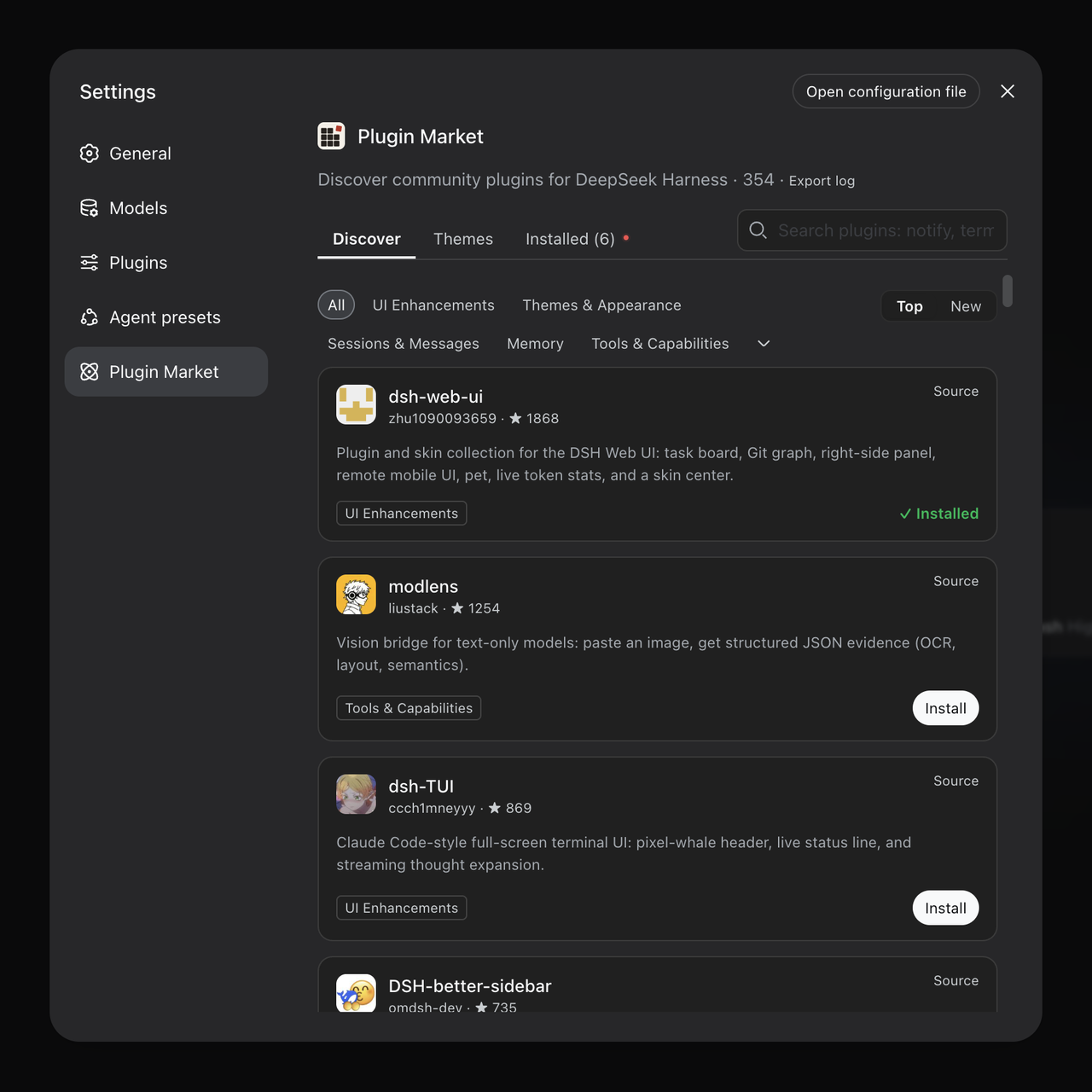
The plugin market for DeepSeek Harness: browse/search/one-click install community plugins and themes, with updates, backup/restore, hot disable, diagnostics, and AI fix.

A persistent whale widget on the DSH web UI that shows DeepSeek balance, today's usage, and per-turn cost, with drag-and-snap and sound effects.