dsh-session-export
Run the following command in DeepSeek Harness:
dsh plugin install uckkk/dsh-session-export
Paste the following prompt into your AI chat to install this plugin:
Run dsh plugin install uckkk/dsh-session-export in DeepSeek Harness (source: https://github.com/uckkk/dsh-session-export), then restart or reload the profile to activate it.
About this plugin
DSH sessions sit quietly on your local disk, and when you need to back up, migrate, or tidy them up, there is no convenient single step to do so. dsh-session-export closes that gap: export any local session to the format you need, without digging through raw log files by hand.
The plugin ships two core tools. session_list enumerates every local session by title, working directory, and creation time, with keyword filtering for quick lookup; session_export renders the chosen session as Markdown (preserving user and assistant messages, tool calls with results, and reasoning steps) or as structured JSON for downstream pipelines. It natively reads both zstd-compressed logs (.jsonl.zstd, the DSH default) and plain-text logs (.jsonl), and is a pure Node implementation with zero third-party runtime dependencies.
Whether you want a regular backup of conversation history, a polished Markdown export for team docs or a blog post, or a JSON dump to feed a knowledge base for summarization and analytics, dsh-session-export covers the need with minimal setup. Paired with dsh-session-search for cross-session full-text search and dsh-context-dashboard for token and context stats, it forms a complete local session management toolkit.
Use Cases
- Regularly back up DSH conversation history to prevent data loss
- Export a deep debugging session as Markdown for team docs or a blog post
- Dump sessions to JSON for knowledge-base ingestion, summarization, or analytics
Best For
- Developers who need to archive or migrate DSH sessions
- Engineers who prefer Markdown for technical notes
- Knowledge workers building personal knowledge bases with structured session data
Related Plugins
A service-oriented sidebar framework for DSH, offering a full workbench with file explorer, embedded browser, real terminal, Git panel, and extensible plugin services.
A beautiful, practical Claude Code-style TUI plugin with pixel whale top bar, flowing glow title, real-time status line, streaming thought expansion, time rewind, context progress bar and TPS gauge — zero core changes.
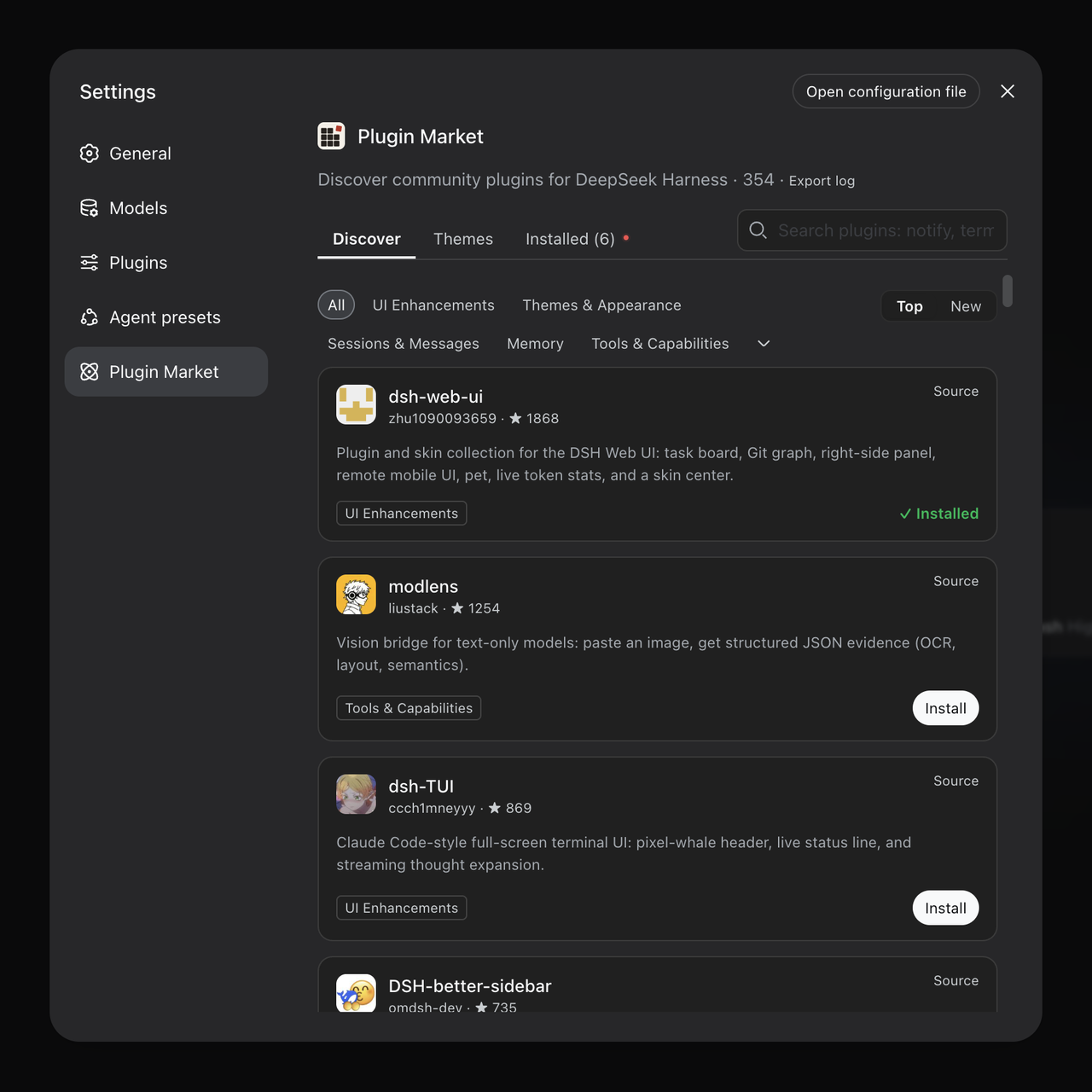
The plugin market for DeepSeek Harness: browse/search/one-click install community plugins and themes, with updates, backup/restore, hot disable, diagnostics, and AI fix.

A persistent whale widget on the DSH web UI that shows DeepSeek balance, today's usage, and per-turn cost, with drag-and-snap and sound effects.