dsh-effort-bars
Run the following command in DeepSeek Harness:
dsh plugin install imdeniil/dsh-effort-bars
Paste the following prompt into your AI chat to install this plugin:
Run dsh plugin install imdeniil/dsh-effort-bars in DeepSeek Harness to install this plugin; the source repository is https://github.com/imdeniil/dsh-effort-bars.
About this plugin
Switching a reasoning effort level in DeepSeek Harness or DSH Desktop used to mean: open the model menu, drill into the Effort submenu, pick a value. dsh-effort-bars collapses that into a single click. A row of equal-height bars appears beside the model button—think of it as a volume fader for depth of thought—each bar representing one level, gradient-filled up to the active setting. Click a bar and the level changes instantly, no menu in sight.
The model menu itself is streamlined too. It opens straight into a searchable list with provider filter chips, a result counter, and adaptive height, reusing the full retrieval capabilities of dsh-model-picker-search. Models without reasoning levels simply get no bars. Full keyboard navigation, radiogroup semantics, and hover tooltips are included. The plugin registers in the conversation.input.model slot at priority −2, so it layers cleanly over the stock picker and dsh-model-picker-search, and gracefully falls back if it is removed or fails to render.
Built for DeepSeek Harness users who toggle between Off, Medium, High, and Max often—especially those juggling multiple models and providers who want to control thinking depth with the fewest possible interactions. Localised in Russian, English, and Chinese.
Use Cases
- Cut down clicks when toggling reasoning depth to a single bar tap
- Repeatedly adjusting thinking depth between Off, Medium, High, and Max
- Quickly locating and switching effort levels across multiple models and providers
Best For
- Daily DeepSeek Harness users who toggle reasoning depth often
- Heavy desktop users managing multiple models and providers
- Developers who prefer minimal-step interactions for maximum efficiency
Related Plugins
A service-oriented sidebar framework for DSH, offering a full workbench with file explorer, embedded browser, real terminal, Git panel, and extensible plugin services.
A beautiful, practical Claude Code-style TUI plugin with pixel whale top bar, flowing glow title, real-time status line, streaming thought expansion, time rewind, context progress bar and TPS gauge — zero core changes.
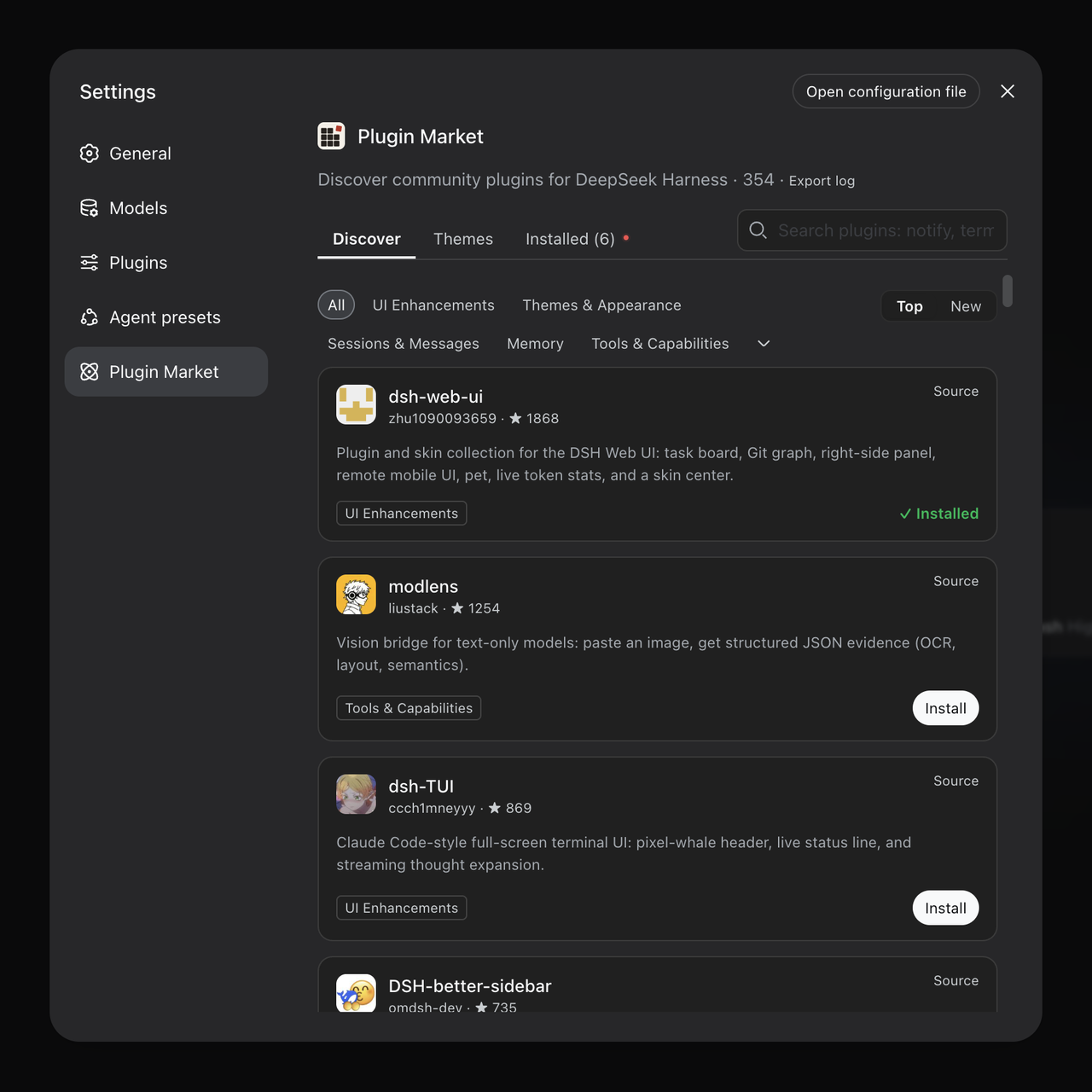
The plugin market for DeepSeek Harness: browse/search/one-click install community plugins and themes, with updates, backup/restore, hot disable, diagnostics, and AI fix.

A persistent whale widget on the DSH web UI that shows DeepSeek balance, today's usage, and per-turn cost, with drag-and-snap and sound effects.