dsh-show-picture
Run the following command in DeepSeek Harness:
dsh plugin install Yaing-Yan/dsh-show-picture
Paste the following prompt into your AI chat to install this plugin:
Run dsh plugin install Yaing-Yan/dsh-show-picture in your DeepSeek Harness terminal to install the plugin (source: https://github.com/Yaing-Yan/dsh-show-picture).
About this plugin
In a DeepSeek Harness chat, when an agent finishes processing an image the user typically sees nothing but a file path or a bare URL. Verifying, sharing, or annotating the result means leaving the conversation entirely. dsh-show-picture closes that gap by adding a single model tool called show_picture that renders an image card right inside the chat flow, so the picture is seen where the work is discussed.
Local files are read through the Host filesystem service, base64-encoded, and delivered to the browser as a data URL (up to 10 MiB per image). The tool supports common formats including png, jpg, gif, webp, svg, bmp, ico, avif, and tiff. Remote images are passed straight to an tag with no intermediate file server. An optional alt argument lets the agent attach a short caption beneath the picture for context.
If you build DSH agents that generate, edit, or analyse images and want users to see results in-place rather than opening a second window, this plugin fits the bill. It plugs in as a Cordis plugin — the Host half registers the tool and the Client half renders the card — so one activation keeps it working across the session.
Use Cases
- Agent finishes generating or editing an image and displays the result as an inline card in the chat
- Agent reads a local workspace image and presents it with a short caption for the user
- Agent references a remote image URL and renders it instantly in the conversation without opening a browser
Best For
- Developers building image generation, editing, or analysis agents on DSH
- End users who want to see image results in-place without switching windows
- Product engineers designing multimodal agent workflows with a focus on interaction flow
Related Plugins
A service-oriented sidebar framework for DSH, offering a full workbench with file explorer, embedded browser, real terminal, Git panel, and extensible plugin services.
A beautiful, practical Claude Code-style TUI plugin with pixel whale top bar, flowing glow title, real-time status line, streaming thought expansion, time rewind, context progress bar and TPS gauge — zero core changes.
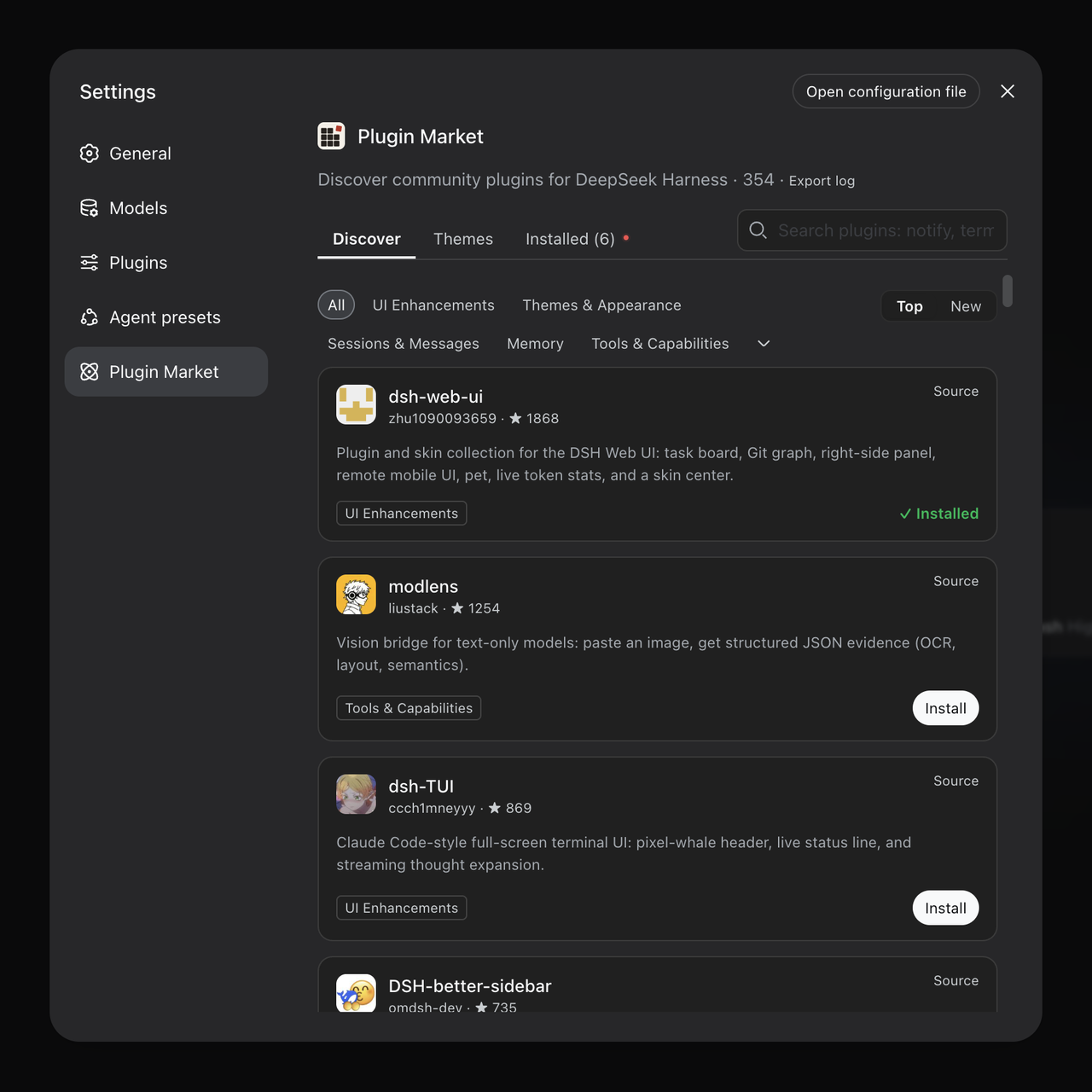
The plugin market for DeepSeek Harness: browse/search/one-click install community plugins and themes, with updates, backup/restore, hot disable, diagnostics, and AI fix.

A persistent whale widget on the DSH web UI that shows DeepSeek balance, today's usage, and per-turn cost, with drag-and-snap and sound effects.