websearch-dsh
Run the following command in DeepSeek Harness:
dsh plugin install takasurazeem/websearch-dsh
Paste the following prompt into your AI chat to install this plugin:
Run dsh plugin install takasurazeem/websearch-dsh in your terminal to install; source code is available at https://github.com/takasurazeem/websearch-dsh
About this plugin
The default web_search tool in dsh is wired to a single provider. One rate-limit, quota exhaustion, or outage and the entire search surface goes dark. Worse, without a DEEPSEEK_API_KEY the tool cannot fire at all. websearch-dsh replaces that single line with a six-leg fallback chain: Tavily, Exa, Firecrawl, Brave, and Serper in order, finishing with a keyless DuckDuckGo path that needs no credentials whatsoever. API keys are resolved in real time from the dsh credential store and the process environment on every call, so adding a key mid-session takes effect on the next search without a restart. Any failure—auth, quota, rate limit, timeout, network, or parse—is classified precisely and the chain advances to the next provider; only a caller-initiated abort stops the walk early.
Beyond the chain itself, the plugin registers a read-only websearch_status tool and a /websearch slash command so you can inspect the live chain, per-provider key presence, and recent failure reasons at any moment. A GUI toggle card under Settings→Plugins→Configurable lets you flip the entire feature on or off with one click; while disabled, zero API credits are spent. Everything sits natively on dsh's tool, settings, and credentials seams—no MCP server, no sidecar process—so the built-in web_search remains the single model-facing surface.
It is built for three audiences: developers who lean on web_search for research and writing and need it to survive provider hiccups; multi-provider users who hold two or three search API keys and want automatic failover; and newcomers who have not yet signed up for any search API and still need a working web search—DuckDuckGo picks up the baton. If you prefer self-hosting an MCP server or sidecar, this plugin's native path offers a lighter alternative.
Use Cases
- A paid search API hits rate limits or exhausts quota—the chain silently falls through to the next provider
- No search API key is configured at all—DuckDuckGo legs serve web_search without any credential
- Inspect per-provider key presence, live chain order, and recent failure reasons via websearch_status or /websearch
Best For
- Developers who rely on dsh web_search for research and daily writing
- Multi-provider users holding two or three search API keys who want automatic failover
- Newcomers who have not signed up for any search API yet but need a working web search
Related Plugins
A service-oriented sidebar framework for DSH, offering a full workbench with file explorer, embedded browser, real terminal, Git panel, and extensible plugin services.
A beautiful, practical Claude Code-style TUI plugin with pixel whale top bar, flowing glow title, real-time status line, streaming thought expansion, time rewind, context progress bar and TPS gauge — zero core changes.
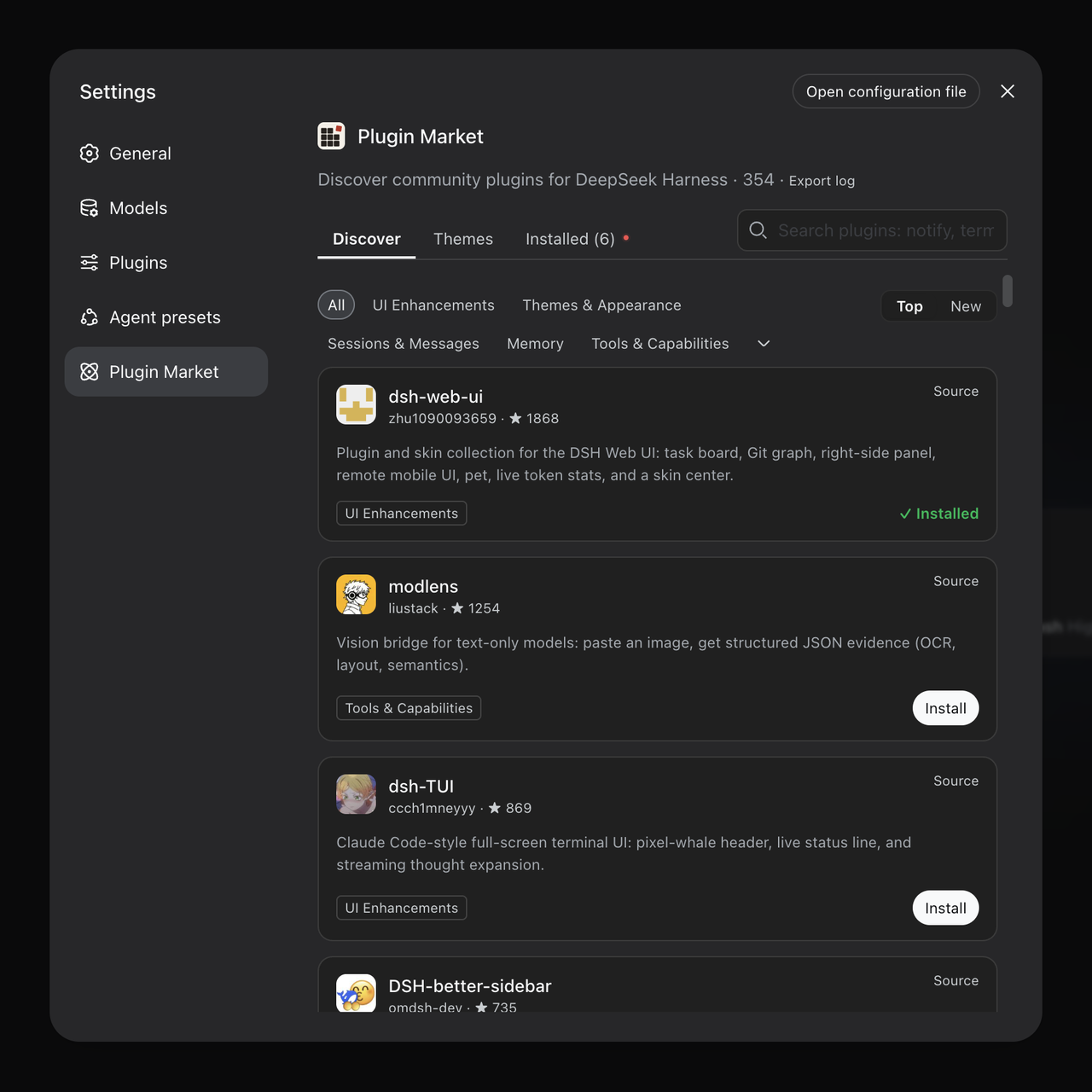
The plugin market for DeepSeek Harness: browse/search/one-click install community plugins and themes, with updates, backup/restore, hot disable, diagnostics, and AI fix.

A persistent whale widget on the DSH web UI that shows DeepSeek balance, today's usage, and per-turn cost, with drag-and-snap and sound effects.