dsh-timeline
Run the following command in DeepSeek Harness:
dsh plugin install konanzheng/dsh-timeline
Paste the following prompt into your AI chat to install this plugin:
Run dsh plugin install konanzheng/dsh-timeline in the DeepSeek Harness terminal to install this plugin; source is available at https://github.com/konanzheng/dsh-timeline.
About this plugin
DeepSeek Harness session history is often a long stream of messages and tool calls. Grasping how the AI actually broke down a problem means scrolling through everything twice. dsh-timeline reshapes that raw trace into an S-shaped energy timeline: turn cards are laid out in a boustrophedon pattern, a blue-to-purple-to-pink gradient Bezier curve threads through the centre of every card, and a glow layer with pulsing light particles turns a dry event list into a rhythmic visual narrative.
The real differentiator is the process-insight layer. Each turn's tool calls are distilled into readable conclusions: multiple greps become "three searches to locate key code", read/write operations are graded by frequency, bash executions are counted, and errors are tagged with a first-failure and fix marker. A causal logic chain (search, read, modify, verify) strings each step into a readable intention. The timeline header aggregates full-trace stats: turn count, total tool calls, top-3 hottest files with heat bars, and a tool-type distribution, all on one screen.
Who is it for? DSH users who need to quickly review a complex session, walk a colleague through the AI problem-solving path, or extract structured insights from a wall of tool calls. Switch to the Timeline view and the timeline opens automatically; click any card header for a detail popover; zoom with Ctrl/Cmd plus scroll; close layers one by one with ESC. Zero configuration, ready to use.
Use Cases
- Reviewing the full problem-solving path in a complex multi-turn session
- Presenting AI tool-call logic and causal chains for team retrospectives
- Spotting hot files and error patterns from dense tool-call traces
Best For
- DSH users who need to quickly understand AI session traces
- Developers or team leads who explain AI reasoning paths to others
- Engineers who want structured insights from dense tool-call logs
Related Plugins
A service-oriented sidebar framework for DSH, offering a full workbench with file explorer, embedded browser, real terminal, Git panel, and extensible plugin services.
A beautiful, practical Claude Code-style TUI plugin with pixel whale top bar, flowing glow title, real-time status line, streaming thought expansion, time rewind, context progress bar and TPS gauge — zero core changes.
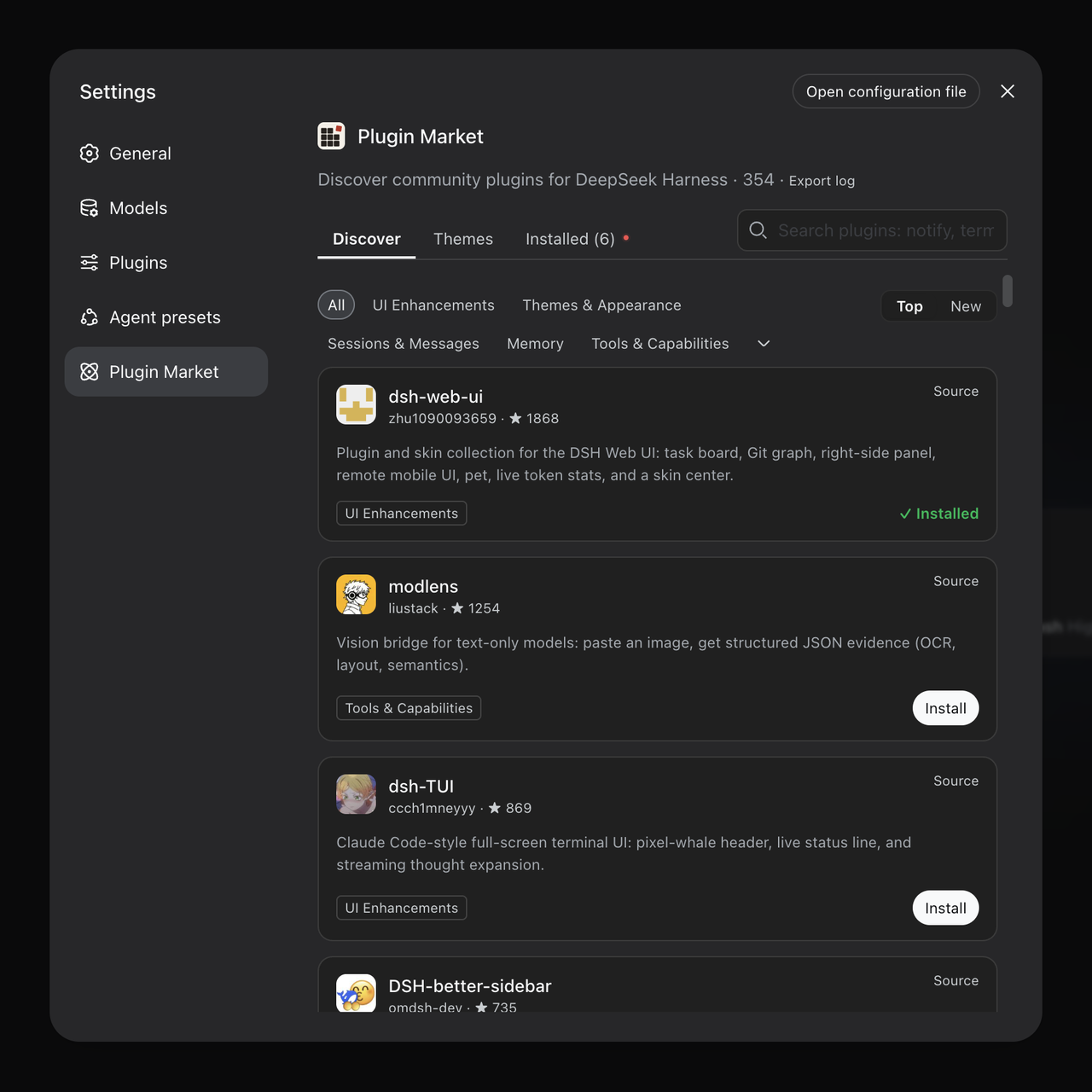
The plugin market for DeepSeek Harness: browse/search/one-click install community plugins and themes, with updates, backup/restore, hot disable, diagnostics, and AI fix.

A persistent whale widget on the DSH web UI that shows DeepSeek balance, today's usage, and per-turn cost, with drag-and-snap and sound effects.