dsh-lens
Run the following command in DeepSeek Harness:
dsh plugin install NexusAgentX/dsh-lens
Paste the following prompt into your AI chat to install this plugin:
Run dsh plugin install NexusAgentX/dsh-lens inside DeepSeek Harness to install the plugin; the source repository is at https://github.com/NexusAgentX/dsh-lens
About this plugin
The blind-write cycle is one of the most common pain points when an agent authors code: a file lands on disk with no immediate signal, and type errors, formatting drift, or cascading impact on neighboring modules only surface in the next turn or during a manual pass. dsh-lens ports the full pi-lens analysis engine into the DeepSeek Harness host so that every write, edit, or bash mutation automatically triggers a five-stage diagnostic pipeline, catching issues before they leak into the next model request.
The pipeline runs in sequence: safe autofix and formatting, LSP file sync and diagnostic collection, ast-grep / tree-sitter / fact-rule scanning, cascade diagnostics on likely neighbors, and turn-end blockers and advisories injected directly into the next request. The plugin also registers the complete agent-facing tool set (symbol_search, lsp_navigation, ast_grep suites, read_enclosing, module_report, and more), nine /lens-* session commands, four upstream pi-lens skills, and a WebUI chip with a composer dock on the official Web profile. Configuration stays in .pi-lens.json, so no new mental model is required.
If you drive code authoring through DeepSeek Harness and want write-time diagnostics, or you already know the pi-lens ecosystem and want a smooth hop to dsh, dsh-lens is the adapter layer in between. One caveat: do not attach pi-lens-mcp to the same workspace alongside dsh-lens, as that would double-start language servers.
Use Cases
- Every agent write triggers LSP diagnostics, formatting, and AST scanning, with blockers injected into the next model request
- After a cross-file refactor, cascade checks automatically surface type inconsistencies and unused symbols in neighboring modules
- Toggle the pipeline per session and inspect LSP latency or event-loop bottlenecks via /lens-health and /lens-perf
Best For
- Developers who drive code authoring through DeepSeek Harness and need write-time diagnostic feedback
- Engineering teams already in the pi-lens ecosystem looking for a smooth migration to the DSH host
- Engineers who want quality gates on agent output without adding manual review overhead
Related Plugins
A service-oriented sidebar framework for DSH, offering a full workbench with file explorer, embedded browser, real terminal, Git panel, and extensible plugin services.
A beautiful, practical Claude Code-style TUI plugin with pixel whale top bar, flowing glow title, real-time status line, streaming thought expansion, time rewind, context progress bar and TPS gauge — zero core changes.
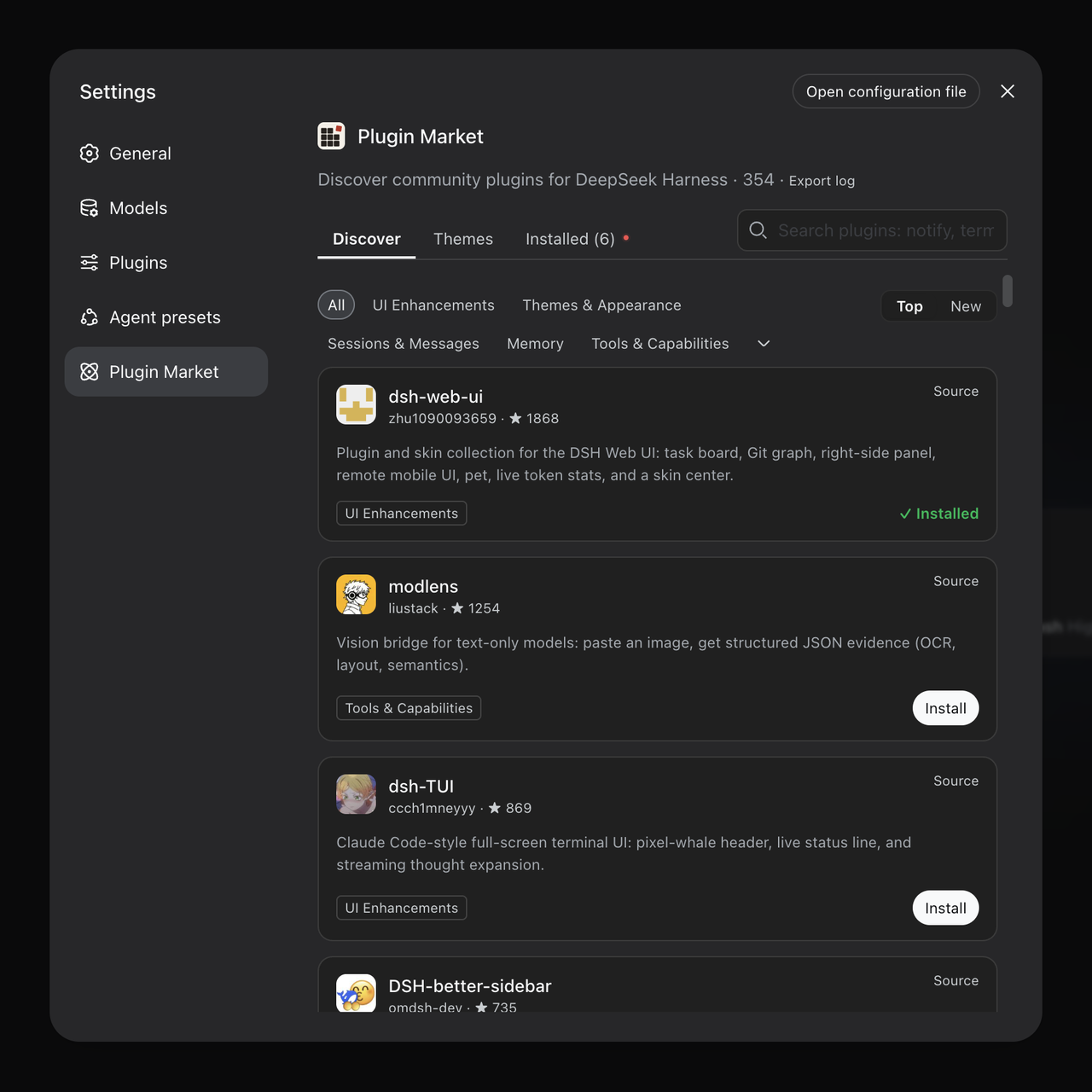
The plugin market for DeepSeek Harness: browse/search/one-click install community plugins and themes, with updates, backup/restore, hot disable, diagnostics, and AI fix.

A persistent whale widget on the DSH web UI that shows DeepSeek balance, today's usage, and per-turn cost, with drag-and-snap and sound effects.